[T]he University of California, Davis, has long been known as a wellspring of science for the wine industry and its master brewer program has played a major role in craft beer’s revolution. Because coffee has matched the rise of those industries (basically running step for step with beer) it should almost be a surprise, then, that the UC Davis Coffee Center has only now been launched.
The center is young, more an initiative than an institute (there’s no building to visit, not yet). Professor Bruce German, the director of Davis’ Foods for Health Institute, says the school had many professors conducting coffee research, but not in a concerted way. By creating the Coffee Center, the researchers hope to attract funding for topics ranging from coffee’s health properties to ion exchange filtration methods to coffee plant pathogens.
Part of the reason coffee wasn’t represented at the school is that, unlike grapes and hops, coffee isn’t grown much in the United States. “Coffee falls through the cracks of the traditional agricultural funding priorities,” German says. “The system was set up for farmers, so if you don’t have farmers growing it why would you fund it.”
While research will drive the center, the professors involved are interested in building a curriculum for undergrads. At the center’s first event, the Coffee Research Conference, held mid-March, Professor William Ristenpart presented a sketch of a potential program for a minor in coffee.
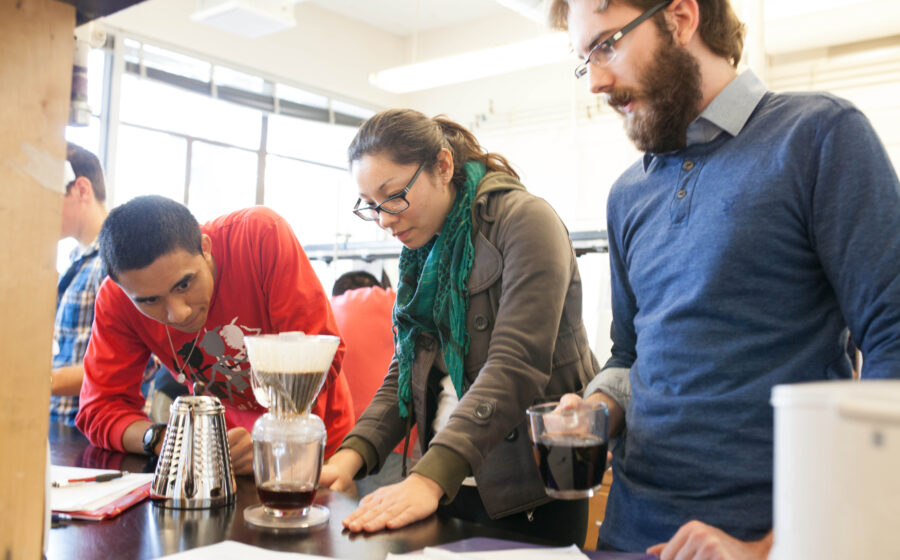
He already teaches a popular freshman chemical engineering classes focused on coffee. Ristenpart says coffee provides a perfect subject to introduce chemical engineering’s concepts. Roasting and brewing involve material balances and fluid mechanics; bagged beans undergo mass transfer; boiling water showcases thermodynamics. Experiments include roasting, grinding, brewing, and, of course, drinking coffee.
Ristenpart imagines a minor built on courses examining coffee and milk’s chemistry, horticulture, and sensory evaluations, the last two are covered by Davis’ wine and beer programs cover. That won’t happen without interest (read: money) from the coffee industry and enrollment by students, but with coffee reaching such sophisticated levels it’s hard to imagine the industry wouldn’t welcome a university graduate who doesn’t just have good coffee senses but understands a cup of coffee down to the molecular level.
—Cory Eldridge is Fresh Cup’s editor.