[I] don’t put sugar in my coffee, but sometimes I wish coffee was more like it. When a recipe calls for sugar, I pull my tub of sugar out of the cupboard and measure it out, confident that the size of each granule is correct for my purposes. If the recipe asks for powdered sugar, I never wonder if the powdered sugar I’ve purchased is powdery enough.
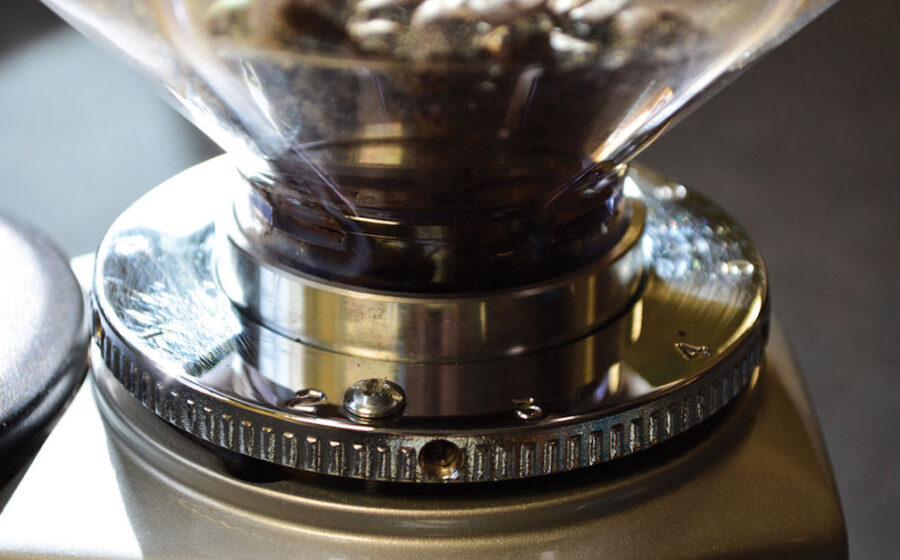
With coffee, on the other hand, getting the “correct” grind can be a frustratingly hit-or-miss process for anyone. “Drip grind” can refer to a whole range of particle sizes, from fairly coarse to fairly fine. “Espresso grind,” which is universally understood to be a very fine grind, is so particular that our industry created an entire line of grinders specifically designed for miniscule adjustments to perfectly dial in the grind. On top of all of that, the accuracy of the grind is critically important to well-brewed coffee. While there is a certain spectrum of grind size within which you can make a perfectly palatable cup of black coffee, espresso really needs to be right.
What are we to do? The answer, as always, is training. Particularly with espresso extraction, we can learn what to look for and how to make adjustments to achieve a very accurate grind.
Simply ignoring the grind—hoping that accuracy just happens—isn’t an option. Customers of all taste sensitivities can tell when something is wrong. They might not know what, exactly, but they know it isn’t right. It’s too weak (too coarse a grind), it’s too strong (too fine a grind), or it’s just right. Finding that spot where it’s just right is crucial.

One of my most memorable training experiences happened with a café that prided itself on making great espresso. You can imagine my surprise, then, when I found duct tape wrapped around the adjustment collar of their espresso grinder with an attached note that read, “DO NOT CHANGE THE GRIND—IT WILL BREAK THE ESPRESSO MACHINE!” The manager told me, “We had a kid who changed the grind once and it was too fine. Broke the whole machine. We had to stop serving espresso and call maintenance.”

“We had a kid who changed the grind once” is the beginning of a scary sentence that usually ends with no one adjusting the grind ever again. It can be tough to move past experiences that had a detrimental effect on our customers’ experiences. But with proper training and knowledge of our equipment, we can empower our baristas to create flavor experiences for our customers that go beyond anything they’ve experienced before.
In order to talk effectively about grinding, we need to establish what espresso actually is. For that, we’ll turn to the Specialty Coffee Association of America, and their lovely definition of the liquid we love:
“Espresso is a 25–35 mL (50–70 mL for a double) beverage prepared from 7–9 grams (14–18 grams for a double) of coffee through which clean water of 195–205 F has been forced at 9–10 atmospheres of pressure and where the grind of coffee is such that the brew time is 20–30 seconds.”
That last part, “. . .where the grind of coffee is such that the brew time is 20–30 seconds,” is what we want to focus on. All of our grind adjustments in the realm of espresso are bent toward that goal: a twenty to thirty second shot of espresso that tastes utterly delightful. Dose and tamp will play a role in getting us there as well, but we can’t dose or tamp coffee that isn’t ground.
In all of my training classes, I share an easy trick that I learned to help place me in the general area of a proper espresso grind. Further tweaking and adjustments may be necessary after this, but it will be a good start.
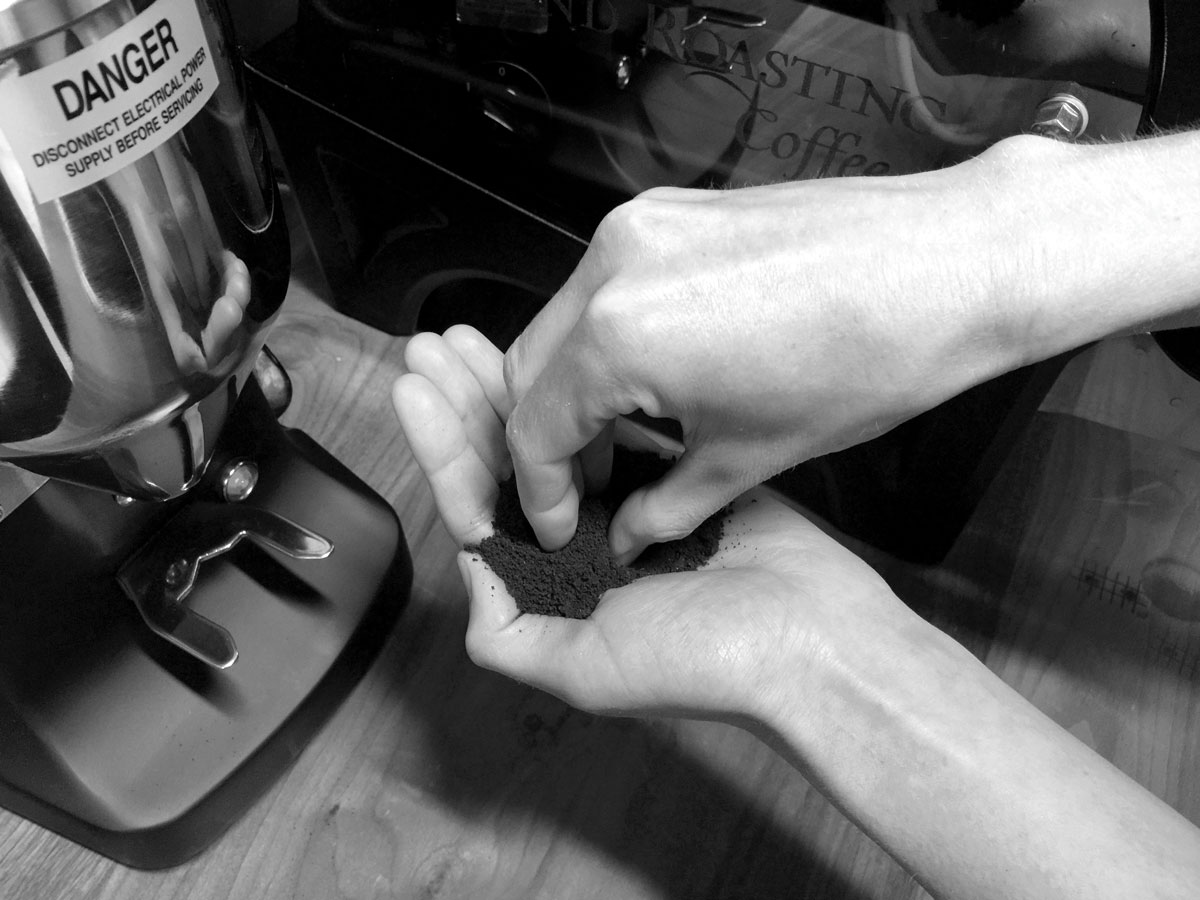
First, turn on the espresso grinder, grind some coffee, and dose a small pile of it into your hand. Next, take your thumb, index, and middle fingers, and squeeze the pile together. Now let go. Did it stay roughly in the shape your fingers squeezed it into? Yes? Great! Your coffee is approximately fine enough. If the coffee fell back into a little pile, it’s probably too coarse, and needs to be adjusted finer.
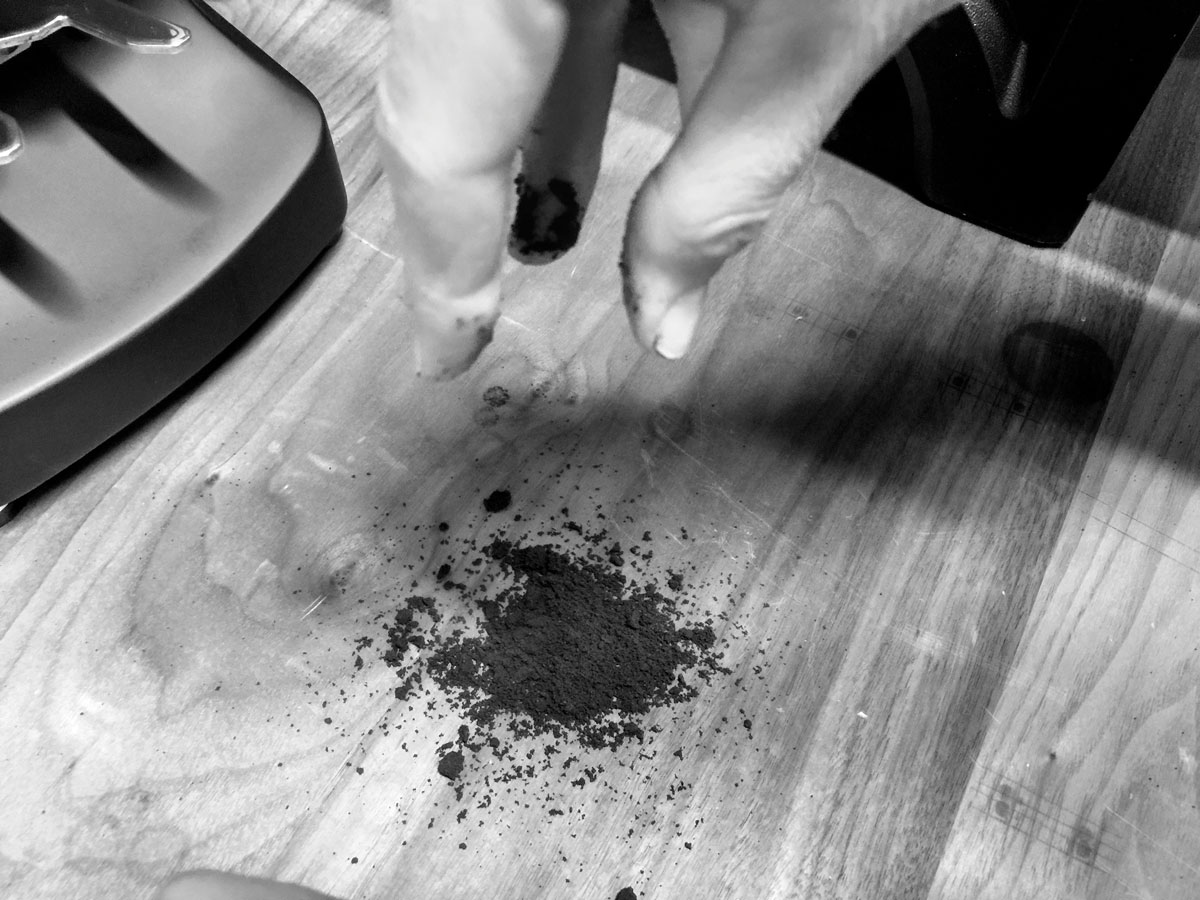
If your coffee stuck together, the next step is easy. Pick up the little squished portion, and drop it from twelve to eighteen inches onto the counter. If the coffee breaks apart into individual particles again, terrific! Your coffee is approximately in the correct range. Fill up a portafilter and pull a shot. If the coffee stayed all squished together, it’s probably a bit too fine, and needs to be adjusted coarser. All these adjustments should be made intentionally, in small increments. With espresso grinders, a little bit of movement makes for big changes in the extraction.
Next month, we’ll continue with a discussion of exactly what effects those adjustments have and how to make them throughout the day so that every customer gets perfectly dialed-in espresso every time.
—Nathanael May is Portland Roasting’s director of coffee and a regular Fresh Cup contributor.