✉️ This story was featured in this week’s Coffee News Club
👋 Get the Coffee News Club newsletter in your inbox weekly—sign up.
Pretty much every coffee shop offers non-dairy milk options like oat or soy. But most charge extra for alternative milks or require the customer to explicitly request a non-dairy beverage. At the same time, dairy milk has a vastly higher carbon footprint than alternatives.
What happens when a coffee shop switches it up and makes oat milk the default? A new study, published in Global Environmental Psychology, found that doing so can reduce a latte’s carbon footprint by up to 34%.
The experiment took place at a university coffee shop in the U.K., where milk offerings were switched so that oat milk became the default, and customers had to ask for dairy. The cafe posted signs explaining the change, noting it was for environmental reasons. Another campus cafe continued with dairy as a control.
The study revolved around the idea of a “default nudge,” the concept that most people will go with the pre-selected option. The study used an ABAB experimental design, which includes four phases: a first baseline, an intervention, a second baseline, and a second intervention. This allows the researchers to more accurately gauge their study’s impact, as it provides two separate sets of measurable results over a longer time frame and with more participants.
During the first baseline phase, when dairy was the default, 16.6% of customers chose oat milk; after oat milk became the default during the first intervention, that jumped to 51.9%. Dairy milk was then returned to the default for the second baseline phase, where oat milk consumption fell to 23%.
During the second intervention, the number who went with the default oat milk jumped again to 46%. While still high, the authors suggest that the slightly lower rate indicates that more research is needed on the nudge’s longer-term effects. The control cafe didn’t see a change in its oat milk usage over the same period.

“We found that customers were approximately three times more likely to consume plant-based milk when oat milk was the default milk option instead of dairy milk and that the mean milk-based carbon footprint per drink reduced by 25%–34%,” the authors wrote in their conclusion. “These findings suggest that default nudges can help encourage plant-based diets among consumers by reducing dairy consumption and enhancing sustainable plant-based milk consumption.”
Dairy milk plays a big role in a coffee shop’s carbon footprint—Starbucks calls it a “key contributor” to the coffee giant’s overall impact. A 2025 study found that milk was responsible for more than 75% of a latte’s carbon footprint. Several coffee companies, including Blue Bottle and Stumptown, have already switched oat milk to the default in their cafes to lower emissions.
“We hope by providing more people with the experience of oat milk we might inspire guests to choose it more often both at our cafes and at home, so together we can reduce our greenhouse gas footprint from dairy,” Blue Bottle stated in a blog post explaining the move.
Read more on the oat milk nudge from Daily Coffee News here.
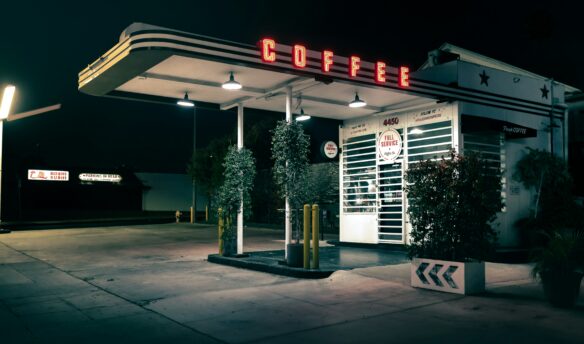
Photo by Clay Banks on Unsplash