The surge in Immigrations and Customs Enforcement (ICE) actions around the United States over the past year has impacted the coffee industry in numerous ways.
In cities from Chicago to Minneapolis to Los Angeles, independent coffee shops have become hubs for protest, resistance, and community-building. Cafe owners, workers, and customers have also been targeted for detainment and deportation. In one case, ICE agents lured a cook at Crumbs & Coffee in Brooklyn Park, Minnesota, from the cafe and arrested him. In Hawaii, ICE has conducted raids on coffee farms and targeted the children of farmworkers.
While many of the agency’s actions have been dramatic and violent, others have been discreet—but no less traumatic. For one coffee worker in Kona, a routine immigration appointment turned into a five-month detention in a federal facility from which he was only recently released.
‘Shocking and Difficult to Comprehend’
In August 2025, Juan José Estrada Lopez attended what he thought was a run-of-the-mill appointment at a United States Citizenship and Immigration Services field office in Hawaii. Estrada Lopez, who works on a coffee farm in Kona—the state’s most acclaimed growing region—came to the U.S. three years earlier without documentation from Nicaragua.
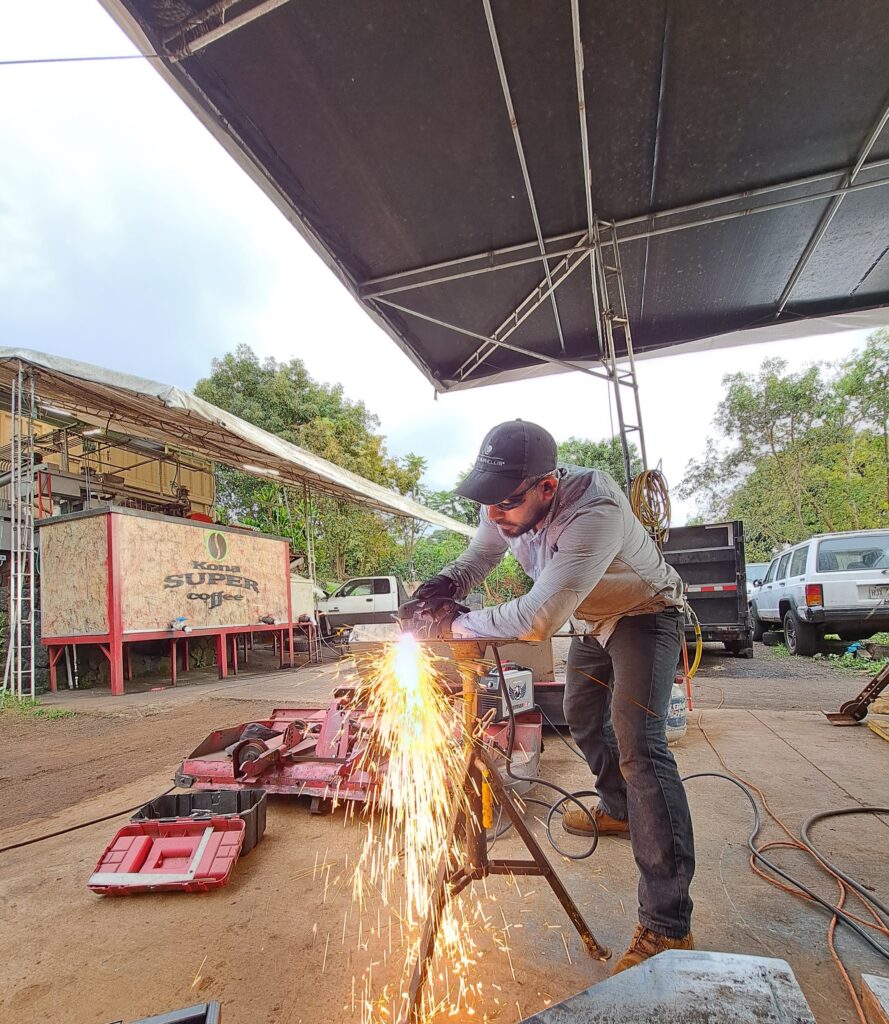
Before coming to the U.S., Estrada Lopez had a background in welding. He worked on coffee farms in Nicaragua, fabricating, repairing, and maintaining coffee processing equipment, such as depulping and destoning machines.
Through contacts in the industry, he learned of an opportunity in Hawaii to provide similar services. He entered the U.S. in 2022 and ended up working on coffee farms in Kona, which is where he met and married Emily Estrada, a U.S. citizen. The couple were in the process of applying for Adjustment of Status, a pathway for certain undocumented people to become legal permanent U.S. residents.
It was at one of their appointments during this process that Estrada Lopez was detained. The experience was “initially shocking and difficult to comprehend,” he says. “Neither my wife nor I expected that situation, as we believed we were following the proper processes.” He was taken to the Federal Detention Center in Honolulu, where he was held for more than five months.

From Green Card Interview to Federal Detention
ICE held Estrada Lopez without bond or charges for several months, until Emily got in touch with the ACLU of Hawaii.
“Emily found our organization while she was looking for an attorney,” ACLU of Hawaii immigration rights attorney Leilani Stacy says. “Private lawyers were going to charge her thousands of dollars, and we do this work pro bono. We’re really in it to protect people’s civil rights.”
Immigration cases are civil matters, not criminal. But despite having no criminal history, Estrada Lopez remained in federal custody for more than five months. “This administration said, ‘We’re only locking up hardened criminals,’ and ‘People need to go through the lawful process,’ and then people who are actively trying to go through the lawful process are the ones that are being punished,” Stacy says. More than 70% of ICE detainees have no criminal convictions, according to data from Transactional Records Access Clearinghouse.
On Jan. 13, 2026, the ACLU of Hawaii filed a habeas corpus immigration lawsuit in federal court challenging the legality of his detention. Habeas corpus petitions date back hundreds of years, and aim to compel the government to prove that a detainee’s confinement is lawful.
In the lawsuit, Stacy argued that “detaining Mr. Estrada Lopez without bond is plainly contrary to the statutory framework of the [Immigration and Nationality Act] and contrary to both agency regulations and decades of consistent agency practice. It also violates Mr. Estrada Lopez’s right to due process by depriving him of his liberty without any consideration of whether such a deprivation is warranted.”
Before the judge could rule in that case, Estrada Lopez had an immigration hearing on Jan. 27, at which an immigration judge granted his request for Adjustment of Status. He was released the same day. The ACLU’s lawsuit put pressure on the government to fast-track the immigration hearing and to waive any appeal from the green card approval, Stacy says. “We think that the collective pressure changed the government’s tone, and led to the outcome of him getting a release that same day.”
In an emailed statement to Fresh Cup, ICE public affairs officer Jason Sweeney said that Estrada Lopez was detained having “absconded from [the Alternative to Detention program]” after an initial arrest by Border Patrol following his entry to the U.S. in 2022. (ATD is a program that allows certain individuals detained by ICE to be released subject to monitoring and reporting requirements.) In a follow-up, Sweeney said Estrada Lopez “did not fulfill those [reporting] obligations.” Estrada Lopez refuted this claim, saying that he has documentation showing he reported and attended appointments. “It may simply be some kind of misunderstanding,” he said.
Sweeney’s statement continued: “He remained in ICE custody pending removal proceedings, and was released Jan. 27, 2026, after an immigration judge’s ruling, thus receiving a due process.” In response, Stacy acknowledged that Estrada Lopez received due process before the immigration judge. However, she noted that their habeas petition was based on his five months being held without a bond hearing. “He was detained, we argued, in violation of due process because he didn’t get an opportunity to challenge his detention at the outset, which he should have been able to do.”
Estrada Lopez notes that he didn’t experience any mistreatment while in the system, and that those working in the detention center were all professional “and most were even kind.” However, he nonetheless spent his time in detention feeling frustrated and helpless. “Everything depended on the judge’s decision and potential actions from DHS,” he says. “There was a lot of uncertainty and disbelief in the system. It was a very difficult time.”
‘Easy Grabs’
As was the case in many other parts of the country, ICE enforcement in Hawaii spiked in 2025. While there weren’t as many agents in the state as in places like Minnesota, the number of people detained quadrupled compared to 2024, according to reporting from Honolulu Civil Beat.
The state’s coffee sector relies on migrant labor for much of its workforce. Last year’s harvest was impacted by ICE immigration raids—in September, Civil Beat’s Jeremy Hay reported that more than 100 coffee workers on the Big Island had been arrested and deported, while others decided not to travel to the state for fear of being detained. ICE agents also targeted immigrant farmworkers’ children, Hay reported in another piece, ostensibly to ensure their welfare but also to ensnare the adults who care for them.
“Immigrant labor and migrant labor has played a really large role in shaping what the [coffee] industry looks like,” Rep. Jeanné Kapela, whose family runs a coffee farm, told Fresh Cup last year. Migrant workers usually fly in from California to work the coffee harvest, but Kapela said that didn’t happen in 2025. “If there are no people flying in seasonally, then who’s going to work our farms?”
As well as worksites, state courthouses and other administrative facilities have increasingly become targets for agents, according to immigration attorneys. Arrests at Massachusetts courthouses, for example, tripled over the first nine months of the second Trump administration.
What happened to Estrada Lopez, Stacy believes, stems from a change in government policy that took place in July 2025. That month, acting ICE director Todd Lyons issued a memo saying the agency had the authority to detain those deemed illegally present in the country without a bond hearing “for the duration of their removal proceedings.” Previously, undocumented individuals with no criminal record were released on bond while their cases were heard; now, they could be held for months or years, even if they had been living in the U.S. for a long time.
“Nationally, we’ve never seen this scale of people locked up while they’re going through the lawful process,” Stacy says. In the ICE statement, Sweeney, the public affairs officer, wrote “As a matter of policy, ICE is committed to enforcing the nation’s immigration laws fairly and in accordance with due process.”
Immigration rights groups immediately challenged the lawfulness of the memo. Matt Adams, legal director for Seattle-based Northwest Immigrant Rights Project, said in an ACLU press release that the policy “blatantly violates the immigration laws that have been in effect for almost thirty years.” In November, a federal judge ordered the Trump administration to provide bond hearings, although that ruling was overturned by an appeals court in early April.
Community Support
The coffee community in Kona was very supportive during his detention, Estrada Lopez says. “My boss and coworkers stood behind me,” he says. “One of our farmers even gave my wife money to put toward my commissary while I was detained.”
The ICE detention-without-bond policy that Estrada Lopez experienced is still active. A recent report in Bloomberg Law detailed the difficulties for individuals and families navigating “overloaded” immigration courts and a “turbocharged” approach to deportation. In response, there has been a subsequent spike in habeas corpus filings around the U.S. and in Hawaii. “This is happening to countless people across the country,” Stacy says. “It has been a really powerful example of the effect that this administration is having on individuals who are real, who are human, and who have to suffer and live with the consequences of a very abstract policy.”
Following his release, Estrada Lopez went straight back to work. He had been in the middle of installing a dry mill, a project that lay idle while he was incarcerated. “When I returned, I focused on picking up where I left off and getting the project moving again,” he says.