Caffeine Is Intolerably Bitter. Why Doesn’t It Ruin Coffee?

by

Editorial Policy

Published on

Most coffee contains between 1 and 1.5% caffeine, the chemical compound responsible for keeping us awake.

This might seem obvious, but caffeine is very bitter. Some have described caffeine as tasting “alkaline,” “slightly soapy,” and “sharp and acerbic,” even in small doses. So why aren’t people squirming as they sip their morning cup of coffee? A team of German researchers wanted to find out.

“The significance of this work lies in explaining why coffee beverages do not taste of caffeine, even though the caffeine concentration of coffee is far above the perceivable level,” said co-author Michael Gigl in a press release.

The answer, the researchers found, lies with a group of compounds called melanoidins. Melanoidins are produced during roasting, and the researchers isolated them to examine how they interact with caffeine. 

In the study, published in the Journal of Agricultural and Food Chemistry, a group of panelists tasted samples. They rated those with melanoidins and caffeine as approximately half as bitter as those with caffeine alone. In fact, the taste of caffeine became noticeable only when the researchers added significantly more caffeine to the melanoidin-containing sample than would be found in a regular coffee.

The researchers theorize that melanoidins may bind to caffeine to “physically obstruct access” to our tongue’s bitter taste receptors. The interactions between melanoidins and caffeine “have a significant influence on the perceived bitterness of caffeine and, consequently, of coffee,” they concluded. 

Researchers hope their findings will spur further research, such as exploring how the addition of melanoidins could improve the flavor of instant coffee and other coffee products.
Read more on caffeine’s bitter barrier compound here.

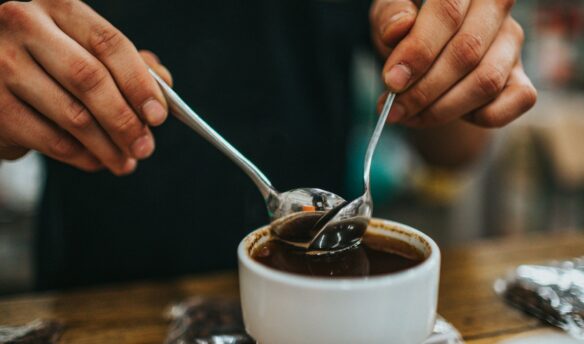
Photo by Robert Shunev on Unsplash

Share This Article
Avatar photo

Fionn Pooler

Fionn Pooler is a coffee roaster and freelance writer currently based in the Scottish Highlands who has worked in the specialty coffee industry for over a decade. Since 2016 he has written the Pourover, a newsletter and blog that uses interviews and critical analysis to explore coffee’s place in the wider, changing world (and also yell at corporations).

Join 12,500+ coffee leaders and get top stories, deals, and other industry goodies in your inbox each week.

This field is for validation purposes and should be left unchanged.


Other Articles You May Like

Is The Pumpkin Spice Latte Dead? McDonald’s Nixes Drink from Fall Menu

This year, McDonald’s is opting out of the pumpkin spice latte frenzy. The choice could be an indication that the drink’s grip on seasonal beverages may be loosening. 
by Fionn Pooler | September 17, 2026

The New Current Coffee Summit Brings Forward-Thinkers Together to Learn and Experiment

The inaugural Current Coffee Summit brings coffee leaders face-to-face with the science, equipment, and ideas reshaping coffee—September 29–30 in St. Louis.
by Garrett Oden | September 16, 2026

Robusta Being More Resilient than Arabica “Not Supported by Scientific Evidence”

One of the coffee industry’s most widely accepted beliefs is that robusta is more resilient than arabica. A new study throws doubt on robusta’s resilience. 
by Fionn Pooler | September 15, 2026

Oatly’s Bike-Centric Pop-Up Proves That Coffee Drive-Thrus Don’t Have To Be Boring

Oatly’s recent pop-up in Amsterdam, called the first-ever coffee bike-thru, was lauded by coffee lovers and cycling enthusiasts around the globe. What can other businesses learn from it?
by Chloé Skye Weiser | September 11, 2026