Cold brew has come a long way from its days as a niche menu item. Over the past decade, the chilled beverage, which is made by steeping coffee grounds in cold water for 12–24 hours, has become a staple in cafes around the world. Today, it rivals traditional iced coffee, or coffee that’s brewed hot and then poured over ice.
In November 2025, “cold brew” was added to Merriam-Webster’s print Collegiate Dictionary. It’s just one more sign of how firmly the beverage has cemented itself in contemporary coffee culture.
“‘Cold brew’ is not just included in Merriam-Webster’s most comprehensive dictionary, but also in its flagship one-volume reference dictionary,” says Dr. Anja Wanner, a linguist and professor of English at the University of Wisconsin-Madison. “That may tell us something about how sure the editors are that the object it signifies—a certain type of beverage—is here to stay.”
But what does it really mean when a new term like “cold brew” is added to the dictionary? And who decides? We spoke to linguists and academics to learn more about the process—and what it reveals about cold brew’s staying power.
The Rise of Cold Brew
To some, the difference between cold brew and iced coffee may seem small—but many consumers are increasingly opting for the former, finding it to be smoother and naturally sweeter than the iced coffee of yesteryear. The fact that cold brew is typically higher in caffeine content (averaging 150–200mg of caffeine per 8oz, versus 80–120mg for iced coffee) is another factor driving its popularity.
According to the National Coffee Association, cold brew consumption in the U.S. has spiked by 400% since 2016, making it the fastest-growing segment in the cold coffee market. Furthermore, Fortune reports that the global cold brew market is growing by 22% each year, and is projected to rise from $4.74 billion USD in 2026 to $24.37 billion by 2034.
Though cold brew has been a significant part of American coffee culture for several decades, the term was only added to Merriam-Webster’s Collegiate Dictionary last year. That doesn’t reflect the drink’s much longer history.
Historians trace the earliest form of cold brew coffee all the way back to 17th-century Japan, where Dutch traders introduced cold brew concentrate as a stable, fire-less, and easily transportable source of caffeine.

From there, people in Japan developed what is now known as Kyoto-style drip, which they called datchi kōhī, or “Dutch coffee.” The method made iced coffee by filtering cold water or ice through coffee grounds for 8–24 hours.
It wasn’t until the latter half of the 20th century that cold brew would catch on in the Americas. In 1964, cold brew coffee was officially introduced to the United States by Todd Simpson, a chemical engineering student from Cornell University who released the “Toddy Brewing System” after coming across cold brew coffee in Peru.
After observing that brewing coffee with hot water often led to bitter flavors and stomach irritation, Simpson created an immersion-style coffee brewer that steeped coffee grounds in cold water for 12–24 hours. The result was a smooth coffee concentrate that was significantly less acidic than hot-brewed coffee. Gradually, the term “cold brew” became more commonplace in American English.
During the third-wave coffee movement of the early 2000s and 2010s, cold brew’s place in the specialty-coffee world was effectively solidified by brands like Stumptown and Blue Bottle, which introduced cold brew to the mainstream in various formats, including canned cold brew and nitro cold brew. New devices for making cold brew at home also became increasingly accessible, and in 2015, Starbucks launched cold brew in thousands of locations across the U.S.
How ‘Cold Brew’ Found Its Definition
If cold brew’s popularity has grown over decades, what pushed linguists to finally recognize the term now?
Wanner says the process by which dictionary editors pick new words to add to their official lexicon can vary. “It really depends on the dictionary and the standards the editors have for considering a new word to have staying power,” she says. “The Oxford English Dictionary, for example, first puts new words on a watch list. Usage is tracked from ‘a variety of sources,’ mostly written sources, since they have to be documented.”
As Merriam-Webster writes on its official website, “A word gets into a dictionary when it is used by many people who all agree that it means the same thing … Dictionary editors read actively, looking for changes in the language. To find vocabulary that has entered mainstream life—terms like ‘bucket list’ or ‘sexting’ or ‘unfriend’—we look at sites and publications with wide national readership.”
When determining which words make the final cut, Merriam-Webster looks for three criteria: frequent use, widespread use, and meaningful use. In other words, the term must be used consistently over a long period of time by people across a wide variety of regions, and its meaning must be recognized by the average adult.
Dr. Kelly Wright, a linguist and member of the American Dialect Society’s New Words Committee, explains why the term “cold brew” has caught on, compared to something like, say, “cold-steeped coffee.”
“I think brew here is serving as a modifier for the already colloquial brew, meaning coffee,” Wright explains. “Brew is a more fun, more informal way of referring to coffee itself, so it makes sense that the shorter, more colloquial version was chosen over something more accurate or descriptive.”
Is Cold Brew Here To Stay?
“Cold brew” being added to the dictionary appears to be a milestone for the drink—but some linguists argue that it doesn’t necessarily guarantee that the term will have staying power.
Wright points to one example of a dictionary word failing to gain traction. “The very first American Dialect Society Word of the Year in 1990 was bushlips, meaning ‘insincere political rhetoric,’” she says. “That word was prominent in the ’90s and was added to the dictionary, but its usage never really took off outside of political pundits—and even then was highly topical and temporally constrained.”
It’s no secret that consumers love cold coffee, but will we always refer to it as “cold brew”? Only time will tell. “There are thousands of words in the dictionary that we don’t use today,” says Wright. “It is, however, very difficult to predict which terms will stick around and which ones will be quickly replaced by new trends, colloquialisms, or vocabulary.”
As coffee culture continues to evolve, the words we use to describe it will too. For now, at least, “cold brew” has officially earned its place in both our cups and our vocabulary.
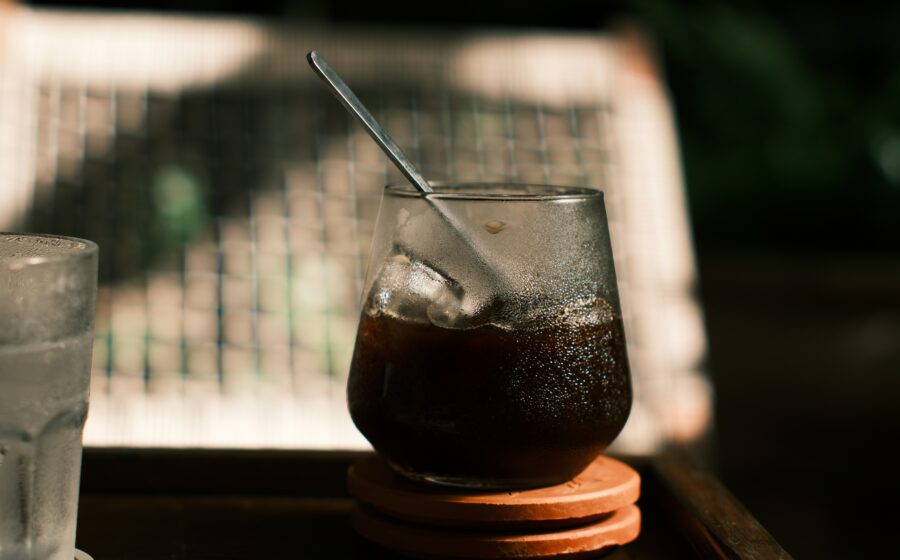
Photo by Phước Sang on Unsplash