Between 2021 and 2025, India experienced an added 30 days of coffee-harming heat per year due to climate change—and it wasn’t alone. Together, the 25 countries that grow 97% of the world’s coffee experienced an average of 47 additional days when temperatures exceeded 30 degrees Celsius, according to a Climate Central analysis. This above-average heat affected prized arabicas, as well as supposedly more heat-resilient robustas.
Yields of both widely grown species were disrupted by these higher temperatures, as well as erratic rainfall, prolonged droughts, and unexpected frosts. In response, growers and scientists are now devoting more resources to exploring climate-resilient alternatives. Among these is Coffea x libex, a hybrid of excelsa and liberica, first identified this May by a group of researchers, led by Aaron Davis, at the Royal Botanic Gardens in Kew, London.
Excelsa and liberica are both native to Africa, and were likely introduced to India by British planters. Until recently, Indian growers did not distinguish between them, and grouped them under the broader name liberica—as did scientists. It was only in August 2025 that the same Kew research team found enough genetic difference to split them into two distinct species. The May 2026 study builds on this previous research.
Compared with liberica, excelsa has more fruits per node, meaning higher fresh fruit yields; excelsa fruits are also smaller, with thinner pulp and parchment, meaning faster drying and processing. These traits mean that excelsa has higher outturns: Fewer fruits are needed to produce the same amount of clean coffee.
While both excelsa and liberica are more climate-resilient than arabica, liberica tolerates higher temperatures, longer dry spells, and a wider range of rainfall than excelsa. Hybridizing the two, the Kew researchers suggest, could combine excelsa’s high productivity with liberica’s climate tolerance—and create a coffee that could withstand our warming future.
The South India Coffee Company (SICC) contributed samples and field expertise to this 2026 Kew study. Founded in 2017 by husband-and-wife duo Akshay Dashrath and Komal Sable, SICC grows excelsa alongside arabica at Dashrath’s family estate (Mooleh Manay in Kodagu, Karnataka). Besides growing its own coffee, the company also researches alternative climate-resilient species; works with growers across India on cultivation and processing; and supplies roasters in India as well as the U.K., the EU, and the U.S.
A fifth-generation planter, Dashrath says his family’s history with excelsa goes back to the 1940s. Some of the oldest excelsa trees on the estate are estimated to be 60 to 80 years old. “As a teenager, when I drank coffee, it was always excelsa. My grandfather loved excelsa, so he only had roasted excelsa at home,” he says.
In most South Indian estates, excelsas were grown around the boundaries, as they were tough and low-maintenance enough to essentially replace fences. But Dashrath’s grandfather liked the coffee enough to plant it between blocks of arabica as well. When the Coffee Board of India advised growers to cut down excelsas in the 1990s because they were prone to pests such as the berry borer if left unharvested, he decided to hold on to them.

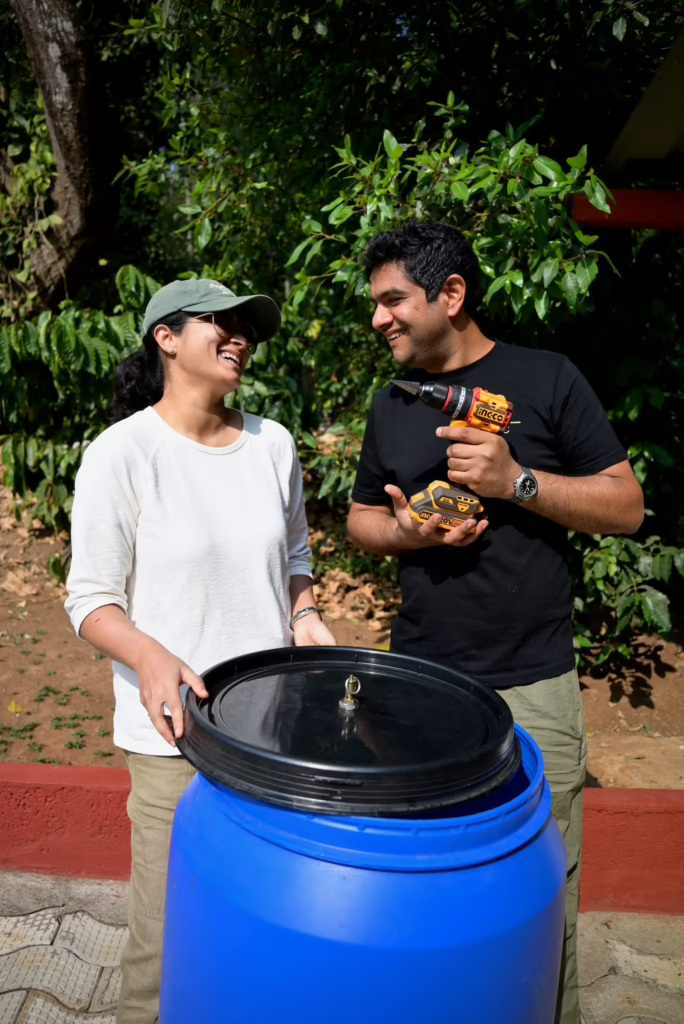
“At one point, my grandfather’s estate was doing 200 bags of excelsa parchment a year, which is bigger than our arabica production today,” Dashrath says. Decades later, that decision proved prescient. Seeing the family estate treat excelsa as a coffee to grow and process carefully is what led Dashrath and Sable to include excelsa as an integral part of SICC from its early days—long before the Kew study made a climate case for the species.
Fresh Cup spoke with Dashrath and Sable about how they came to be involved with the Kew study, what makes excelsa climate-resilient, and how SICC itself came to be.
This interview has been edited for length and clarity.
To begin, tell us about your personal journey with excelsa.
Akshay: I run a tech company in London that deals with a lot of startups in the U.K., including specialty coffee shops. We realized Indian coffee didn’t feature in the U.K.’s specialty scene, except for one or two farms.
From 2015 onwards, we started visiting coffee shows and talking to importers, which was not the nicest experience. So we decided to set up our own importing company in the U.K., set up an exporting company in India, and start doing small shipments. Through a client, we found a potential buyer. We started with arabica, but I’ve always thought excelsa was the best coffee in the world and wanted to take it to the U.K. and see what people think.
Komal: We were shot down initially. People in the specialty industry said it tasted like burnt rubber. In 2019, Coromandel Coast in the U.K. was the first roaster to buy from us, and they have been buying our excelsas consistently since.
Now there’s a lot more interest. We are slowly increasing our export volumes. We are doing a lot of education about what excelsa is and why you need to start adopting a different species. We are also placing it in competitions. Our excelsa has won awards in barista championships in Italy, the U.K., and India.
How and why did you start working with Aaron Davis and his team at Kew? How did you contribute to this new study on liberica-excelsa hybrids?
Akshay: During Covid, we were in India and doing more work around our estate. That’s when we started researching native coffee species that may be low-intervention. In the process, we came across Aaron Davis, and realized he was doing work on excelsa.
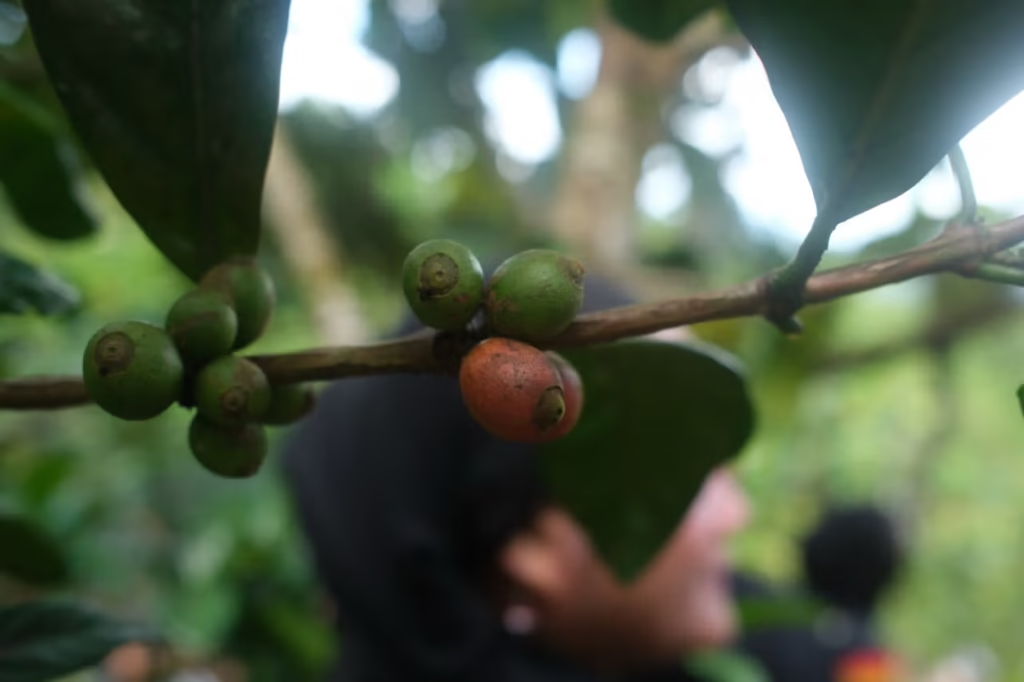
I dropped him an email in 2020 or ’21 saying, “We may have excelsa or liberica. My granddad always called it excelsa, but the locals called it liberica.” And he said, “Why don’t you send me a dried leaf sample? We’ll genotype it.” We sent him a sample and it turned out to be excelsa.
Unlike arabica and robusta, excelsa has never been bred—it is effectively a wild population. In terms of yield and cup, there’s a lot of variability from one plant to another. So we were building a map of what kind of material we have, and what needs to be propagated if we want to make this commercially viable in the specialty industry.
Around the same time, as our sales of excelsa grew, we were also buying coffee from estates around us. Fruit would come to us, we would process it, and when a certain fruit looked different, we would go to those farms and see how that plant may be different. As part of this process, we were introduced to the Malleshwara Estate, where some plants looked a little different. We sent those to Davis’ team and they turned out to be a hybrid of liberica and excelsa [Davis’ paper calls this libex].
What does the study mean for coffee and its ability to adapt to climate change—and for the future of Indian coffee more broadly?
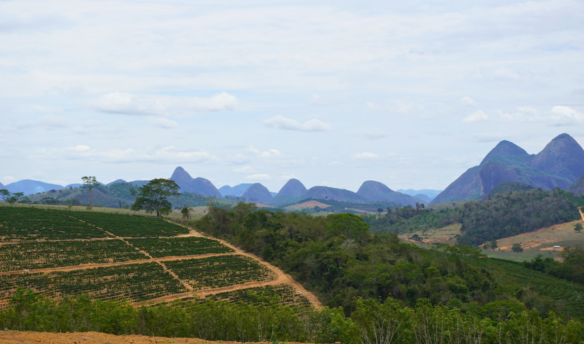
Akshay: From what we have seen, excelsa predominates in coffee-growing districts in India, such as Kodagu and Hassan. It grows at higher elevations of 500–1,200 meters and handles climate variability, including excess moisture and heat, well. Liberica is lower-elevation and even better at handling heat, which is why it does better in hotter places like Sarawak, Malaysia. Libex, because it carries liberica’s genes, is more heat-tolerant than excelsa alone. In India, we don’t necessarily experience the kind of heat that they do in Borneo, so we don’t need that level of heat tolerance. Here, excelsa by itself works well.
Excelsa has a thinner outer parchment than liberica. An excelsa node has far more fruit per node than liberica. So from a commercial perspective, a pure excelsa is more profitable to grow than a pure liberica.
What Davis’ research shows is that in regions where excelsa alone would struggle, and you want the commercial benefit of excelsa but need a more heat-tolerant option, the hybrid libex could be better suited, because the yield and outturns are better than liberica.
As for us, in a project with the Coffee Vision Fund two years ago, we analyzed how excelsa saplings behave in Indian conditions. We planted them in parts of Kodagu, Mysore, and Chikmagalur, and the saplings didn’t really get very stressed. So there isn’t really a need for us to actively seek out libex for climate tolerance. We’ve already got excelsa.
When people say excelsa is “climate-resilient,” what does that actually look like at the farm level?
Akshay: The excelsa root system is the most resilient because it is deep-rooted and pest-resistant. So you can graft an arabica or robusta scion—the fruit-bearing top portion of a plant—onto an excelsa rootstock, and get some of the benefits of the excelsa’s root system. However, unless you graft an arabica onto a fully formed excelsa, whose roots have gone really deep, you’re not gonna take advantage of the depth of those roots overnight. The rooting system will only grow as deep as the scion requires it to. But the advantage of the excelsa rooting system is if it’s going through extended periods of drought, the root system has the ability to go deeper.
If you want climate resilience, you also need to keep your shade cover. Of all the regions where coffee grows, the Indian drought period is one of the longest. Shade buffers this drought. So your best-case scenario if you want the most climate-resilient and commercially viable option is to have ample shade, an excelsa rooting system, and an arabica scion.
What’s also very interesting about excelsa is it’s evolved to handle some degree of waterlogging. Two years ago, we had half our entire yearly rainfall come down in one month. Apart from a handful of species, coffee cannot handle waterlogged soils. But excelsa handles waterlogging better than arabica or robusta. In one month of rain, we lost almost all our stenophylla [another climate-tolerant species], but only about 20% of our excelsas.
When you say climate variability, you’re talking about extremes. Sometimes there’s no water, sometimes there’s too much water. And excelsa does well in our conditions with both these extremes. From all the material we have today, it does the best.
For a specialty roaster or buyer who has never encountered excelsa or libex, how would you describe what’s in the cup?
Komal: If it’s processed well, excelsa tastes sweet. It is low in acidity and bitterness. It is super fruity, with a fermenty fruit note. It’s also low in caffeine. Overall, it’s a perfect entry point for people who have been drinking instant or commercial coffees and want to try out specialty.
Akshay: Some excelsas can have a prominent medicinal note. We’ve been trying to figure out how to breed that out. The libex at Malleshwara has some of the benefits of both excelsa and liberica. So it has a degree of florality and this medicinal note isn’t so prominent, or is even nonexistent.
You’ve sold some excelsa lots to specialty roasters in India, like Blue Tokai and Subko. How has interest from Indian buyers evolved?
Komal: Blue Tokai did a nano-lot of our excelsa last year, and I think they’ll do the same this year. Subko has been very gung-ho about it. They sell our excelsa through their website and have it in their cafes. They want to showcase that there’s another species of coffee, and have done a lot more work explaining to the consumer what an excelsa is.
In the Indian market, there is not much interest. I can probably count on my fingers how many people are selling excelsa. But that number is slowly increasing. With specialty coffee, you always want that novelty value. But I don’t want excelsa to be a novel product. It needs to be something that can be on somebody’s menu. So if it is a smaller blend component, it means that it’s there to stay. I think that’s where it should be headed.