This article is sponsored by our partner, WMF Professional Coffee Machines.
It’s becoming more common to see espresso machines in places like offices, hotels, university lounges, car dealerships. As quality coffee becomes more ubiquitous, the range of businesses that can become steady wholesale accounts for roasters becomes more expansive. Dedicated office coffee service companies, however, dominate the market for these settings, often because they offer coffee-plus-equipment deals that are hard to match.
WMF wants to change that. The Germany-based espresso machine manufacturer, known for commercial superautomatic machines, built two new compact models—the WMF Peak 50 and WMF Elevation 10—that are designed to help roasters set up lower-volume partners with machines that the company’s larger flagship equipment isn’t designed for. Both machines are rolling out globally in stages across the latter half of 2026.


We spoke with Tharyn Estevez, global marketing senior director at SEB Professional Beverage, WMF’s parent company, about what these machines offer roasters, how they fit into the modern workplace coffee program, and why the right equipment in a wholesale account can make or break the coffee relationship.
WMF is known for its superautomatic machines. What inspired the company to create these machines to serve lower-volume settings?
Today, coffee consumption is no longer limited to traditional cafe environments. Employees, guests, and consumers increasingly expect high-quality coffee wherever they are—offices, educational institutions, boutique hospitality settings, self-service locations. And their expectations go beyond espresso classics into plant-based milks, cold coffees, and other ingredients like match and ube.
The WMF Peak 50 and WMF Elevation 10 were developed to address this shift: bringing professional quality into environments that were previously underserved, while staying compact and easy to manage day to day. They’re built on WMF’s established engineering foundation: in-house manufactured grinding discs from Geislingen (Germany), a two-boiler system, and proven milk and cleaning technologies.
Can you explain the names “Peak 50” and “Elevation 10?”
Both names are part of a new naming framework that SEB Professional Beverage is introducing across the WMF professional coffee machine portfolio. The concept is built around a mountain metaphor: “Elevation” marks the entry point into professional coffee, while “Peak” represents the next level.

The numbers were chosen for global usability: 10 and 50 are easy to pronounce and consistently readable across languages, which matters when you’re launching across markets.
How are these machines different? How can a roaster help a business determine which is best for them?
For roasters trying to match accounts with the right machine, the decision is defined by daily volume, beverage requirements, and the operational reality of each customer.
The WMF Elevation 10 is designed for spaces making up to 50 cups per day. It’s just under 12 inches wide, so it fits into smaller environments such as offices, reception areas, waiting rooms, educational institutions, hair and beauty salons, as well as small guesthouses and B&Bs.
What makes it stand out in this segment is the standard combination of a bean hopper and a powder hopper (for things like matcha or chai powder), a 7- or 10-inch touch display for intuitive navigation, the milk steaming system for hot milk and fine foam, and a choice between a 16g or 24g brewing unit. Moreover, the machine can be configured with a steam wand for manual foaming. Daily milk system cleaning can be completed in approximately three minutes using Click+Clean [automatic milk steaming feature].

The WMF Peak 50 is designed for spaces making up to 80 cups per day and represents a best-in-class solution within its segment. It is suited for medium-sized offices, small restaurants and cafes, hotels, convenience environments, and reception areas such as car dealerships. The WMF Peak 50’s flexible brewing system can make hot americanos, cold coffee that ice can be added to, and filter/drip coffee.
The Peak 50 and Elevation 10 can be configured with a 24g brewing unit, allowing the machine to prepare larger drinks, such as a 16 oz Americano, in a single programmed cycle rather than running two separate extractions. In recipes where a comparable machine would use two smaller doses, this can reduce the amount of coffee used per drink. We estimate the savings at roughly 15%, depending on the recipe.
For roasters, the positioning is clear: The WMF Elevation 10 opens access to a segment that has previously been difficult to serve effectively, while the WMF Peak 50 is the next step up for customers with higher volume requirements or more complex beverage expectations.
These machines have an optional powder hopper. How are workplaces actually using it?
Matcha latte is the clearest driver. Both the WMF Elevation 10 and WMF Peak 50 support matcha preparation fully automatically via the powder hopper. Chai lattes are another strong performer, particularly relevant for the U.S. market. Hot chocolate—not vending-machine quality, but a properly prepared powder-based version—is also popular.


To put it simply: the powder hopper is what enables operators to serve the beverages that younger employees are actively looking for. The same drinks they’d order at their favorite cafe around the corner are all available by simply touching a screen.
The CoffeeConnect telemetry system allows roasters to track machine usage remotely. How does this help roasters serve their accounts?
The CoffeeConnect module integrates directly into the machine and provides access to a central dashboard covering machine performance, sales data, consumption patterns, and cleaning cycles.
For roasters, this means beverage recipes can be transferred remotely across all connected machines, ensuring consistent quality throughout an entire customer network, even when blends change or grind settings are adjusted.
It also provides usage data about top-selling beverages, peak times, machine status, and maintenance requirements. This transparency allows for informed operational decisions, like more accurate restocking, proactive maintenance, and more efficient allocation of service resources.
As a result, digitization extends beyond the individual machine to the entire coffee operation. Roasters can move from a transactional supplier role to a data-driven beverage partner.
Why are these machines a good addition to a roaster’s wholesale portfolio?
The WMF Elevation 10 and WMF Peak 50 open a wholesale segment that has historically been difficult to serve at a consistently high level. Small offices, boutique hospitality, convenience environments, and reception areas. Expectations within these segments have evolved: employees, especially from younger generations, expect the same quality and variety they experience in specialty coffee environments.
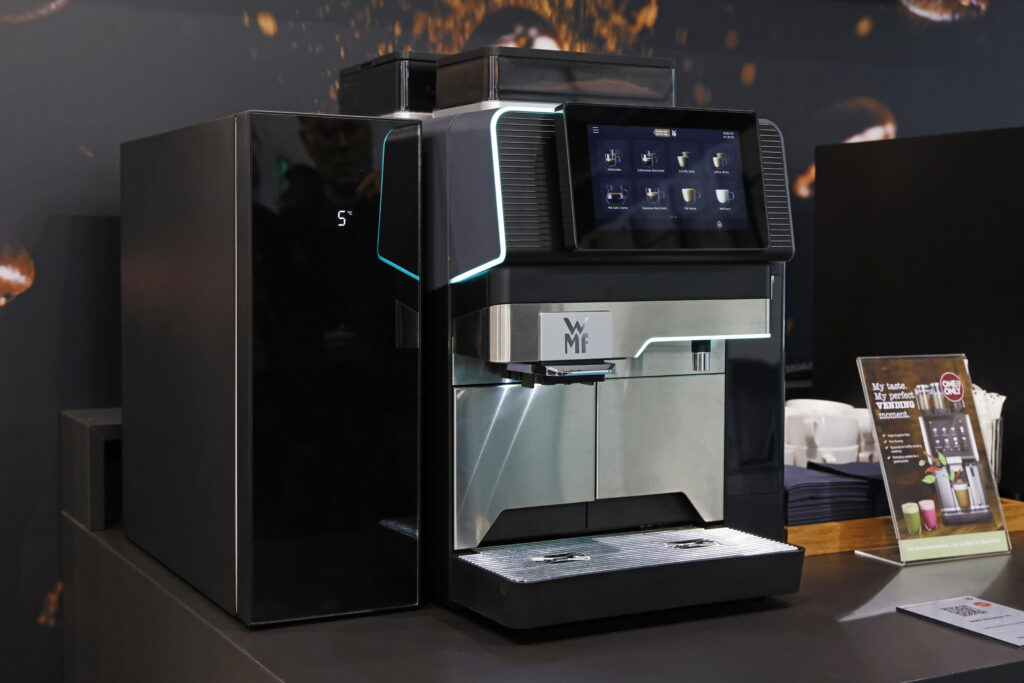
The equipment a roaster places in those accounts shapes the relationship. Systems that are difficult to operate or maintain ultimately lead to inconsistent results, and quality perception is often attributed to the coffee rather than the equipment. Both new WMF models are designed to mitigate these risks. They combine intuitive operation, guided cleaning processes, and robust engineering to ensure consistent performance over time—even in environments without trained staff.
Ultimately, these machines are not defined by their price point, but by their relevance. They enable professional coffee quality in environments where this was previously difficult to achieve—extending WMF’s positioning consistently into new segments.
Sponsored by WMF by SEB PROFESSIONAL BEVERAGE
SEB Professional Beverage is the manufacturer behind WMF and Schaerer professional coffee machines, serving cafes, offices, and hospitality accounts worldwide.