Ask a roaster how they price their wholesale coffee and you might get a complex spreadsheet, or a shrug.
When Fresh Cup surveyed more than 40 roasters this summer on wholesale pricing, goals, and 2027 plans, we asked how they set their wholesale prices. One roaster answered that the process is “mostly a guess.” Another wrote out a four-step formula that produces an exact net margin, with all business operating expenses accounted for. Most fell somewhere in between.
We already shared what the roasters charge for wholesale coffee, and whether they plan to raise prices in 2027. Now, we’ll look at the pricing formulas and philosophies that led them to those prices.
Luke Waite, founder of Pomelo Coffee Consulting and author of The Owner’s Manual: A Guide to Sustaining a Coffee Roaster, teaches the pricing lesson in Fresh Cup’s Wholesale for Roasters course. Much of what he covers there speaks directly to what roasters told us.
“Your margins have to be in your favor,” he says. “Because if they’re not, selling more coffee doesn’t mean more profit.”
In the lesson, Waite describes three common ways roasters set prices. Most of our survey responses fit one of the three.
What Are They Charging Up the Street?
The first style is what Waite calls ‘up the street’ pricing. A roaster investigates the pricing of the roaster up the street, a friend one state over, and a cafe that buys from a competitor. Then they average what everyone charges and call it their price.
“We’re averaging based off of the market, not off of me,” Waite says. The problem is that the result has no connection to the roaster’s own costs. “We can’t with specificity know that when I sell a pound of coffee at $12 a pound, all of my expenses are covered and I’m making money.”
About one in five roasters in our survey described some version of this. “No formula. We price at what our market will bear,” says the owner of one California roaster. A Wisconsin roaster is candid: “I wish, but it seems more like gut instinct at this point.” Others told us they set a minimum margin, then match what local competitors charge.
Waite isn’t against knowing the market. But the market can’t be the only input. “You need to be able to keep your company alive and open,” he says, “and the only way to do that is to cover your operating expenses and to make sure you make money.”
Doubling the Cost of Green Coffee
The pricing methodology Waite says he sees most often borrows from restaurant menu pricing. If a salad’s ingredients cost $7, a restaurant might use a 2x multiplier and charge $14, hoping the second $7 covers rent, labor, and a profit.
Roasters often do the same thing with green coffee. Courtlyn Crosson, co-owner of Coffee Corral, prices at “2x green cost after weight loss plus packing.” Another roaster in our survey multiplies green cost, adjusted for weight loss, by 2.2. A third uses green price multiplied by 2 to cover operating expenses, then again by 1.35 to add profit. One more uses a multiplier of 1.8 to 2 on most coffees, dropping as low as 1.3 on high-end lots that sell in smaller volumes.
It’s simple, and it’s better than guessing, but Waite says it still leaves a gap. “Our coffee cost is covered,” he says, “but it doesn’t ensure that our operating expenses are also covered, and it doesn’t ensure that we’re gonna get to profit. But we’re getting closer.”
A few roasters work backward from retail instead. Christian Jolly, the founder of The Roastery, often sets wholesale rates at 70% of retail prices. Andy Newbom, co-founder of Torque Coffees, sets his retail price so that at least 20% of it goes back to origin, then sets the wholesale rate at 65% of the retail price. Starting from the retail price and marking it down is just like marking up using a multiplier: it doesn’t guarantee the roastery’s own costs are covered.
Starting With Every Cost Accounted For
The third style is the one Waite teaches his consulting clients and shares with students in the Wholesale for Roasters course. He calls it profit and loss (P&L)-integrated, or cash flow, pricing. The model starts by calculating every expense the roastery incurs, not only green coffee and packaging. Then it divides that sum by the total number of pounds of roasted coffee sold or projected to sell. This final figure gives roasters an understanding of how much of the operating expense needs to be covered by each pound of coffee.
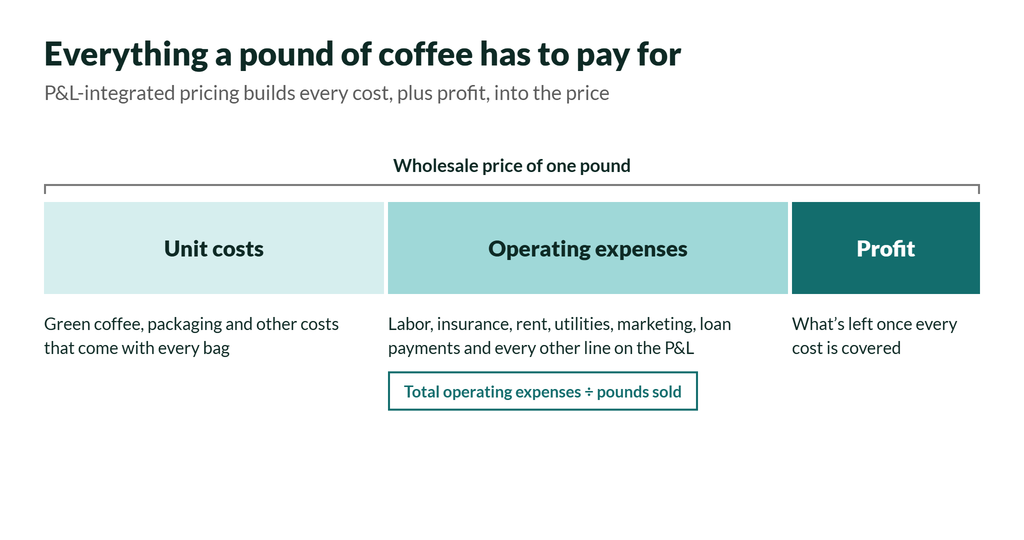
Every line on the P&L is accounted for, including marketing, samples, and the delivery van. “That’s a business operating expense,” Waite says. “So if we’re not including that, how is it going to get paid?”
This is the most complex way to price coffee of the three, but it is the most anchored to actual operating expenses. Several roasters in the survey explained pricing processes that align with this methodology.
Ron Kosko, director of operations at La Prima Espresso, uses a process that looks like this: green cost minus shrink, plus a per-pound overhead figure (La Prima recalculates this every quarter), plus packaging. From this base number he applies his markup.
Another roaster, located in Michigan, shared his pricing formula: landed cost multiplied by 1.15 to account for weight loss, multiplied by 1.5 to cover operating expenses, and finally multiplied again by 1.25 to achieve profit, which they say produces a 20% net profit margin.
None of the roasters in our survey mentioned debt or loan payments, but it’s important to note Waite advocates for debt service to be included in pricing calculations. If a roastery is making loan payments every month, he argues, those payments have to be built into the price of every pound.
The Markup and Margin Mix-Up
In the survey, we asked roasters if they have a target gross margin—gross margin, specifically—they aim for when pricing their wholesale coffee. Some gave net margin, some gave gross margin, and some were clearly describing markup while using “margin” terminology. The difference between markup and margin can be easy to miss in casual conversation, but it’s no small thing.
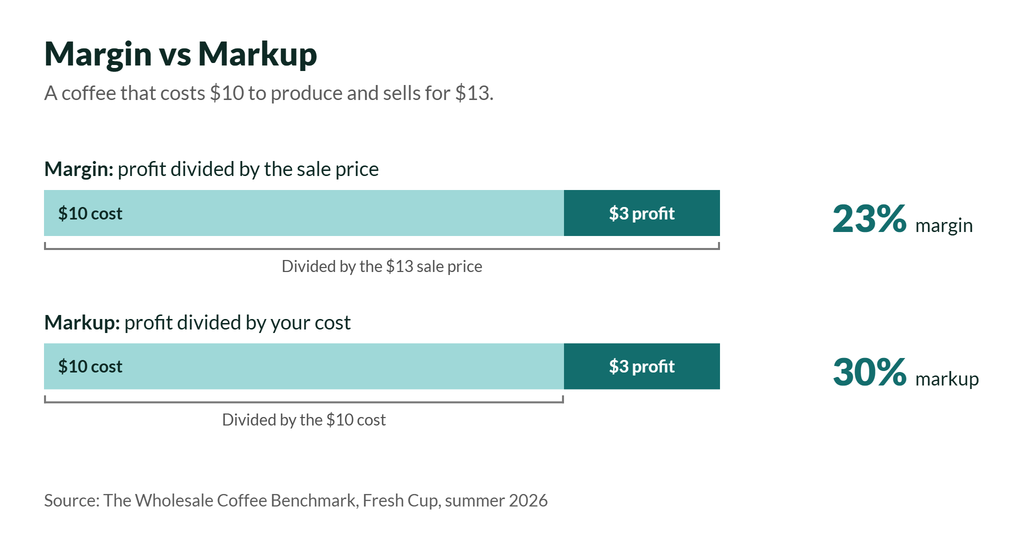
Margin is the difference between the sale price and your cost to produce the product. For example, if you sell a coffee for $13 that it takes you $10 to produce, the difference is $3, and that $3 represents your margin of 23% of the final sale price.
Markup is the amount you add on top of your costs to produce a product, typically expressed as a percentage of that cost. If the same coffee costs $10 to produce and you add $3 to set your sale price, that $3 is 30% of your cost, so your markup is 30%.
It’s $3 of gross profit either way, but a mix-up in the language can lead to incorrect estimates and poor planning. To earn a true 30% margin on $10 coffee, the sale price would need to be $14.29.
Waite prefers to use “markup” rather than “margin,” suggesting that when most roasters talk about margin, they really are talking about markup.
Whatever pricing method a roaster starts from, Waite says it all comes down to the same essential question: Does every pound of coffee cover its share of the business, and still leave a profit? Because, he says, in the end, “you’re not made of money, I don’t think.”
Photo courtesy of Madeline Liu on Unsplash.