There’s a roaster in the northwestern United States that roasts about 130,000 pounds a year and charges $13.50 per pound for its most-purchased wholesale coffee. That’s above the $12.85 median price in our survey. Still, when we asked in our 2026 survey how the company felt about its wholesale pricing, the roastery selected “We know we aren’t charging enough for what it costs us to produce.”
In 2027, the company plans to raise prices.
The concern of not charging enough shows up across the wholesale pricing survey Fresh Cup ran this summer. We collected 42 responses about wholesale pricing, margins, and plans for next year. In August, roasters used the survey to tell cafes what they wish their wholesale accounts knew. This time, we’re looking at the numbers.
The roasters in this analysis are all based in the United States, representing companies as large as 500,000 pounds roasted annually, all the way down to one-person-team startups. Most roasters indicated they preferred to remain anonymous.
It’s a small sample size in the grand scheme of things, but the pricing and comments reported offer a sense of direction for how roasters are feeling about pricing structures, and where they want to be heading.
What Roasters Charged for Wholesale Coffee in 2026
We asked roasters how they price their wholesale coffee per pound when sold in bulk (most commonly, a five pound bag). We only asked about standard offerings, and asked roasters to exclude any coffee they consider limited-release or special (and higher priced) in some other way.
First, we asked roasters about their ‘most-purchased’ wholesale coffee. In most cases, this is an espresso or some other daily-driver blend. The median among the roasters for most-purchased coffees was $12.85 per pound.


More than half of those roasters (24) charge between $12 and $14 per pound for their most-purchased coffee. Ten charge less than $12, and eight charge more than $14. Across those most-purchased coffees, prices ranged from $10 to $17.99 per pound.
A roaster’s full lineup, from its cheapest wholesale coffee to its most expensive, runs much wider than that. For the median roaster, the lineup runs from $12 to $15 per pound for standard offerings. A handful of roasters reported coffee lineups with much broader price ranges. For example, a Battlefield, Missouri roaster which roasts about 145,000 pounds a year prices its lineup from $11 to $24 per pound, while its most-purchased coffee sells for $12.95.
Is It Enough?
We asked roasters, “How do you feel about your current wholesale pricing strategy?” and gave them three answers to choose from. Of the 37 who answered, 16 (43%) chose “We are charging enough to sustain and grow the business.” Another 15 (41%) chose “We are making it work, but absorbing too many rising costs,” and 6 (16%) chose “We know we aren’t charging enough for what it costs us to produce.”
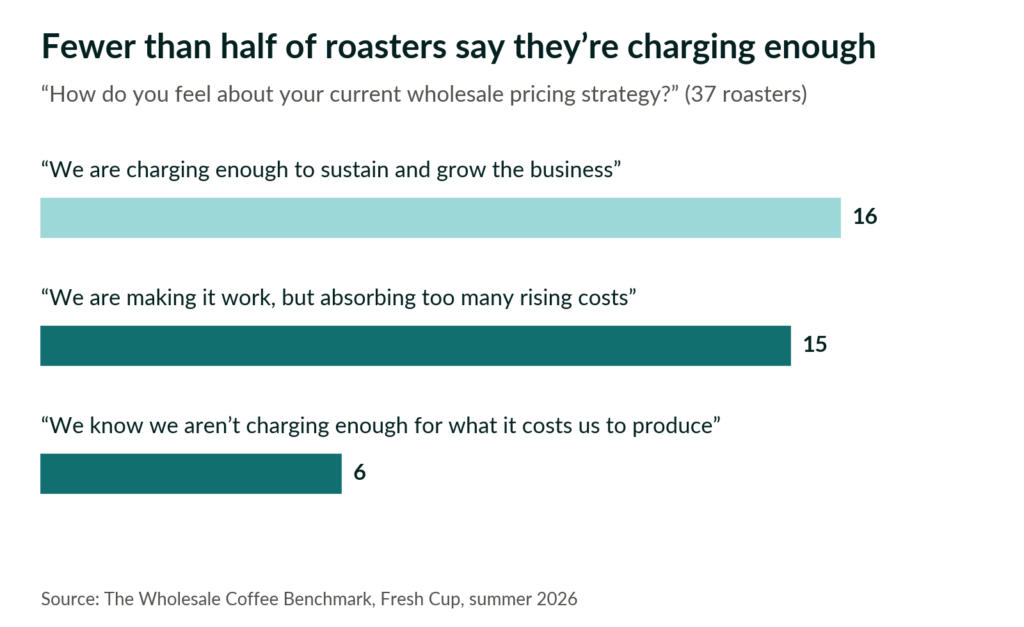
Roasters who chose the last answer tended to charge less. Among the five who gave detailed pricing information, the median most-purchased coffee sold for $11.75 per pound—notably lower than the $12.85 median for all roasters. Among roasters who chose “We are charging enough to sustain and grow the business,” the median was $12.83.
Some roasters charging more than the median still say “we know we aren’t charging enough for what it costs us to produce.” Evans Brothers in Sandpoint, Idaho determines its wholesale price from an all-in cost: unroasted green coffee, shipping, shrinkage (weight lost during roasting), roaster labor, power, and delivery. “We look for a minimum 40% margin on that cost,” says founder Rick Evans.
With the rollercoaster of green coffee prices and rising labor and supplies costs, the math is hard to get right, even for roasters who have done it for years. “Wholesale pricing is often one of the most difficult [things] roasters grapple with,” says Jared Trimbo, founder of Full Keel Coffee, which roasts about 35,000 pounds a year in Washburn, Wisconsin. Full Keel chose “We are making it work, but absorbing too many rising costs,” but the company says it plans to keep its wholesale prices the same in 2027.
Who’s Raising Prices in 2027?
We also asked, “In 2027, which will happen?” Nineteen (52%) of the 37 roasters chose “We will raise wholesale prices.” Seventeen (45%) chose “We will keep wholesale prices the same,” and only one (3%) chose “We will lower wholesale prices.”
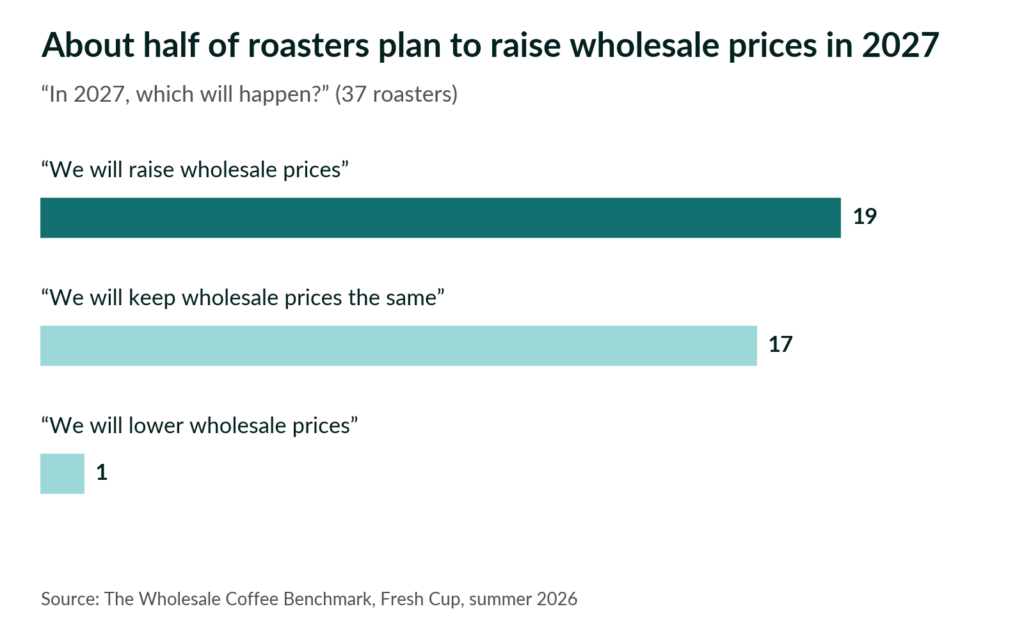
Some of those increases will be small and spread out. Chapter One: Coffee & Tea, which runs Lakeside Coffee Roasters in Rouses Point, New York, and roasts about 90,000 pounds a year, revisits its costs once a year. “The more a customer orders, we’re inclined to keep their pricing low and will only raise their costs marginally when we recost beans during our annual review,” says Chapter One’s founder, Chris Rosenquest.
Other roasters are raising prices from a position of strength. La Prima Espresso, a Pittsburgh roaster, chose “We are charging enough to sustain and grow the business,” and it still plans an increase. Ron Kosko, the director of operations at La Prima, advises other roasters to know exactly what each product costs. “Make certain every revenue stream or singular product has a clear understanding of every expense that is directly tied to the revenue stream,” he says. “No loss leaders.”
Still, not every roaster is moving prices up. One roaster chose “We will lower wholesale prices,” even though it also chose “We are making it work, but absorbing too many rising costs.” That was Alex Eliscu Kipling of Aquarela Coffee, a farm-direct roaster in Los Angeles, who pointed to trade policy and the harvest outlook as the reason they’ll be able to lower prices next year. “Prices will fall in 2027 because (for now) there are no tariffs,” Alex says. “It also is going to be a healthy harvest year, so we can probably manage farm purchases better as well.”
For cafes, the survey offers a practical signal. Two-thirds of the roasters who chose “We are making it work, but absorbing too many rising costs” plan to raise prices in 2027. If your roaster has spent the past year absorbing rising costs, an increase is more likely than not.
One roaster who raised prices after a rough year explained why it stopped looking for cheaper coffee. “During that time, we tasted a lot of coffees in the hopes that we could find savings somewhere without losing the quality we built our business on,” the roaster says. “We couldn’t. It was better to raise prices and be able to proudly stand behind and beside our coffee than chase a price that was barely lower.”
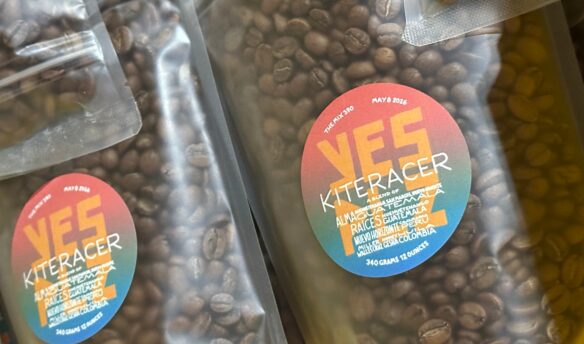
Photo courtesy of Battlecreek Coffee Roasters on Unsplash.