Specialty coffee is undeniably on the rise—and younger coffee drinkers are largely to thank for that fact. Last year, consumption hit a 14-year high, mainly driven by 25–39-year-olds. But there’s a caveat: Most of those consumers don’t want the same old black coffee anymore. Instead, the specialty coffee experiences they typically seek are defined by customization and novel flavors.
This reveals a key tension. On one hand, co-ferments and cold foam stand in stark contrast to the OG specialty ethos, which prioritized the inherent characteristics of the coffee bean. On the other hand, it’s natural that specialty coffee would evolve over time. No longer a disruptor, it’s now borderline mainstream.
But younger consumers’ coffee preferences don’t end at the cup. Gen Z is viewed as a values-driven generation, and its members—who range in age from their mid-teens to late 20s—pursue what they perceive as authentic experiences, including ones that increasingly take place offline. This presents an opportunity for coffee brands willing to engage customers on their own terms.
“The younger generations don’t want to be marketed to; they want to be part of something meaningful,” says Martin Mayorga, the founder and CEO at Mayorga Coffee. In his experience, younger generations see right through traditional marketing, corporate posturing, and antiquated systems, and crave authenticity. This attitude puts Mayorga’s brand, whose purpose is to eliminate systemic poverty in Latin America through responsible trade of organic products, ahead of the curve. “We have no investors and couldn’t care less about industry trends. We’re as real as it gets,” he adds.
Some specialty coffee companies might feel daunted by the challenge of staying current with changing consumer preferences. But as Mayorga’s example shows, there are opportunities for brands that can thread the needle between offering unique experiences and values-driven engagement. It’s about meeting customers where they are—but without compromising on what makes their brands specialty, and distinct, in the first place.
What Gen Zers Want From Their Coffee
While specialty was initially able to differentiate itself from commodity coffee thanks to its emphasis on quality, today, quality coffee is widely available. As Gen Z and Gen Alpha gain more purchasing power, appealing to the digital-native generations is more about a brand’s values and ability to capture attention than it is about vague notions of quality, according to supply chain advisor Kosta Kallivrousis.
The younger generations don’t want to be marketed to; they want to be part of something meaningful.
Martin Mayorga, Mayorga Coffee
“Minimalism, quality, and ethics are no longer differentiators,” he wrote on LinkedIn about an article he authored for the SCA website. Instead, branding is critical, he argues, and what makes a brand is what you share, not what you sell. He cites examples like Chamberlain Coffee, founded in 2019 by Gen Z content creator Emma Chamberlain, which was built on the internet personality’s down-to-earth vibe with content as the core distribution channel. The brand was widely seen as building a foundation of culture, community, and authenticity before commerce.
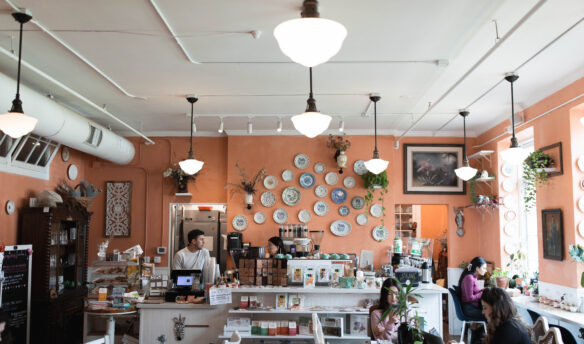
For many Gen Z consumers, the experience is just as important as the coffee. “The first thing I look for is a cafe with a warm, welcoming, stay-for-a-while aesthetic,” says Kylie Buccellato, a 25-year old student based in Boston, who says she visits cafes three times a week for coffee and pastries. “Somewhere with an already-crafted vibe, be that a remote-working cafe or a no-tech one. I also love a place that has events, like open mic, poetry, and trivia.”
Quinn O’Connor, an 18-year-old student in New York, echoes these sentiments. “The factors that attract me most to cafes are location and cuteness,” she says. “I mostly go to cafes as a social activity rather than a daily ritual, and my friends and I love a really charming environment to sip drinks in—especially if we want to take a picture together or just spend some time sitting there.”
In addition to being vibe-sensitive, Gen Zers are often willing to “doomspend” on pick-me-up purchases instead of saving. Facing a tight job market, war, and climate change, many are prioritizing mini indulgences, à la the lipstick effect (a phenomenon whereby consumers treat themselves to less-costly luxury goods during times of economic crisis).
“I think I have a pretty frugal mindset, so if I’m paying $5+ for a coffee or tea, I would like it to come with a really nice experience at the cafe,” O’Connor adds. Many Gen Zers also look for that feeling of experience to carry over to the beverages they order, and are known for their taste for boldly flavored and highly decorated drinks, which can be freely customized to their tastes.
This is clearly a departure from specialty coffees’ founding ethos. But Gen Z consumers’ sensitivity to both in-person experiences and flavor reveals an innate discernment—one that aligns with specialty’s traditional emphasis on quality, and which coffee brands can harness.
For Younger Consumers, Coffee Needs To Walk the Walk
Gen Z is drinking coffee differently than previous generations—But younger consumers’ considerations don’t end at the cup and the cafe. Gen Zers are also highly motivated by social causes: They want authentic social betterment, and are willing to walk away when they do not find it.
The Danish coffee brand Coffee Collective is one example of a specialty company that’s foregrounded its social responsibility. On its Instagram page, the brand shares info t on new coffees, quaint shots of its shops and homemade pastries, and updates on in-shop Aeropress competitions. It also posts about its annual transparency report, including data on exactly how much the brand pays farmers.
This approach is in line with co-founder Klaus Thomsen’s hopes to shift the needle within the coffee industry. “The smallholders producing some of the very best coffees either as single farms or in cooperative are still not benefiting what they ought to,” he says. “Roasters should work harder to ensure the money actually makes it to the farmers and pickers.”
Brands who walk the walk on transparency, and can communicate that without being “cringe” (such as taking themselves too seriously or trying too hard), may appeal to Gen Z’s values. In other words, brands who say they build strong relationships, both with business partners at origin and employees, better be able to back it up.
“Customers want to know the story behind the product, that it was produced responsibly and by people they trust. They also want a holistic service experience that elevates [the overall] experience, be it in a coffee shop or at home,” says Thomsen.
The factors that attract me most to cafes are location and cuteness. I mostly go to cafes as a social activity rather than a daily ritual, and my friends and I love a really charming environment to sip drinks in—especially if we want to take a picture together or just spend some time sitting there.
Quinn O’Connor
Doing things for the right reasons has also been the motivating factor behind Mayorga Coffee. “In my opinion, the coffee industry treats coffee-producing communities and people as invisible, underpaid labor,” Mayorga says. “I was raised in coffee countries and saw the impact of abusive practices. It impacts families and communities.”
He says his business has thrived for 28 years because of its ethical approach that runs contrary to these prevailing trends. “We operate on lower margins so we can pay farmers more and still give U.S. consumers incredible value,” Mayorga says. “We don’t answer to external investors or shareholders; we answer to our farmers and our communities.”
It’s this authenticity that has helped Mayorga Coffee build an “intensely loyal community,” he says, including Gen Z consumers, who “reward brands that have a backbone and invite participation in a movement.” This includes his own employees; Mayorga’s marketing team is predominantly Gen Z.
Specialty’s New Phase
In today’s specialty industry, quality has evolved from a far-off ideal to the baseline. It’s also diversified. Quality no longer just means “good coffee.” but also exceptional service, unique presentation, and the extent to which brands practice what they preach.
In this way, this founding principle of specialty coffee is still alive and well—it’s just broadened, guided in part by younger consumers’ priorities and tastes. That’s good news for specialty coffee brands, who can stay true to their ethos even while adapting drinks, service styles, and spaces to keep pace with Gen Z.
“To me, specialty coffee is the mentality that you want to keep making the coffee better,” says Jonas Gehl, co-founder and CEO of Denmark’s Prolog Coffee. “Whether that’s the quality of green coffee, roast, equipment, or hospitality. It’s also about the culture of your business [which is] something you can feel when you walk into a coffee shop.”
He likens this mindset to an apple orchard. “You can plant a good apple tree in depleted soil, and it’s not the same as an apple tree that’s living in a healthier environment. You may not see it on the surface level, but you can feel it.”
From NYC and based in Odense, Denmark, Chloé is a celiac foodie and sustainability writer most likely to be found with a cortado in hand, dreaming about a world where circular thinking is the default and food waste is nonexistent.
Join 12,500+ coffee leaders and get top stories, deals, and other industry goodies in your inbox each week.
Little Joy Coffee had a surprise hit when it created the raspberry Danish latte. But instead of keeping the recipe, they encouraged independent shops to recreate it.
How Michael Vaclav built an established, six-location coffee brand to be more timeless than trendy, relationship-forward by design, and approachable to all.
Instagram helped many coffee businesses build their brands. But now, as algorithms change and posting requirements grow, many shop owners are rethinking whether it’s worth the investment.
Valentine’s Day may not be a classic occasion for coffee shops—but as these four operators show, cafes can still harness the holiday with limited-time drinks, bundles, and other lucrative extras.