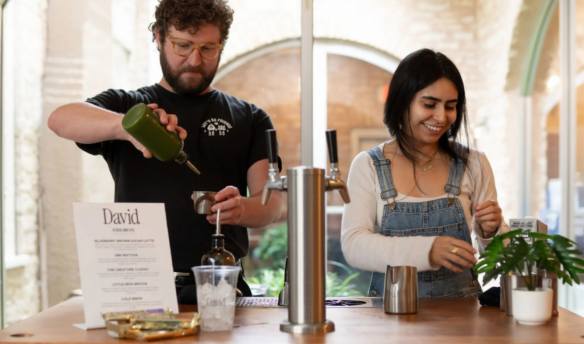
Once a week, I visit The Folk in Odense, Denmark. It is both a specialty coffee shop and a popular brunch destination that draws international crowds. On weekends, young laptop workers, fueled by iced matchas, are joined by multi-generational families who come to eat together. The coffee menu reflects this range: Co-owners Milena and Dmitry are conscious of their varied audience, and so they offer medium-roast house espresso alongside fruit-forward pour-overs.
During a recent visit, I ordered a pour-over that sounded out-there: a Costa Rica from the Amsterdam-based Dak Coffee Roasters, with notes of cherry, purple grape, and licorice. Once, a coffee like this would have only been served at niche shops that catered to committed coffee geeks. But now, it was just one more option on a wide-ranging drinks menu.
It prompted me to ask Milena: Had specialty coffee gone fully mainstream? “Hell yeah,” she answered without hesitation.
I’ve been hearing this across the industry a lot lately. It started when I attended a panel discussion, “Specialty coffee has gone mainstream – is that a problem?”, at the 2026 Danish Coffee Festival, hosted by the Specialty Coffee Association (SCA) of Denmark.
Although I live in Denmark now, I grew up in New York. My father, a baby boomer who cut his teeth on pre-ground Folgers and Maxwell House, marvels at the cost of a specialty batch brew. But he is still intrigued by the specialty coffee joint right next to his office, showing that the allure of the latte is reaching even those who yearn for the $1 coffee cup of yore.
Research from the National Coffee Association backs up the panel’s thesis. While the popularity of traditional coffee remains high in 2026, with 62% of American adults consuming it within the past week, that consumption rate hasn’t changed since 2022. Specialty consumption, however, is rising steadily: 58% of American adults reported having specialty coffee in the past week, compared to 53% in 2022.
Meanwhile, in response to these changing consumer preferences, large corporations and private equity firms are entering the industry in greater numbers, co-opting the look and feel of specialty while offering it at a lower price point.

There is a clear tension here: What happens when specialty coffee—which arose as a reaction to lower-quality commodity coffee—becomes the mainstream? Does it lose something essential when big brands and multinational companies come on board?
At least among the Danish Coffee Festival panelists (including prominent coffee business founders Klaus Thomsen, Jonas Gehl, Bram de Hoog, and moderator Omar Maagaard Hossain), there’s still optimism about specialty’s future. Collectively, they believe that the sector’s growth will continue to raise the tide for all boats.
But this moment remains an uncertain, transitional time for specialty—and for the coffee industry as a whole.
How We Got Here: Defining Specialty
Specialty coffee goes by different monikers around the globe. In Czechia, it’s called “výběrová káva” or “selected coffee.” In Denmark, it’s been dubbed “barista kaffe.” These terms have developed in reaction to commodity coffee, which many still consider the benchmark.
Adding to the confusion is the fact that there are different opinions about what exactly constitutes specialty coffee. Within the industry, the term refers to a coffee experience that is recognized for its distinct attributes; traditionally, that has meant a coffee that scores 80+ on the Specialty Coffee Association (SCA)’s 2004 scale. But when it comes to customers’ understanding of specialty coffee, perception rules supreme.
“There’s both the ‘specialty grade’ of green coffee, which is a standard, and the consumer side, where many would consider a coffee shop that does latte art ‘specialty.’ I think both have become more mainstream, or more accessible to people in general,” says Klaus Thomsen, co-founder of Danish coffee brand Coffee Collective.
Thomsen has been involved with specialty coffee since the mid-2000s. Looking at the current moment, he says, specialty is now mainstream enough that pour-overs are easy to find, and there’s a coffee nerd in nearly every friend group. In my friend group, I’m that nerd—always looking for openings to talk about flavor notes and farmer compensation. I’ve heard many acquaintances describe their varied understandings of specialty, including hazy ideas about quality: what the coffee should taste like, how it’s presented, where it comes from, and the look and feel of the brand that sells it.
A clearer definition of “specialty” is in order, says Thomsen. More roasters are taking pains to emphasize specialty’s unique focus on sourcing and equity, for instance. Coffee Collective publishes a transparency report detailing what it pays farmers, and even includes this information on its bags of coffee.
Other businesses, from mom-and-pop stores to multinational companies, are borrowing the aesthetics and messaging of specialty coffee, if not its actual tenets. Take brands like Blue Bottle, which started as a single coffee cart in 2002 but which was later acquired by Nestlé and by the Chinese brand Luckin Coffee as of this year. As Blue Bottle has scaled the specialty concept for a wider consumer base, it’s also invited questions about whether this has tarnished its original ethos.
Meanwhile, one of the signs that specialty has gone mainstream is its ubiquity in unexpected places, like gas stations, according to Bram de Hoog, general manager of the Germany-based brand Paso Paso. “A place that is not traditionally known for quality has incorporated specialty coffee in their offering, [including the] use of high-end espresso machines and more premium beverages like [the] flat white,” he says.
Just look to the global convenience store chain 7-Eleven, which now offers a variety of single-origin coffees. Even McDonald’s has gotten in on the action, from its marketing materials that make fun of the flat white to advertisements that offer “barista coffee for a reasonable price” in the Nordics.
Aesthetics Without Engagement
There’s something questionable about larger brands emulating specialty coffee to gain market share, including with the growing at-home market. Even while many have adopted the rhetoric and imagery of specialty coffee via phrases like “100% arabica” and “single-origin,” featured alongside photos of smiling farmers, they lag behind on many of the industry’s original commitments to social and environmental progress.
Komma Kaffe founder and CEO Omar Maagaard Hossain sees a move towards the “specialty mindset” in at-home consumers, who are buying espresso machines in high numbers. At the same time, he laments their tendency to purchase coffee from big-name brands, which are supported by popular entertainers. “I’m a huge fan of [George] Clooney, but I don’t think [his Nespresso ad] counts as specialty,” he says.
In the last 20 years, watchdogs have documented human rights abuses by many multinational coffee companies. Among them, Nestlé (parent company of Nespresso) has been called out for “coffeewashing” due to numerous scandals, including slave labor and wage theft. Meanwhile, most coffee farmers are prevented from setting their own prices due to the global commodity market (also called the C market), and many cannot afford to stay in coffee if they want to support their families.
“Aspects such as bean quality, traceability, and transparency are not mainstream to the same degree,” says De Hoog. “This results in an expansion of the aesthetics of specialty coffee, but not the full product offering, especially in quality and sustainability.”
He especially sees “larger coffee businesses [buying] specialty-grade coffee at lower prices and without [building] relationships,” which is what actually makes coffee production economically viable for farmers. Additionally, “There is very little true accountability. If you want, you can label commodity-grade beans as specialty without many people noticing, apart from bean quality.”
Think of a specialty-curious but traditional coffee drinker in your life. For me, it’s a millennial friend who can move between Trader Joe’s Wake Up Blend and an Ethiopian single origin with ease. He wants to support farmers, but can’t pay $30 for 12 ounces of coffee, and looks doubtful when I point out the clarity of a blueberry note.
In theory, if specialty coffee businesses with demonstrated commitments to transparency can win over more of these consumers, that could lead to a broader positive impact. To this end, I’ve seen roasters from Queens to Odense begin offering a wider range of roasts and price points. Meanwhile, the SCA’s transition away from the 100-point scale for evaluating specialty coffee—it launched the Coffee Value Assessment in 2023, which has room for a wider range of cultural assessments—shows the industry is becoming more accepting of a broader understanding of “specialty.”
Indeed, growth in specialty may hinge on the acceptance that not everyone can appreciate a gesha. For example, Hossain tells me that his father-in-law has served as the guinea pig for Komma Kaffe’s portfolio, which now offers a wider range of roasts for different tastes.
“It’s okay to like a dark-roasted traditional coffee because that’s a comfort zone for you,” says Jonas Gehl, co-founder and CEO of Denmark’s Prolog Coffee.
Thomsen agrees that there’s room to bring more consumers into the specialty fold if they’re invited in on their own terms. “[I fundamentally believe] that customers are much smarter than a lot of roasters and coffee shops give them credit for,” he says. His experience has shown him that “everyone can taste the difference between a delicate light roast and a bitter, dark roast. When we put up tastings of two different Kenyans they would also be able to taste the difference and even put similar words to the coffees as we would.”
Even consumers of dark roasts or commodity coffee are open to choosing fairer coffees when they feel there is also room for their taste preferences. Thomsen is even making headway with a neighbor or two, who are newer to specialty coffee consumption.
‘It’s Not All or Nothing’
Today, specialty businesses face many challenges, not least of which is corporations co-opting the specialty aesthetic while diluting the sector’s values. But Thomsen, Gehl, De Hoog, and Hossain still see reason for hope, even as specialty coffee enters a new, mainstream era.
Doubling down on the value of fair sourcing and transparency in the supply chain is one way that specialty can continue to distinguish itself from corporate lookalikes, they suggest. Though still uncommon, the farmer co-ownership model used by brands like Pachamama Coffee and Paso Paso can create a more equitable value chain from producer to consumer. “In our business […] the money will always flow back to the farmer,” says Paso Paso’s De Hoog. “For farmers, [our model] assures a long-term commitment and shared decision-making. For coffee shops and retailers, it assures long-term commitment as well as supply.”
While some believe specialty means “small” while mainstream is about saturation, a middle path is now needed. Making lasting relationships with farmers and showcasing the value of this coffee at the point of sale is the key to keeping specialty sustainable at a larger scale. Thomsen sees a way for this middle option to raise the bar for everyone.
“If we intentionally stayed ultra-small, just for the sake of remaining ‘special,’ we wouldn’t fulfill our purpose of bringing more value to farmers,” he says. It would also make it harder for Coffee Collective to “[create] more exciting coffee experiences for more people.”
Progress is slow, and it often requires embracing contradictions. “In one room of my house, I have a piece of furniture that’s carpenter-made and another that’s from IKEA,” Thomsen said on the panel that inspired this article. “It’s not all or nothing.”