In 2017, Nestlé acquired a majority stake in the California-based chain Blue Bottle Coffee. The world’s largest food and beverage company spent a reported $425 million to purchase 68% of one of the foremost specialty coffee brands in the United States.
Nestlé proceeded to grow the company significantly. Blue Bottle opened dozens of new stores across the United States and abroad, expanding from around 40 locations in 2017 to more than 100 today. But growth also brought about labor unrest. In 2024, workers at five Blue Bottle locations in Boston unionized. A year later, employees at four stores in the Bay Area followed suit.
Blue Bottle Independent Union (BBIU) has been negotiating with the chain to agree on a first contract. But over the Thanksgiving holiday, in response to what it says were retaliatory firings and a lack of progress in bargaining, the union went on strike. Then, on Dec. 1, the day the strike ended, news broke that Nestlé was considering selling Blue Bottle.
The timing of the news might not have been a coincidence, according to the union. “I think our efforts at expanding could be one thing that spooked them,” says BBIU president Alex Pyne of the potential sale. “It’s something that they could be doing to try and prevent us from reaching a contract.”
Now, eight years since Blue Bottle was brought under Nestlé’s umbrella, the future is once again uncertain for the specialty coffee chain—and its union.
From Potting Shed to Silicon Valley
Blue Bottle Coffee was founded in 2002 by James Freeman, who began roasting in a potting shed in Oakland and selling his coffee at local farmers markets. The company grew throughout the Bay Area, becoming popular with the Silicon Valley set and taking on venture capital investment in 2008 and 2012, and again in 2014.
By 2017, when Nestlé took a majority stake, Blue Bottle was one of the most famous of the third-wave trailblazers, alongside brands like Stumptown, Intelligentsia, Counter Culture, and Verve. Freeman was profiled by the Wall Street Journal, the New York Times, and Fortune Magazine, among others.
The company had already started expanding beyond the Bay Area prior to Nestlé’s purchase: It opened a cafe in Williamsburg, New York in 2010; it acquired the Los Angeles-based Handsome Coffee Roasters and the Tonx subscription service in 2014; and it launched its first Tokyo location in 2015.
Nestlé bought Blue Bottle at a time when specialty coffee was booming, and when consolidation was increasing. Consumers, especially Millennials, were increasingly interested in quality coffee, and big brands were taking note. In 2015, Chobani founder Hamdi Ulukaya bought a majority stake in the Philadelphia-based roaster and retailer La Colombe. That same year, investment firm JAB Holdings, through its subsidiary Peet’s Coffee, bought two other seminal third-wave brands: Intelligentsia Coffee and Stumptown Coffee Roasters.
As Daniela Galarza wrote for Eater at the time, purchasing Blue Bottle allowed Nestlé to gain a foothold in the still-growing U.S. specialty market. Nestlé was “investing in a team, and expertise that we don’t really have,” marketing director Patrice Bula told the Financial Times.
In the eight years since the acquisition, Blue Bottle has expanded its retail presence even further. It now operates stores in cities like Chicago and Washington, D.C., and has extended its international footprint with additional stores in Japan, plus new outlets in South Korea, China, and Singapore.
While it had started selling canned cold brew before the acquisition, Blue Bottle has since branched out into instant coffee, and Nestlé has worked to integrate the company into its wider coffee business. Beginning in 2023, Nespresso and Blue Bottle launched a series of capsule collaborations, and both brands have separately collaborated with Abel Tesfaye, aka The Weeknd, for a product line called Samra Origins.
Unionization, Negotiation, and Retaliation
Blue Bottle’s growth has not been without issues, most notably on the labor front. In 2020, the company paid $1.5 million to former employees as part of a class action settlement over alleged wage theft. The lawsuit claimed that Blue Bottle failed to pay overtime or provide required breaks to its employees, which the company denied.
In April 2024, workers at five stores in the Boston area filed to unionize, requesting voluntary recognition of the new Blue Bottle Independent Union. “We are unionizing because Blue Bottle does not pay us enough to meet our basic needs, does not allow us any input into cafe operations, and shows continuous disdain for us as workers,” BBIU wrote in a statement at the time.
After the company declined to voluntarily recognize the union, workers held an election with the National Labor Relations Board—and won, with a vote of 38 to 4. Blue Bottle hired Ogletree Deakins, which the organization LaborLab called one of the big four law firms known for union avoidance, to represent it in negotiations. BBIU alleges that multiple workers were fired without cause in the months after the election.
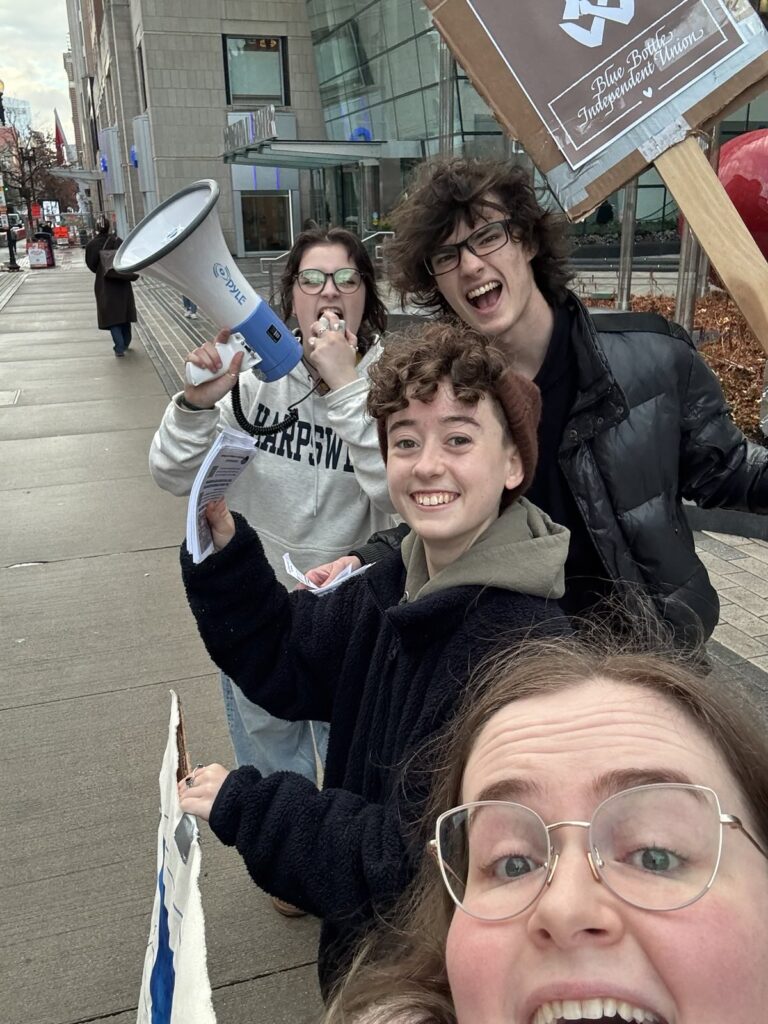
Blue Bottle’s union drive takes place within a wider labor movement in specialty coffee, one that has impacted some of its fellow third-wave-innovators-turned-corporate-acquirees. Workers at Chicago outposts of both La Colombe and Intelligentsia unionized in recent years; Intelligentsia organizers ratified a union contract in 2022.
In June 2025, workers at four stores in California’s East Bay filed to join BBIU, winning their own election two months later. Since then, BBIU has been in collective bargaining with Blue Bottle over a first contract, but negotiations haven’t gone smoothly. “They continue to basically give non-offers in order to waste our time,” Pyne says. “We want consistent scheduling practices, and they’re refusing to even talk about it with us.”
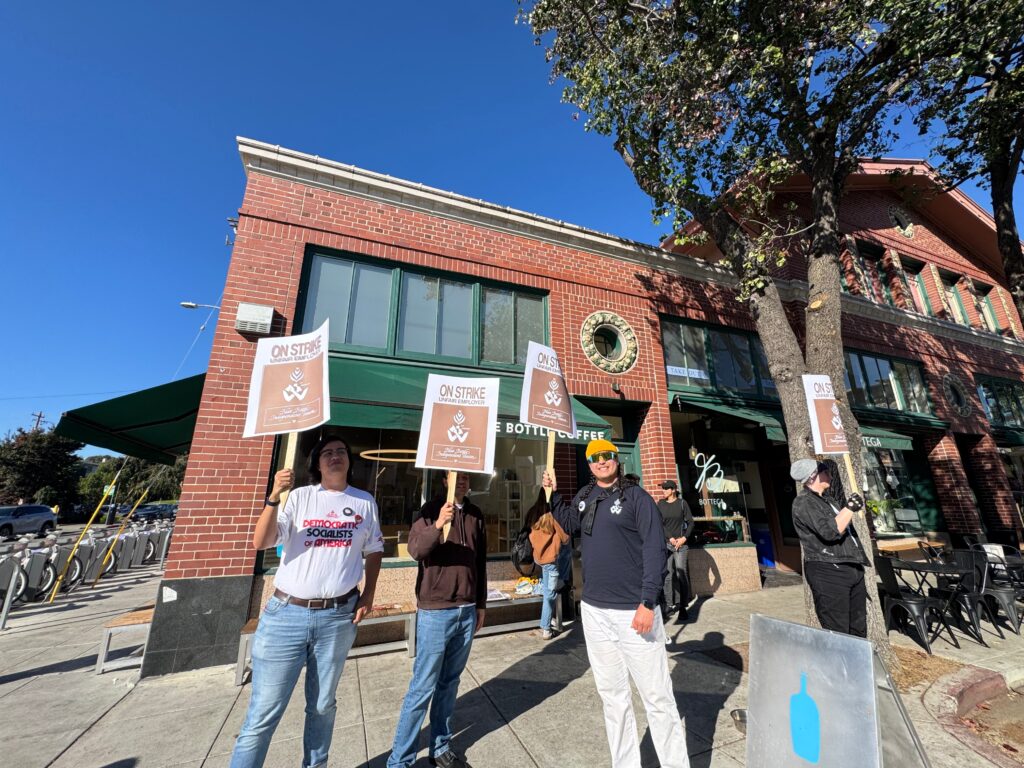
BBIU planned a strike coinciding with the Thanksgiving holiday weekend to protest the lack of progress made in contract negotiations. However, the week before the planned walkout, BBIU alleges that Blue Bottle fired the union’s secretary-treasurer and communications director, Abbey Sadow, over a dress code violation. Then, the day before the strike, another union member was fired.
“It was such clear retaliation,” Sadow says of her firing. The dress code issue—Sadow had shown up to work wearing green pants—happened weeks beforehand, she said. “I think that the company was really trying to push our buttons and see if we were actually planning on striking, and I think that they were also trying to scare employees into not going out on strike.”
In response to questions from Fresh Cup, a Blue Bottle spokesperson said: “We value the contributions of all Blue Bottle Coffee employees and respect their right to be represented by a union. We have continued to meet and bargain with the union in good faith and remain committed to reaching a mutually beneficial agreement.”
The strike action took place over the weekend that Pyne says is one of Blue Bottle’s busiest of the year, and managed to close seven stores between the two coasts. Two locations stayed open, staffed by managers, but the strike was still “a major success,” Pyne says. “Seven stores out of like 78 in the nation is still close to 10% of their labor market, and we reduced the capacity for the ones that were open, so I would consider that a success. They had a terrible holiday.”
Pyne says BBIU has filed unfair labor practice charges over the firings, and Sadow hopes to be reinstated. In the meantime, they have further bargaining sessions planned in January.
A Rumored Sale and the Union’s Future
On Dec. 1, the day the strike ended, Abigail Summerville reported for Reuters that Nestlé was working with the investment bank Morgan Stanley to review its options regarding Blue Bottle. One possible route was to sell the brand.
The move is part of a wider strategic review under Nestlé’s new CEO, Philipp Navratil, who is looking to streamline operations after taking over in September. The Swiss multinational announced 16,000 job cuts in October, while Summerville wrote that the CEO is looking to “exit the business of operating physical retail locations.”
Three sources familiar with the matter told Summerville that one possibility is that Nestlé divests from Blue Bottle’s cafes but retains the brand’s intellectual property in order to continue selling products such as the Nespresso-collab capsules. The sources also noted that the Swiss giant stood to make a loss on its 2017 investment. Nestlé and Morgan Stanley declined to comment on the Reuters piece. On Dec. 16, Bloomberg reported that one interested bidder is the Chinese startup Luckin Coffee and its backer, the private equity firm Centurium Capital.
What does Blue Bottle’s potential sale mean for the union campaign? “In theory, it can make a huge difference if a company changes ownership during a contentious union campaign,” says Professor John Logan, director of labor and employment studies at San Francisco State University. However, he points out that union opposition is still the norm for most businesses in the U.S.
Logan says that BBIU building momentum and organizing additional locations in new cities will be the key to its continued success in the face of a potential sale. “Probably more important to the union campaign will be its ability to spread to more Blue Bottle stores, which won’t be easy,” Logan says. “But baristas across the country have repeatedly chosen to exercise their right to form a union, even in the face of aggressive, and often unlawful, employer opposition.”
Because the Reuters report is light on detail, BBIU organizers aren’t getting their hopes up. And even if a sale happens, Pyne says, “I can’t imagine a situation where we have a new owner and things get better.”
For Sadow, the next meeting with Blue Bottle will be key. “I’m excited to see how they respond in the next session,” she says. “I think that the company is truly afraid of the power that we hold.”
Photos courtesy of BBIU