This article is sponsored by our partner, ColdPerk.
Demand for cold coffee shows no signs of slowing. Cafes are selling more cold drinks than hot coffee, the RTD aisle keeps growing with more canned and bottled options, and many offices use cold brew on tap as a way to entice workers. Over the years, Fresh Cup has tracked the explosion of cold coffee, and we’ve noticed that people are interested in coffee concentrates and making cold brew for themselves. Regardless of where they’re drinking, consumers are seeking out more cold coffee options than ever before.
Most roasters haven’t been able to meet that demand at scale. Producing cold coffee at volume has largely been the territory of large contract manufacturers with the infrastructure to brew hundreds of gallons at a time. For independent roasters, the options have been limited to small-batch systems and that take hours—often between 16 and 24—to brew.
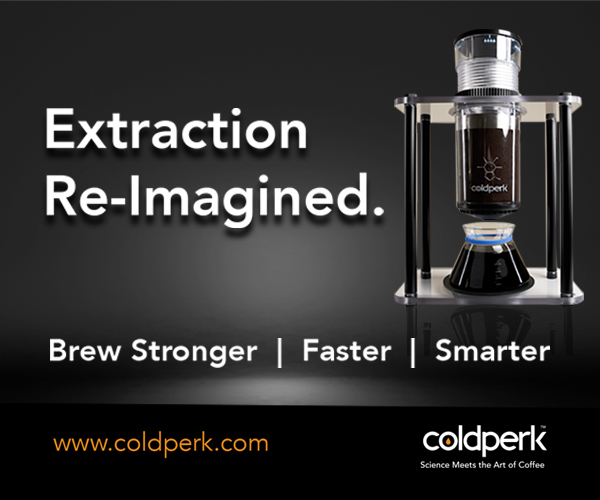
The ColdPerk Commissary 70 is designed to change that. The brewer continuously flows water through the bed of coffee grounds using gravity alone—the same extraction process behind ColdPerk’s smaller Café 2 brewer—the system can brew 70 pounds of coffee at a time, producing up to 28 gallons of espresso-strength concentrate in roughly two hours. It does so without pumps or heat.
We spoke with John Green, CEO of ColdPerk, about who the Commissary 70 is built for, how the cost per cup breaks down, and the new opportunities roasters can access now that producing cold coffee at scale is more accessible.
How does the Commissary 70 compare to other systems for brewing cold coffee at scale?
The Commissary 70 can produce up to 28 gallons of espresso-strength concentrate in about two hours. For context, most large cold brew systems require 12–24 hours before filtration and cleanup can even begin.
The real advantage isn’t just speed; it’s flexibility. Instead of tying up tanks overnight, you can brew, package, clean up, and be ready for another batch the same day (up to 7 times in an 8 hour shift depending on your recipe).
If demand changes, you’re not waiting until tomorrow to make more coffee.
What is the programmable Flow Control System and how does it work?
The Flow Control System allows operators to program the water volume and rate of flow. In other words, you can automatically manage water delivery throughout the extraction process. The water is then poured into our patent pending DWIP Manifold, which distributes water evenly into the coffee grounds. By monitoring flow conditions and dosing water to the DWIP manifold as needed, the system helps deliver consistent water distribution and repeatable results from batch to batch.
How big of a roasting company do you need to be before the Commissary 70 is a good fit for you?
I don’t think it’s really tied to the size of the roasting company as much as it is the size of the cold coffee program.
Once overnight steeping, tank space, labor, or cleanup start becoming operational challenges, that’s usually when systems like the Commissary 70 become interesting.
We’ve talked with companies only brewing a few dozen gallons a week and others producing several hundred. The common theme is usually the same: they want more production capacity without adding more tanks, more steep time, or more labor.
For many operators, the Commissary 70 starts making sense when cold coffee transitions from an occasional offering to a meaningful source or revenue.
Cleaning a brewer that’s just made 28 gallons of coffee sounds like a chore. How does the Commissary 70 simplify that process?
Honestly, cleanup was one of the first things we thought about when we started developing the system. Brewing coffee is easy. Cleaning up 70 pounds of wet coffee repeatedly gets old fast.
Our patent-pending tilt-frame design makes spent coffee removal much easier than traditional brewing tanks, and the reusable stainless steel filtration system eliminates the need for disposable paper filters. The system also incorporates a built-in spray-down hose that can be used to rinse the brew tank during unloading and cleanup, helping speed up the overall cleaning process.
For large roasters who only make smaller amounts of cold coffee, what does producing espresso-strength concentrate like this enable that wasn’t an option before?
If you’re producing espresso-strength concentrate, you’re not locked into a single finished product. The same concentrate can be diluted for ready-to-drink coffee, kegged for draft systems, blended into specialty beverages, or sold as concentrate.
For many roasters, it creates opportunities to explore wholesale, RTD, and foodservice programs without investing in multiple production systems.
How are companies other than coffee roasters using the Commissary 70?
We’re seeing interest from RTD producers, beverage manufacturers, co-packers, commissaries, and foodservice operations.
We recently helped solve an interesting challenge when a client needed 20,000 cold coffee drinks (cold brew and lattes) for a weekend convention. After testing their coffee, we helped develop a recipe for the Commissary 70 and ran a pilot where we made seven batches of cold coffee. Each batch completed in one hour, and it was enough coffee for all 20,000 drinks in the end. Do that with an espresso machine.
At the end of the day, they’re all trying to solve a similar problem: producing a consistent coffee concentrate efficiently and at scale.
The end product may be different depending on the business using the Commissary 70, but the production challenges are often very similar. A co-packer may be producing concentrate for canned beverages, while a commissary may be supplying multiple retail locations from a central facility.
The Commissary 70 allows those operators to produce a concentrated coffee ingredient that can be efficiently scaled across a variety of products, packaging formats, and distribution channels.

Sponsored by COLDPERK
ColdPerk is a gravity-flow cold brew system that produces espresso-strength concentrate in 10-15 minutes without electricity or plumbing.