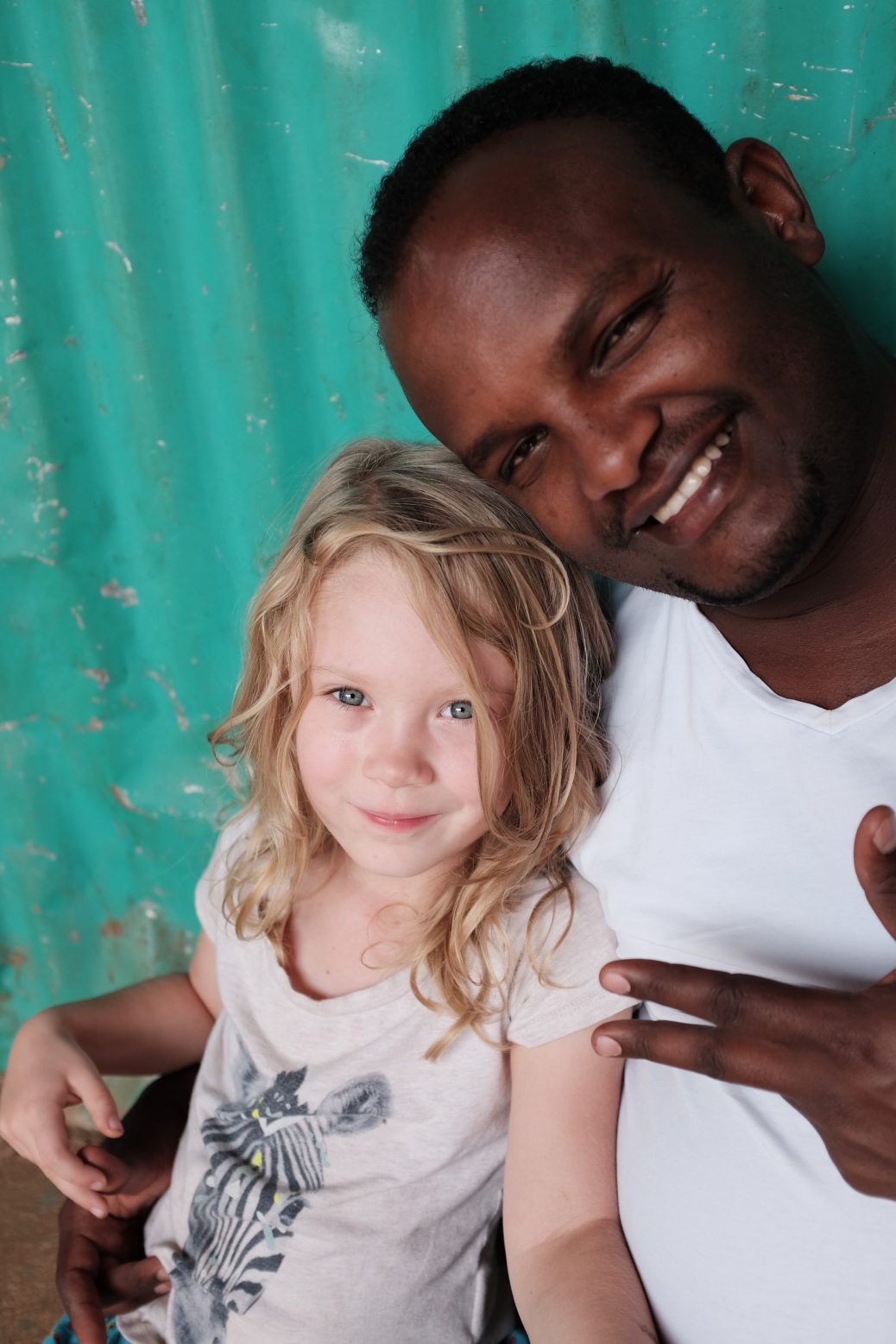
Since November 2016, Emily McIntyre has been living in Ethiopia with her husband and five-year-old daughter, Eire. As part of their work with Catalyst Coffee Consulting, the McIntyres have been traveling around the country to partner with producers, mills, and processing/export professionals. Their efforts are focused on education, deepening relationships, and moving toward truly progressive Ethiopian coffee. Read more of her reports here.
[O]ne of the questions I get a lot is, “What’s it like, living with a five-year-old in Ethiopia?” The answer varies by the day, from “Magical!” to “Really, really rough.”
This is our first family experience living outside the United States, though we’ve moved around a lot, and it’s been wonderful. Without exception, Ethiopian people love children. And Eire loves people, all kinds. So, from Girmay, our daily driver who brings treats, lends her his phone, and shyly gives her handmade necklaces, to the employees of our guest house who let her “mop,” transform into cats on command, and bring her the first steaming plate of food in the morning, she is embraced.
This in turn helps us older folks emerge from our stiffer selves. Her smile and her excitement—even her tantrums, really—are the key to unlock relationships everywhere.
(Photos: Emily McIntyre.)
We’ve spent ten-plus days at a time on incredibly rough roads in the coffee lands with her, hiked up mountains and ridden donkeys, and danced under the stars with our farmer partners in Gololcha (where she fell asleep on the lap of Bezawit, mom of five and wife to community leader Abebeyahu). We’ve weathered extreme traveler’s belly in Yirgacheffe (she still remembers the Dilla Delight Hotel as “that one where we all got super duper sick!”), spent days baking in the sun at coffee mills Reko Koba and Semalo Pride (“I’m a peaberry hunter!”), and chattered back at monkeys at the Aregash Lodge. She’s a better traveler than most adults, gotta be honest.

She goes with us to the export warehouse/coffee lab here in Addis Ababa, where she pulls a bottle around on a piece of string, teaches all the teenage boys sitting around with nothing to do the English alphabet, and consumes endless plates of kolo (roasted barley).
So many orange Fantas has she consumed, she’ll have a rude awakening when we return to our soda-less existence in Portland. Almost every weekday, we walk through the trash-filled alleyway and across the busy street (no crosswalks here—better run or the mototaxi might get you) to the juice store where we practice reading while we consume endless mango smoothies. In lieu of internet that works well enough for Netflix, she’s become a mad Uno player.
So my answer to the question is: “It’s real.” Living with a five-year-old anywhere is both excruciating and glorious, but absolutely, unequivocally, fun.