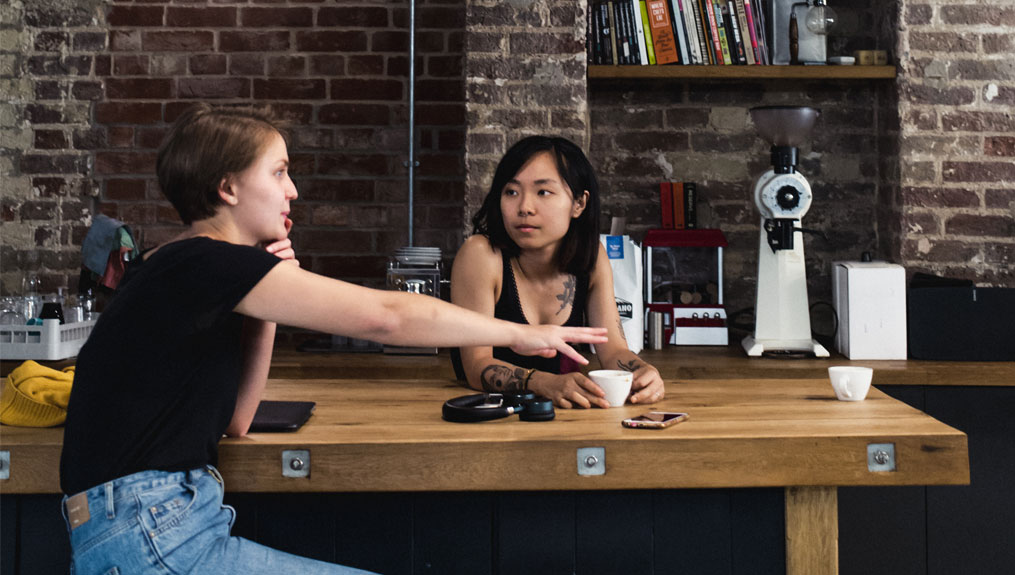
Lydia Smith (left), content marketing manager at Assembly Coffee/Volcano Coffee Works, chats with Sierra Burgess-Yeo (right). Photo courtesy of Sierra Burgess-Yeo.
[B]orn out of a need for change, frustration, and the lack of accessibility, the Kore Directive is London’s newest non-profit organization directed at helping women in coffee. Set to launch this November, the Kore Directive was founded by Sierra Burgess-Yeo, a barista and manager at the Department of Coffee and Social Affairs’ Facebook Headquarters location. The Directive will be operated by six other female members as well.
“I was really struggling for a while and thinking, there are so many other women out there in London who feel the same way, there must be something we can do,” says Yeo. “Then I thought, okay, I am tired of feeling angry and upset and I wanted to make sure these feelings had some positive impact, so that was how the Kore came about. It was really just a very selfish way for me to divert all this energy—all this negative energy—into something positive.”
After taking the idea to a few close friends in April this year, Yeo attended a gender equity talk in London hosted by a local roastery. At the event, she met with the head roaster of the coffee company, who ended up donating his roastery for Kore workshops and events.
“Once we landed these premises, I just started feeding the idea to more and more people, with many saying, ‘Yes we are happy to come on board, what can we do, how can we help,’ and that made me think there was something concrete in the initiative,” says Yeo.
The organization will be split into two aspects, one of which will be a social event where coffee professionals come together once a month and network regardless of their gender. Panel discussions or guest speakers will also be featured at these events to talk about a range of different topics concerning women in the industry.
Yeo says a couple of those events coming up next year include discussions about coffee and mental health, and competition season where female competitors will be invited to talk about how they prepare for competitions.

The other aspect is the practical workshops, where a small group of women will be taught various skills. The first session is set to be on how to production roast. Yeo explains that this aspect was inspired by the Specialty Coffee Association since a lot of their courses are “quite inaccessible and expensive—we wanted to provide an alternative.”
The qualification would provide women with the skills which they can then “put on their CV, go to a roastery and say, ‘Look, I don’t have certification but I bloody know how to roast, so trial me and you can see what I’m made of.’”
“I found that as a barista,” she continues, “I couldn’t and I am still struggling to make that jump off the bar. I want to do something more meaningful in terms of a coffee career. But I don’t have the skills, and I can’t get my foot in the door and I suspect that a lot of other women are feeling the same way.”
The Kore will start off as a seven-month project, running from January to July to first see how the public responds. During this period, Yeo also wants to see whether there are possibilities for expansion in terms of including a wider range of careers in the coffee industry or a wider range of classes and skills across the U.K.
“We want this to be hugely collaborative in the sense that it transcends business competition,” she says. Yeo explains that when she reached out to roasteries and companies, many were concerned about collaborating with competitors.
“But our stance has been quite neutral from the start, and we want this to be an industry effort,” she says. “So we will be hosting our events in different places across London just to show that we are objective and we are not biased and we want this to be affordable and accessible to everyone—regardless of where you work and what you do.”
Originally from Singapore, Sierra Burgess-Yeo has been working in the coffee industry in the U.K. for the last five years, after stumbling into it once graduating from university. But throughout those years, the feeling of discontent followed her.
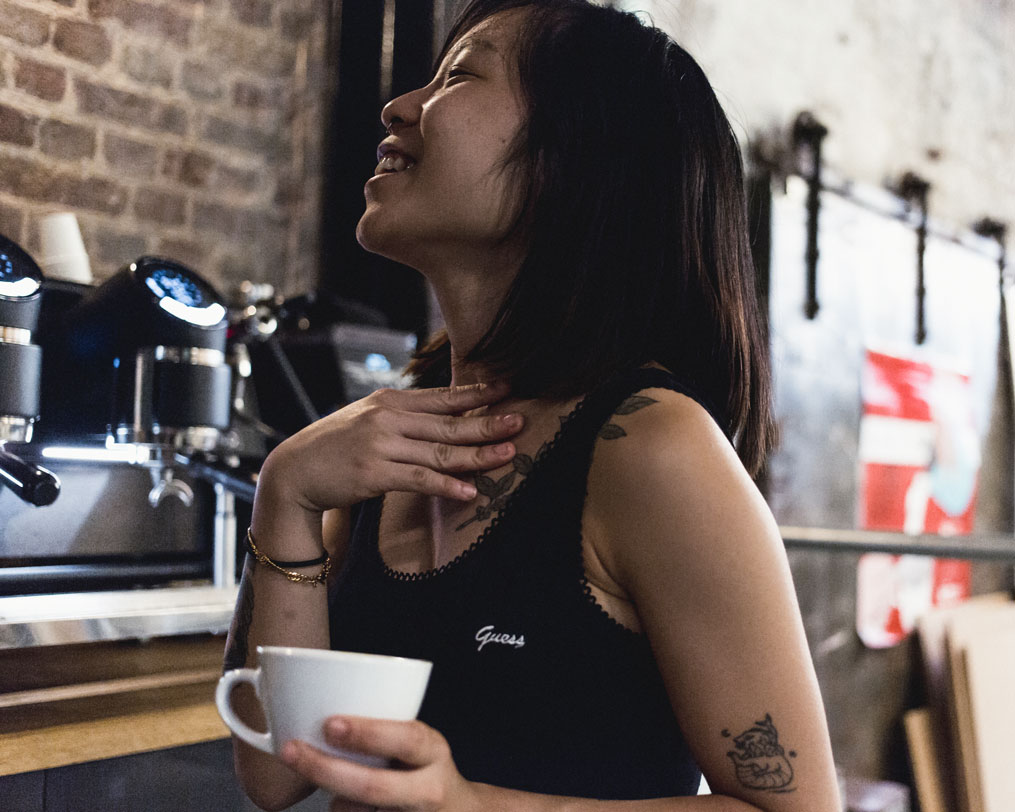
Talking about her professional past, Yeo says that when she was working front-of-house in a managerial role in Manchester and attending coffee events, she found information inaccessible.
“I also found it really hard to approach anyone about wanting to learn more,” she says. “I was in this WhatsApp group with all these baristas in Manchester, and men dominated a lot of the conversation in that chat….I wasn’t comfortable enough to go in and say, ‘Hey, I am really interested but oh my gosh I don’t understand what you’re talking about,’ and this was really frustrating for me. For someone who is used to asking questions, is outgoing and outspoken. So I started thinking about why I didn’t feel comfortable.”
This feeling was then lodged in her mind and she “wanted to find a way to rectify that.”
Yeo then spent a year in London working as a barista and says even then she couldn’t break through the glass ceiling: “I was jumping from place to place wanting to be promoted, wanting to learn more, but just finding that cafés in London couldn’t afford to train their staff.”
Yeo was also landing jobs in places where the majority of positions of power were given to men.
“The last place I worked at had a really bad gender balance problem,” she says. “I was the only female person of color working behind the bar out of two women, out of a stack of ten to twelve people. That left me really frustrated and resentful.”
Yeo goes on to say that in all the places where she has worked and felt equality to be an issue are places where people just don’t see that as a problem: “It is literally a non-issue and that’s the dangerous bit.”
This is why Yeo aims to ensure the Kore Directive is progressive in terms of the classes and who is teaching them.
“I have had people ask me—so is this like no men allowed? And you know, it’s such a silly question but it’s always worth clarifying our stance and our stance was definitely—no, of course, we are not an echo-chamber and we want men onboard.”
“If we excluded men,” she continues, “we would be doing the exact same thing as the industry has been doing to us for years. But we are also careful to say, that our roasting classes and the actual workshops, we wanted to keep that just female so there is no intimidation. There is a good mix and balance with the Kore approaches and we definitely still want to keep it open and accessible to everyone in some way.”
Yeo adds that although discussions about gender equality in coffee are starting to take place and people are having more informed conversations, the industry in the U.K. is very much in the early stages.
“It comes down to cultural difference and down to the fact that we just don’t talk about it as much,” she says. “It is quite systemic and quite insidious; there aren’t a lot of open conversations. As far as I know, this is the first of its kind [in the U.K.], which is really quite shocking.”
“We want the Kore to be stable, routed and organically grown,” she says. “We want this to be around over the long term and hopefully, this is something that we will be able to give back to the community.”
Learn more about, or register to attend, The Kore Directive Launch Party on November 15 HERE, and stay tuned for more coverage on FreshCup.com.