This story is sponsored by our partner, Franke Coffee Systems.
At the 2025 Caffè Culture Show in London this October, a popular social media creator named Frank couldn’t resist visiting the Franke booth. Frank, who chronicles his journey to find the best flat white through the account @flatwhitefrank, was initially drawn to the coffee and kitchen appliance manufacturer’s booth because of its name.
While he was there, Frank decided to order a flat white from the Franke superautomatic machine on display—and made a video of the results.
“When you see these coffee machines, you usually get the vibe they’re gonna be a bit burnt,” he says during the video, articulating a common perception of the quality of superautomatic machines. As he’s drinking, however, he notes that “I’m not getting any of that. It’s an absolutely beautiful coffee.”
Like Frank, many of us have preconceived notions about superautomatic espresso machines. We may not associate them with the quality we expect from specialty cafes, or feel reluctant to delegate the critical task of making coffee to a machine versus a skilled barista. Like Frank, we may also be surprised by how far such machines have come.
Choosing the right espresso machine can define your cafe’s success. It can be the difference between baristas working efficiently or struggling to keep up, customers getting consistent or uneven drinks, and your business growing or falling behind.
For a long time, superautomatic models were completely left out of the conversation when it came to choosing a cafe-quality machine. But now that we’re witnessing a huge leap forward in automation, it begs the question: What can superautomatic machines offer today that they couldn’t 20 years—or even a decade—ago?
Demystifying the Superautomatic Machine
Roselyne Rebe, a technical program manager at Franke, says that one of the biggest barriers to purchasing a superautomatic coffee machine is the idea that it could take over what you’re used to doing on your own. “Automation brings a bit of reservation,” she says.
She compares it to the shift from manual to automatic cars, which began in the 1940s. When automatic cars were first introduced, Rebe says, “people—I’m talking about my dad here—were not big fans. Now automatic cars are everywhere and they drive even better.”
There are similar reservations with automatic coffee machines. “The misconception is that it won’t produce a cup as good as I would, because I know how to manipulate the temperature, pressure, all that good stuff,” she says.
Arguably, the history of espresso machine innovation is one of slow and steady automation. At first, fully manual coffee machines had levers that baristas pulled to force water through the coffee. In the 1940s, semi-automatic machines came along, which had internal power pumps that pushed water through the coffee bed with the flip of a switch (and stopped water from flowing when the switch was turned off). The Faema E61 changed the game in 1961, offering more automatic features, like volumetric control with a pre-set amount of water for each espresso shot.
Superautomatic machines hit the market around 2000, and automated the whole process of brewing espresso inside the machine—from grinding and tamping the beans to pulling shots and adjusting parameters for extraction. Afterwards, most machines even ejected the puck into an internal waste bin.
Today, the question of automation in espresso machines is less a binary yes/no than a spectrum. Volumetric control is common, and most cafes have adopted additional automatic features for ease, consistency, or speed. “We’ve moved from lever espresso machines and into espresso machines with digital screens,” says Franke’s marketing manager, Gage Johnston.
Even now, baristas typically dial in at the beginning of their shift and adjust parameters throughout the day. With Franke’s superautomatic machines, however, this is no longer a daily task for baristas. Instead, calibrating the machines is a process that takes place between skilled technicians and cafe management before installation.
This functionality is especially useful for large businesses. “Baristas don’t adjust recipes day-to-day,” says Kim Vera, buyer at Caribou Coffee, a Minnesota-based coffee chain with more than 800 locations globally. “They do regular quality checks throughout the shift, but the machine is calibrated to stay consistent between shots.” In big operations like Caribou’s, espresso recipes are developed by company leaders and rolled out to stores for consistency. “If needed, our maintenance techs can tweak things like grind size, shot time, and temperature, but for the most part, the machine handles it.”
Caribou has been using Franke’s superautomatic machines since 2007. “This 20-year partnership between Franke Coffee Systems and Caribou Coffee is built on the shared vision of redefining the coffee experience through innovation,” says Wyatt Yeater, Account Director at Franke Coffee Systems. Prior to his position with Franke, Yeater was a Senior Operations Engineer at Caribou Coffee where he worked closely with the chain’s 1500 locations on implementing technology for operational efficiency and customer experience.
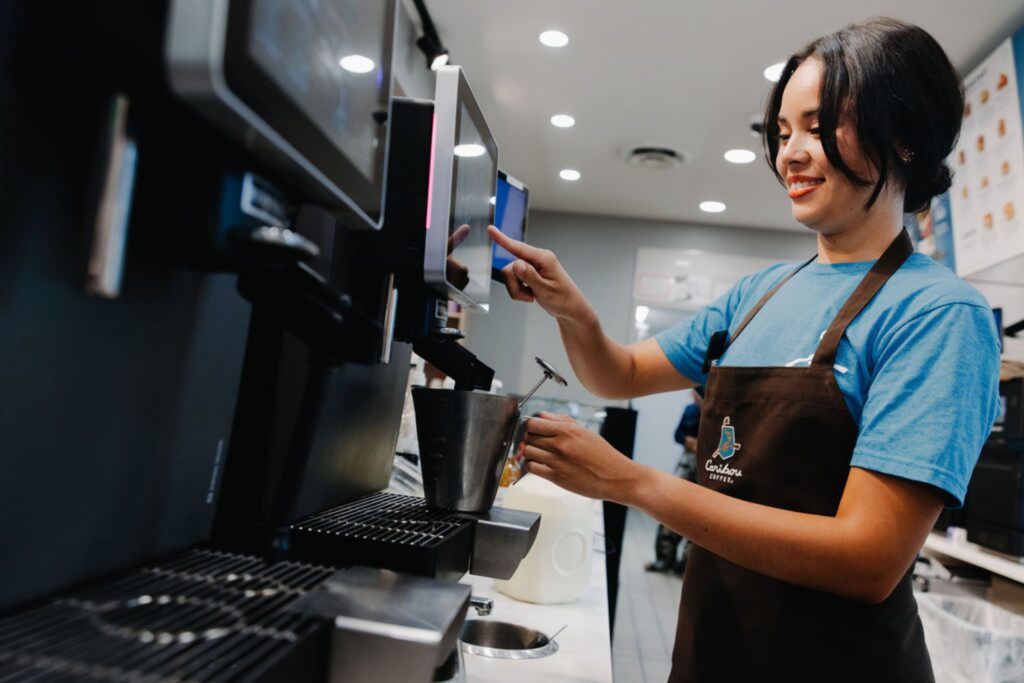
The chain recently transitioned from a customized Franke A800 Two Step to the S700 to better suit its needs. “The S700 isn’t custom-built like the A800, which makes installation and servicing easier,” says Vera. “It still delivers the key benefits we loved about the A800—like programmable recipes for consistent shots and easier training—but adds a larger steam boiler, which means faster recovery, better steam pressure, and quieter operation.”
Some things haven’t changed, however. In both machines, “the biggest value is consistency. Every shot pulls the same, which helps us deliver a high-quality espresso beverage to each guest, every time,” she says.
When it comes to programming the superautomatic interface, the basic parameters are similar to traditional machines, and include water, coffee, and grind size. Franke machines can also be upgraded with advanced features, for example, to fine-tune milk temperature or foam percentage to achieve a specific taste profile. After installation, baristas use the interface to select customers’ orders, which brew according to the pre-set.
What Customers Want, and What Businesses Can Provide
When staff is hard to come by and $7 vanilla lattes keep your lights on, says Johnston, going superautomatic can actually be a customer-centric decision—especially in larger operations. According to the National Restaurant Association’s 2025 State of the Industry report, 77% of restaurant operators are struggling to recruit and retain employees.
“Consistency is really hard with constant staff turnover, or training across 10 different units, or when recipes change frequently,” Johnston says.
Meanwhile, according to Allegra World Coffee Portal’s Project Café USA 2025 survey, consistency is precisely what the average U.S. coffee shop customer is looking for. The survey shows that 78% of respondents prioritize consistent beverage standards; they placed qualities like latte art much lower down the list.
Furthermore, 68% of respondents under 35 said the most important factor in a cafe was staff attentiveness. And if younger consumers are more likely to visit a cafe with both consistent drinks and attentive staff, Johnston says, investing in a superautomatic machine could be the right choice.
Some industry members may argue, however, that specialty coffee has long been associated with handmade drinks. How will customers perceive the shift?
The answer, as many businesses are finding, is that automation can bridge the gap between convenience and craftsmanship. In 2023, Stephen Welch, when working as coffee development manager at Pret A Manger, told Fresh Cup that upgrading the cafe’s machinery to superautomatic machines improved customer perception.
In 2024, the World Latte Art Championship had competitors make drinks using a superautomatic machine for the first time, something Johnston was excited to see given his own hands-on barista experience. He thinks it’s a signal that the market is shifting, and that coffee professionals are growing more amenable to superautomatic machines. “It takes away some of the monotony, so that I can hone in on the guest experience,” Johnston says.
Despite fears that the technology could make baristas obsolete, in reality automation can support bar flow, helping ease the pressures of the job. Automatic features can also cut down on repetitive movements that lead to injuries, like leaning down to remove and replace milk from a fridge or tamping coffee.
“Traditionally, I’d be in a rush at the start or end of the day adjusting my grind collar. Now I get to focus on making sure that everything around the drink is the best it can possibly be,” says Johnston.
Putting Your Superautomatic Machine to Work
Rebe has been the go-to technical expert for Caribou’s coffee program for more than seven years. She oversees recipe creation and implementation, and ensures consistency across Caribou locations, including the company’s 470+ stories in 19 U.S. states and select international outlets.
“Whenever they want to change settings, I work with their team to program that into their equipment,” she says. At Caribou, a given store could have up to three espresso machines; Rebe estimates the chain uses about 1,500 machines total.
Franke’s program managers get deep in the details with roasters and cafes about the coffee menus they want for their superautomatic machines. “Let’s say you have a taste profile that you want to achieve. Some of the base settings can transfer from manual to automated settings, and others we have to manipulate,” Rebe says.
The calibration process starts from a base and is then applied to other drinks to test if the results stay consistent. “So we do a test profile for, say, an espresso that has 12 grams, and you would like to yield 45 milligrams in your cup,” Rebe says. “Then we see: Does it transfer to other specialty beverages? That’s where the nuances come in.”
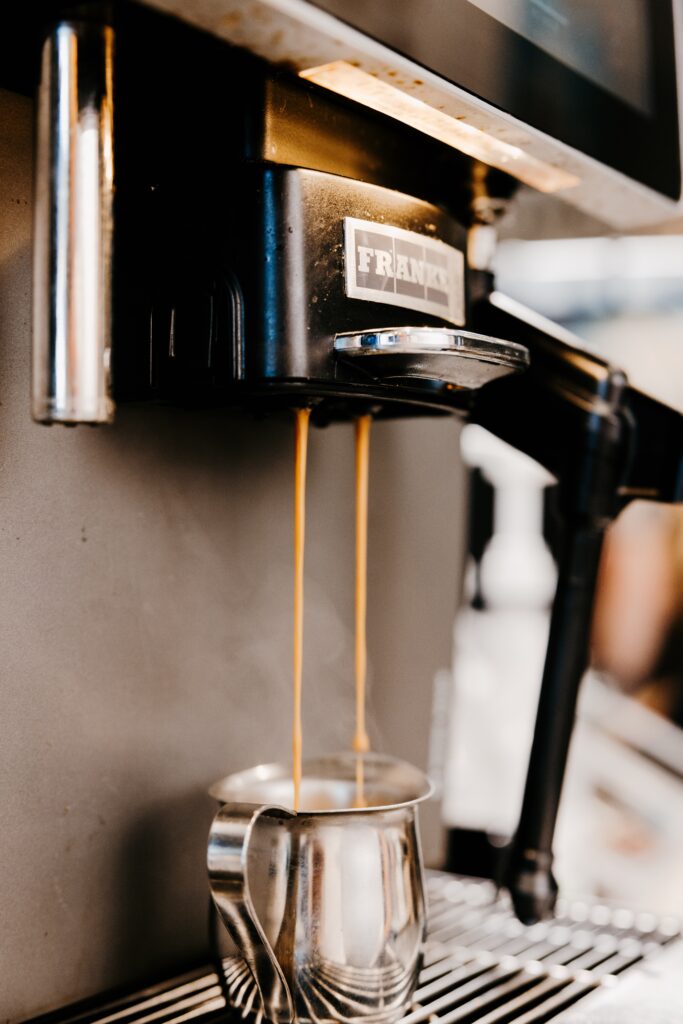
Vera says it’s precisely the balance between customization and automation that attracted Caribou to Franke’s machines. Once the machine is dialed in with Caribou’s menu, “They give us consistency across stores […] These machines are built for high-volume environments like ours, and they’ve been a solid upgrade in terms of speed, reliability, and quality.”
The chain has taken full advantage of the range of features its superautomatic machines offer.
“Caribou is very meticulous,” Rebe says. “We work on the consistency of espresso itself, but also on the foam quality, fill levels, and viscosity. It also has to be repeatable across stores and machines, not just something we achieve at the lab level.”
Is a Superautomatic Coffee Machine Right for You?
At the end of the day, all cafes measure their dream espresso machines against core factors like budget, skill, consistency, and output pace. While high-end specialty cafes might opt for a classic two-group machine, this requires a strong training program to ensure consistency.
On the other hand, businesses with a high-volume, fast-service model can benefit from a superautomatic machine that reduces the skill level needed to provide a good experience and a consistent drink.
While there’s no single formula for success in the industry, espresso machines typically serve as the backbone of coffee businesses. In theory, you could always upgrade later—get what you can afford now, save money, and buy your dream machine. In practice, however, many cafes prefer to measure twice and cut once.
For businesses like Caribou, a superautomatic machine brings all the pieces together: It’s easy to use, allows a high degree of drink consistency, and is reliable not just throughout individual barista shifts but for the long haul.
“During morning rushes, we’re pulling hundreds of shots and the S700 doesn’t slow down. The quality stays consistent, and there are no burnt shots and no weird timing issues,” Vera says.
When baristas can rely on the machine working as expected, Vera says, “It frees up our team to focus on what matters: a warm, welcoming guest experience that sparks chain reactions of good.”

Sponsored by FRANKE COFFEE SYSTEMS
Franke Coffee Systems, a division of the Franke Group, is a technology and solution provider of professional automatic coffee machines. Our passion for the best coffee quality motivates us to elevate the customer experience through sharing state-of-the-art innovations and profound industry expertise.