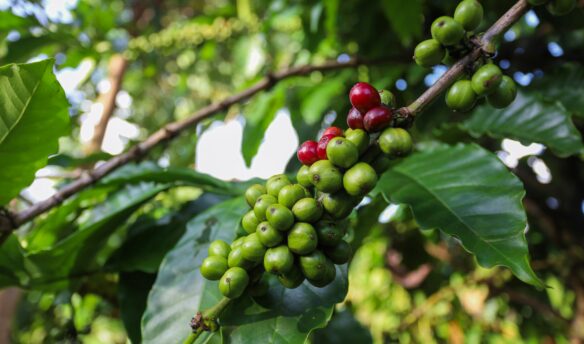
In 2016, while traveling through Uganda for work, Alan Lai met chia seed farmers out in the field. They were working in difficult conditions, amidst intense heat and choking dust, yet earning only a fraction of the retail value of their product.
At the same time, as a buyer, Lai faced challenges in quickly and reliably assessing the quality of the chia seeds he wanted to buy. He realized that despite widespread digitalization, there was no accessible, objective way for him to quickly determine product quality—and therefore enable the farmers to earn better, fairer prices for their products.
“A 1kg bag of chia seeds cost me about £.50 GBP [roughly $0.67 USD] while the very same seeds being sold at grocery stores in London, where I was based at the time, were being sold for £6 GBP [about $8 USD] for 250g,” Lai says.
This experience inspired the creation of ProfilePrint, a Singapore-based technology company that provides an easy-to-use quality-assessment tool for food products. The tool also aims to improve profits for the producers by making quality assessment more measurable, which Lai calls “democratizing quality assessment of food ingredients.” Since its inception in 2017, the company’s products and software have been used in more than 80 locations across six continents.
Coffee is one of the products it analyzes. As Lai says, coffee quality has traditionally been assessed either by trained Q Graders or by lab equipment. Although the latter can be highly accurate, it is often expensive and time-consuming to employ. Smaller players, such as coffee cooperatives, individual farmers, and emerging traders, often do not have the same on-site access to reliable, quality data as larger buyers.
“Democratizing quality assessment, for us, means leveling that access,” Lai says. “The system is portable and easy to operate, making it possible for users without QC lab skills or cupping experience to generate quality insights that were previously available only to the larger companies.”
How It Works
To visualize how ProfilePrint works, consider a coffee trader in Nairobi managing multiple lots from different cooperatives. Traditionally, evaluating each lot involves roasting samples, conducting cupping sessions, and sending physical samples to overseas buyers, which can take days or weeks and accrue significant costs. Instead, the trader can now use ProfilePrint’s Mini Beluga tool to scan each lot multiple times, creating a detailed digital fingerprint of a specific coffee.
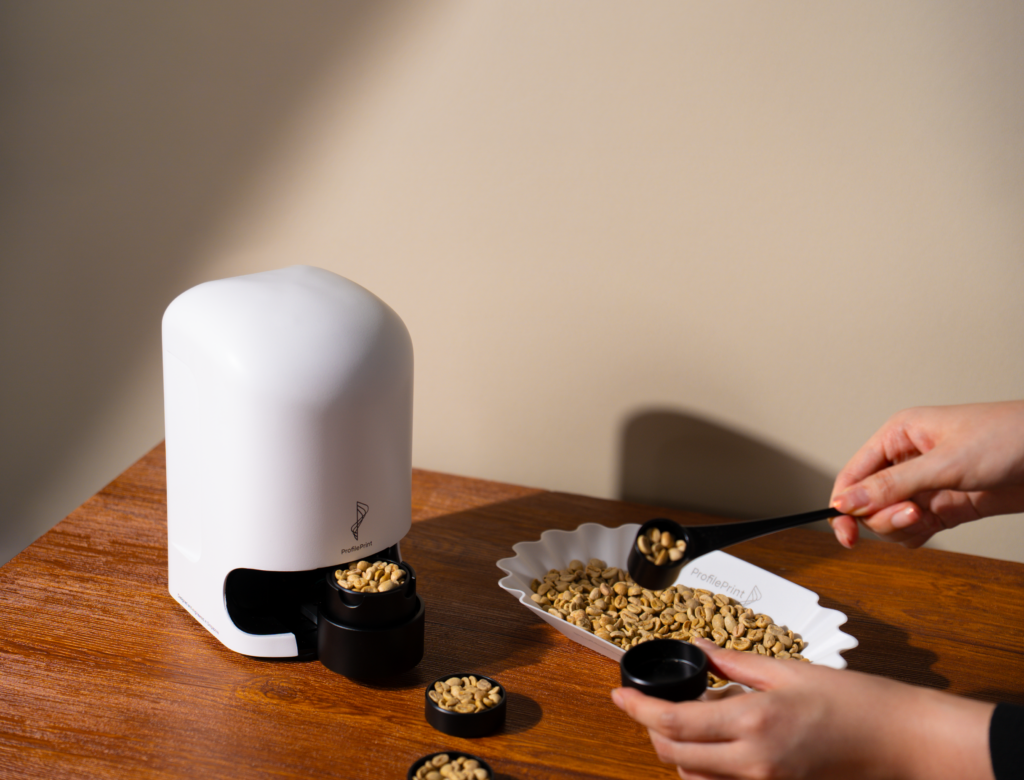
The newly released Mini Beluga works by using spectroscopy to capture the molecular signature of a specific coffee sample. When green coffee beans are placed inside, the device emits light through the sample and measures how molecules absorb and reflect it at different wavelengths. This produces a unique spectral pattern, a “digital fingerprint” that represents the sample’s full molecular composition. The process takes just seconds.
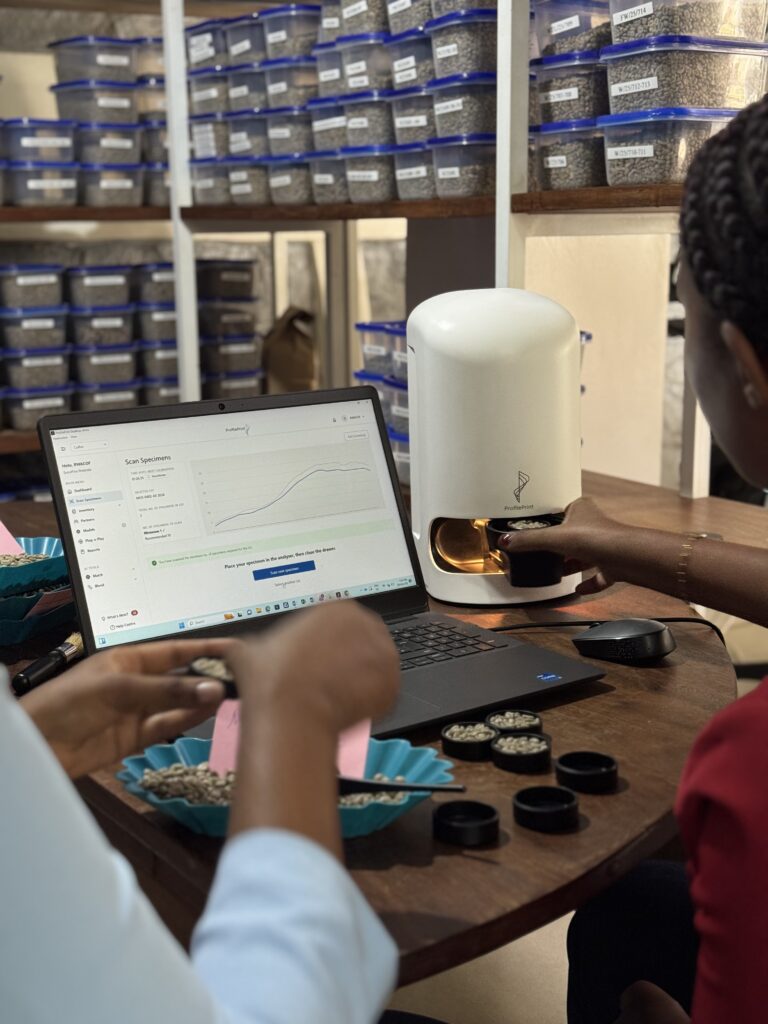
That fingerprint is then uploaded to a cloud-based AI platform, ProfilePrint Lite, where machine learning models analyze the data and correlate it with key quality attributes, such as SCA scores, flavor profiles, and moisture levels. The company’s in-house Specialty Arabica Green Bean AI model has a global database of more than 30,000 specialty coffee samples assessed by Q Graders worldwide.
The benefits to traders are significant. They can generate quality reports, compare lots with approved reference samples, and share insights directly with buyers and partners, enabling faster, more transparent transactions. By verifying shipment quality before export, they can also reduce rejection risks.
While it additionally runs an enterprise platform for larger organizations, ProfilePrint has recently refocused on small and mid-sized enterprises, buyers, roasters, and regional traders. According to Lai, getting started with ProfilePrint Lite is straightforward: Users first register for a free account online, after which they can subscribe to the Mini Beluga analyzer through a leasing model priced at $500 per month, with a minimum one-year commitment that also includes 3,000 credits per year (one credit allows a user to convert one green coffee bean sample into a digital lot, which they can then use to run AI models and view recommendations and predictions).
“The work the ProfilePrint team has done to support real-world integration has been exceptional, and is creating tangible benefits for our business,” says Carl Sara, global head of technology innovation at farm-to-roaster coffee company Sucafina. “What started as a device that provides us with data has grown into a tool that supports decision-making and speeds up our team’s work, letting our people focus on what they do best: making the calls that really need that human touch.”
Expansion to Africa
Several chain players are optimistic about this new technology. Among them is Nairobi Coffee Exchange (NCE) Chief Executive Officer Lisper Ndung’u, who has welcomed the new technology, saying it is likely to considerably reduce the costs of coffee sampling in the central room located in Nairobi.
Lai says this functionality is particularly impactful in coffee-producing countries in Africa, where production is abundant but access to quality assessment tools is limited. By enabling objective and rapid analysis, the company helps producers better capture the true value of their beans and participate more competitively in global markets.
“In Africa, adoption is gaining momentum, particularly in key coffee-producing regions. We’ve already deployed our solution with exporters in Kenya, Tanzania, Uganda, and Rwanda,” Lai says. “Several traders, cooperatives, and exchanges have shown strong interest in using AI-driven quality insights to improve transparency and reduce transaction friction.”
For Lai, transparency means that both the buyer and the seller can view the same quality results for a given coffee sample, including the same molecular fingerprint and predicted quality characteristics, “which removes a lot of the ‘he said, she said’ that can creep into traditional quality disputes.”
Reduced transaction friction is as beneficial for buyers as it is for producers. Because buyers can assess quality before the goods physically arrive, even before payment, they have far greater confidence in what they are committing to.
In March, ProfilePrint hosted a demonstration in Nairobi, which marked a significant milestone in its expansion into Africa. Kenya, believes Lai, represents a strategic entry point due to its well-established auction system and strong quality culture.
“Looking ahead, we see strong potential across Africa’s major coffee-producing regions,” he adds. “With growing global demand for high-quality African coffees and rising price incentives, the adoption of accessible quality assessment tools is likely to accelerate.”
Overcoming Challenges
As is true with any frontier technology, building trust in ProfilePrint is one of the company’s primary challenges, Lai notes. Because coffee is a deeply sensory and experience-driven industry, adoption requires demonstrating that technology can complement human expertise without replacing it.
The most common misconception, according to Lai, is that the company is trying to tell people how to run their businesses, or that it thinks its AI is better than humans with decades of experience.
“We’ve had people telling us straight, ‘I’ve been cupping for 20 years, and no machine is going to tell me what good coffee is,’” says Lai. “And they’re right! No sensor, no algorithm, and no AI model is going to replicate two decades of tasting experience, of understanding coffee and the market, of knowing what their customers want. However, what AI excels at is processing complexity quickly. We take a fingerprint of a sample and simply tell you, objectively and consistently, what’s in front of you. Not whether it is good or bad; that’s your call.”
According to Lai, ProfilePrint is not designed to replace traditional cupping. He believes that human expertise remains central to coffee evaluation, particularly in interpreting flavor and market preferences.
“When things fall short, it’s usually for one of two reasons,” Lai says. “The first is data: insufficient or inconsistent samples or data make it hard to build robust models, and good data is the backbone of any good AI. The second is a mismatch between human expectations and what AI can do, for instance, expecting a model to be 100% accurate, which isn’t realistic since humans aren’t 100% accurate either. Our role is clear: We provide the data, and the human experts make the call.”
Additionally, expanding into regions with varying levels of digital infrastructure presents operational challenges. “We have addressed this by designing solutions that are portable, user-friendly, and accessible, even in resource-constrained environments,” says Lai. “Ultimately, our progress has been driven by close collaboration with industry partners and a strong focus on user needs.”
With its current deployment in 80-plus locations worldwide, and across multiple food sectors—including coffee, tea, cocoa, juices, and many others—ProfilePrint has seen strong year-on-year growth. According to Lai, the company has experienced 90% sales growth across key markets, and usage has expanded exponentially from 2024 to 2025. Many of these deployments have gone fully operational: The technology has graduated from testing or pilot phases to day-to-day decision-making.
Customer Reception
At the World of Coffee Bangkok in May, three ProfilePrint users had the opportunity to talk about their experiences with the technology. The three were Martin Sunghwa Jeong of Foosung Corporation, a green coffee importer and exporter based in South Korea; Fajar Maulana Fikri, the director of coffee at Espresso Lab, which operates coffee shops and a roastery in Dubai; and Hemanta of the Nepalese Coffee Project.
“What defines ProfilePrint is speed, efficiency, and prediction,” says Jeong. “My favorite part of the Beluga and Mini Beluga is the matching function, because when you want to find some green coffees, it is really helpful for the importers and exporters, and also for the farmers.”
According to Fikri, the technology has helped a lot with his workflow, especially when Espresso Lab has a lot of green coffee samples to cup. He says his team no longer needs to roast them all; now, they can just scan, narrow down the options, and proceed with the samples they’re most interested in.
“The technology is fast, convenient, and in demand,” says Hemanta. “I love how the profiles are available online anywhere for you to check out.” Hemanta notes that coffee farmers in Nepal would likely benefit from the technology, as many have limited access to coffee labs or the ability to track the quality of their coffee from year to year.
According to Lai, these are some of the use cases that give this technology so much potential. “What AI offers is speed, consistency, and objectivity,” he says. “It enables users to process complex molecular data instantly, providing a reliable baseline for decision-making. By combining human judgment with AI-driven insights, the industry can achieve greater efficiency, reduce subjectivity, and improve trust across the value chain.”