Green coffee prices have gone through extreme ups and downs over the last few years.
Spurred in part by extreme weather events in major coffee-producing countries, such as Brazil and Vietnam, green coffee prices soared by 40% in 2024. In 2025, costs rose further still as climate impacts collided with low inventory and tariffs. And now, in 2026, prices remain so high that many coffee companies have been forced to fundamentally change how they do business.
Consumers are feeling the squeeze, too. According to the U.S. Bureau of Labor Statistics, the average retail price of a pound of ground coffee reached $9.14 in September 2025—up 41% from the same month the previous year. The broader consumer price index shows coffee prices up 19% year over year, even as overall food inflation has cooled.
For many coffee businesses, the impact of such prices now reaches well beyond a line item on a balance sheet. Margins were already tight before prices shot up; now, there’s limited room left to absorb higher costs—and limited ability to pass them on to customers—without making difficult trade-offs.
To better understand how businesses are navigating these increases, Fresh Cup sent a poll to roasters across the country in November 2025. We pulled together the most salient responses from 13 different businesses that reveal exactly how roasters are adapting their sourcing, pricing, and daily operations—all without alienating their customers in the process.
Margin Pressure and the Risk of Passing Costs Along
The roasters that we polled report increases in green coffee costs ranging from roughly 17.5% to as high as 75%, with a median increase of around 50%.
In response, several roasters describe having to walk a narrow line between raising prices and maintaining customer loyalty. At C&S Coffee Roasters in Forest Park, Illinois, chief operating officer Peter Deo says its green coffee costs have gone up by 50% over the past year. When those changes reach customers, he says, even modest price increases can begin to affect demand.

“As with any product, as costs to the consumer rise, the consumption decreases,” Deo says. “Traditionally, the consumer might switch to lower-quality coffee, but in this market, there is not a big difference anymore between the costs associated with quality levels. We have seen a decline in consumption just in the last few months alone.”
Many coffee sellers say it’s been hard to pass along the full increase in costs to their customers. Matt Marietti, president of De Fer Coffee & Tea in Pittsburgh, Pennsylvania, says its green coffee costs are up roughly 70%, which has forced the company to raise prices on retail coffee and beverages, though those increases don’t fully offset the added costs.
“We’re not able to pass all of that increase along, or we’ll lose so many customers that we’ll go out of business,” Marietti says. “So we’re compressing our already-tight margins and trying to increase prices in lock step with our peers so that, again, we don’t move first and lose customers to everyone else.”
As prices rise, competition for lower-cost, high-quality coffee has intensified, leaving fewer options that meet both quality and price expectations, he adds.
Several roasters note that rising costs are hitting at the same time as slower sales, squeezing margins from both directions.. When volume drops, any price increases become even harder to absorb.
Buying Deeper, Rotating Less
As margins tighten, many roasters said they’re making significant changes behind the scenes, shifting toward sourcing strategies that require more time, labor, and long-term commitment.
Rather than constantly rotating offerings, some roasters are choosing to buy more of the same coffees when they find beans that work for their bottom line. At De Fer, Marietti says the company’s core sourcing values haven’t changed, but its buying strategy has.
“When we find [a coffee that works], we are likely going to buy more of it and keep it around longer,” he says. “The short-term effect of this strategy will be less variety for our customers.”
Multiple roasters describe offering fewer coffees, and keeping them on their menus for longer. Driven Coffee Roasters in Chanhassen, Minnesota reports that its green coffee cost increases have meant more time and effort spent widening importer relationships to find viable options.
“This leads to increased time chasing coffees, sample roasting, and cupping endlessly to find the diamonds in the rough,” says Erin Halloran, senior account manager at Driven Coffee. “Ultimately, it has been a catalyst to further direct-trade relationships.”
Halloran points to the cumulative operational toll of those decisions. “When you have an ingredient cost rise as quickly and sharply as coffee has, you’re unable to maintain a healthy margin in the short term,” she says. “It puts small businesses in triage mode to correct the product margin through making really tough decisions.”
At Peaks Coffee Company in Syracuse, New York, CEO and owner Samuel Bender says green coffee price increases touch nearly every part of the business. “It affects what we buy, where we buy it from, and how we buy,” Bender says. “It affects our margins. Our team has definitely had to run much tighter this year.”
To protect margins, Peaks has adjusted blend components, including adding robusta to certain products. “We’ve had to add in some robusta for our grocery-style blends, and adjust blend components in other areas to continue to hit a semi-OK return on our product,” Bender says.
For newer roasteries, those decisions can feel even more consequential. Mary Bozzelli, owner at Armadillo Coffee Roasters in Austin, Texas, says green coffee price increases are forcing the company to weigh competitiveness against what the business can realistically absorb. “We have to decide whether to eat the rising cost to try and stay competitive or increase our price point with the rest of the coffee community,” she says.
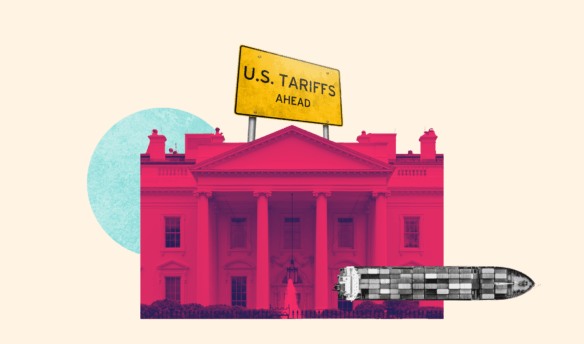
Armadillo largely moved away from Brazilian coffee during the period when steep U.S. tariffs made Brazilian imports significantly more expensive, for instance, even though it had been a staple in some blends. “It’s too bad. We stocked up a little bit before tariffs went through, as some wholesale customers love it,” Bozzelli says. “But we’ve told them to consider other coffees.”
Wholesale Relationships and the Cost of Consistency
Several roasters say that wholesale customers prioritize consistency, which limits how much they can raise prices, even in the face of rising costs.
At C&S Roasters, Deo says the company offered customers the option to switch to different origins as green coffee became more expensive, but most chose to stick with the same coffees. “The majority of our customers want us to maintain the consistent products that their customers love,” he says. “So no major changes have happened.”
A small number of roasters have avoided the worst of the squeeze, at least so far. These businesses report being better insulated from recent volatility due to long-standing sourcing models and purchasing strategies. At Torque Coffee in San Diego, California, founder Andy Newbom says despite price fluctuations, the company hasn’t raised prices.
“Our entire model is built upon the idea of keeping more money at origin and focusing cost savings on the middle controllable costs,” Newbom says. “So we have a built-in solution to these cost increases.”
Torque’s sourcing strategy has provided short-term stability. “We are fully booked out for a year with excellent coffee,” he adds.
For many roasters, however, stability has been elusive—particularly given that the current pricing environment is unlikely to ease quickly. Across all 13 survey responses, one takeaway was clear: Rising green coffee costs are already reshaping how roasters source, price, and plan. For most, the work of adaptation is incremental, and largely invisible to customers. But it’s happening now, even as roasters continue to adapt within increasingly tight constraints.