For decades, the Amazon has served as a symbol of ecological loss. News stories and environmental reports regularly cite the region’s rates of deforestation, biodiversity decline, and rising temperatures. Such reports are often accompanied by images of burning forests, and warnings about illegal logging and agricultural expansion.
Less visible within that coverage, however, are stories about how farmers and organizations operating in the Amazon are experimenting with new, more benign agricultural models—including coffee systems designed to increase productivity without clearing additional forest.
One of the clearest examples comes from the Brazilian Amazonian state of Rondônia. Over the past two decades, the state has become Brazil’s leader in canephora, or robusta, productivity. Between 2001 and 2025, its yields increased from 7.8 to 68.5 bags per hectare, surpassing the national average of 50.4 bags, according to Embrapa, Brazil’s Agricultural Research Corporation. Even more remarkable is the fact that Rondônia has managed this increase by shifting away from an extractive agricultural model.
Rondônia’s transformation into a model for coffee production did not happen overnight. Formerly one of the Amazonian states most affected by deforestation (linked to cattle ranching and settlement programs), the state gradually restructured its coffee sector through public research, improved genetic material, and agroforestry integration. It has also relied on the knowledge of smallholder and Indigenous communities, whose land stewardship long predates modern coffee systems.
Today, it’s worth examining how Rondônia achieved this remarkable transformation—and how its agricultural tactics can influence and inform future coffee production globally.
The Amazon: A Multi-Layered Territory
It’s important to understand that the Amazon is not a homogeneous region. It is a transnational biome that spans nine South American countries and territories: Brazil, Peru, Colombia, Bolivia, Ecuador, Venezuela, Guyana, Suriname, and French Guiana. Within this vast area, there are many distinct ecological and social systems.
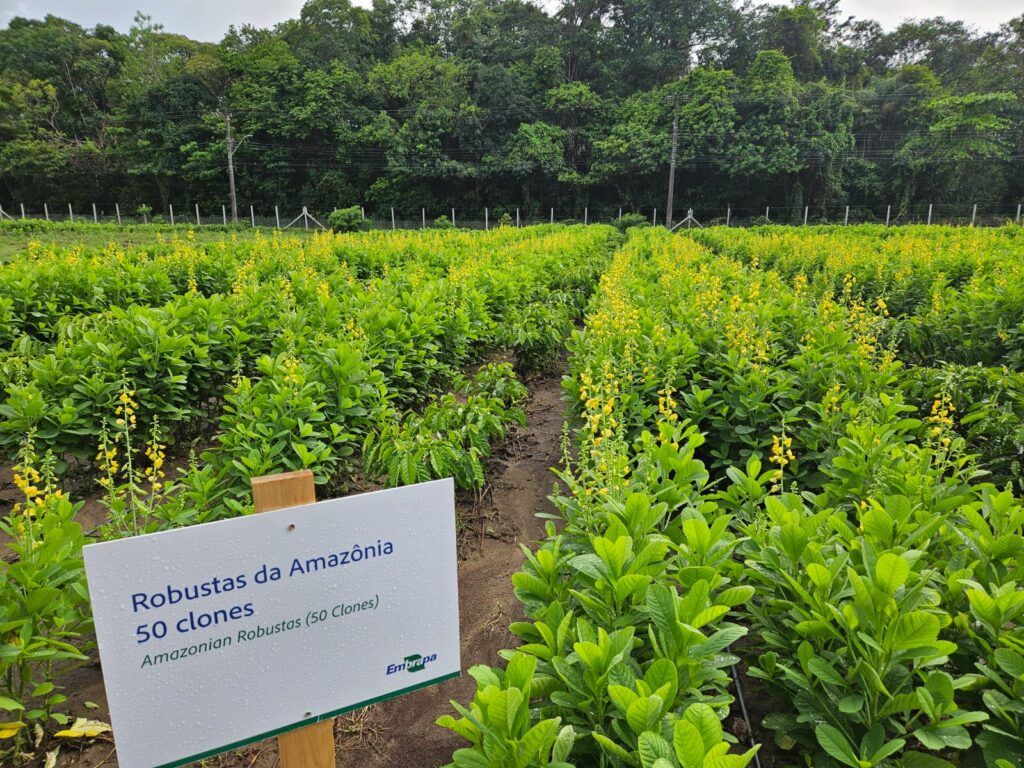
Besides Brazil, which accounts for approximately 95% of the robusta farmed within the Amazon biome, coffee is grown in several other countries in the greater Amazon region. These include Ecuador (~3%) and Peru (~1%). Today, Brazil is the world’s second-largest robusta producer, after Vietnam, and the Amazonian state of Rondônia is its second-largest robusta growing region. It supplies around 15–20% of Brazil’s canephora production, according to the National Supply Company (Conab).

In 2024, Rondônia shipped 35,056 tons of coffee and generated US$130.99 million in revenue—placing the state among Brazil’s five largest coffee exporter-states for the first time.
More than 7,000 growers operate across the state, the vast majority in family-owned smallholdings. Production is concentrated in the Matas de Rondônia Geographical Indication (GI), which encompasses 15 municipalities that are collectively responsible for some 75% of the state’s output. Marketed as “Robusta Amazônica,” these coffees are increasingly evaluated through fine robusta grading systems.
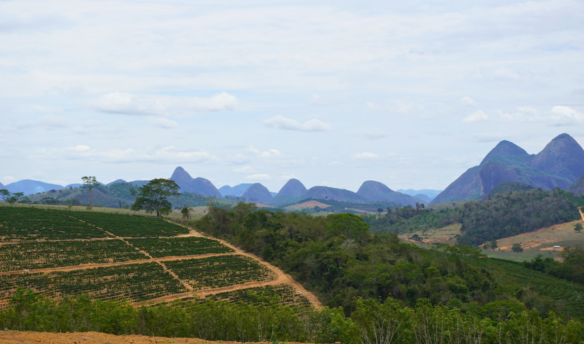
Although coffee is now one of Rondônia’s principal crops, it is far from the most land-intensive. Coffee farms occupy less than 1% of the state’s territory, while pasture linked to cattle production covers close to half. Soy and beef remain the state’s top commodity exports, yet coffee’s economic impact relative to its territorial footprint makes it one of the most economically significant agricultural models in the region. Today, it accounts for 63.6% of the Matas de Rondônia region’s gross production value, according to Embrapa.
Coffee Without Expansion
What’s even more remarkable about Rondônia’s coffee success story is that it’s not the result of recent expansion. A 2025 Embrapa study found that the total area planted with coffee in Rondônia actually declined, from 245,000 hectares in 2001 to 60,600 hectares in 2023, even as productivity rose more than sixfold. Agronomists refer to this dynamic as “land saving,” a process by which higher yields reduce pressure for agricultural conversion.
For Dr. Enrique Alves—a senior researcher at Embrapa Rondônia, and one of the leading scientists behind the Robusta Amazônica research program—understanding this “land-saving” mechanism is central to explaining Rondônia’s productivity success.
“This is not ‘forest coffee,’ in the sense of coffee growing inside untouched rainforest,” he explains. Rather, it is coffee cultivated in established agricultural territories within the Amazon, often integrated into diversified and agroforestry-based systems designed to sustain productivity while coexisting with the forest and its native peoples—not at their expense.

“What stands out is that coffee uses a very small portion of land and still generates substantial income,” he says. “While soy, for example, requires far larger areas and involves far fewer families.”
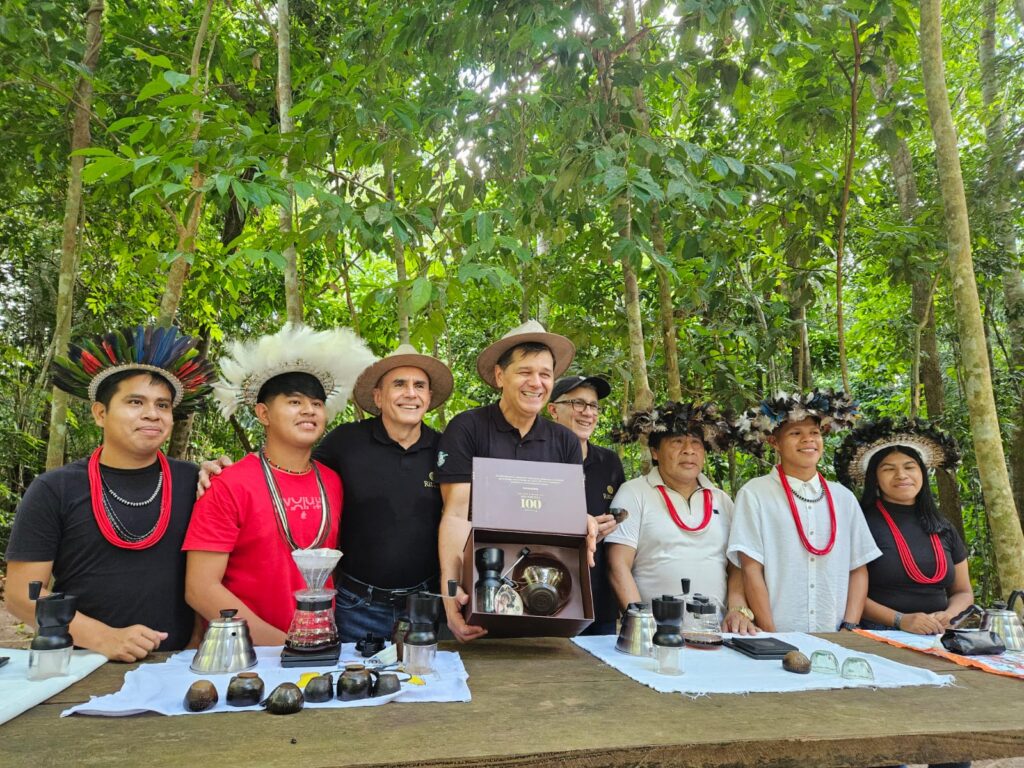
Amazonian coffee has been able to grow partially because of initiatives that link Indigenous producers to formal markets and quality systems. Among the most prominent is Projeto Tribos, launched in 2018 as an initiative among partners like Funai (Brazil’s Indigenous affairs agency), Embrapa, local governments, and the roaster 3 Corações.
What began as a mapping effort—identifying coffee already growing on Indigenous lands and typically sold at low prices—evolved into a structured quality program. Projeto Tribos introduced standardized cupping protocols, post-harvest training, and guaranteed purchase mechanisms for higher-scoring lots.
Initially involving just three Indigenous families, the project now includes 169 families across seven ethnic groups. Most of the families belong to the Paiter-Suruí people. Today, the initiative operates within two Indigenous territories in Rondônia—Sete de Setembro in Cacoal, and Rio Branco in Alta Floresta d’Oeste—encompassing nearly 500,000 hectares.
From Dispossession to Stewardship
But how did robusta become such an important crop in the Amazon in the first place?
Rondônia’s coffee industry was established in part as a result of severe frosts in southern Brazil in the late 1970s. These frosts displaced farmers northwards, where they were drawn by lower land prices. “That was the beginning of the Amazonian coffee frontier,” explains Alves. “It was marked by improvisation, limited technology, and, in most cases, deforestation.”
Non-Indigenous settlers introduced robusta plants to the region, which were then adopted by Indigenous communities after the Sete de Setembro and Rio Branco lands were demarcated in the 1980s. As a result, Indigenous people gradually incorporated the crop into their own production systems.
By the 1990s, Embrapa researchers worked alongside local farmers to conduct systematic plant selection and develop canephora clones capable of withstanding the Amazon’s heat and humidity.
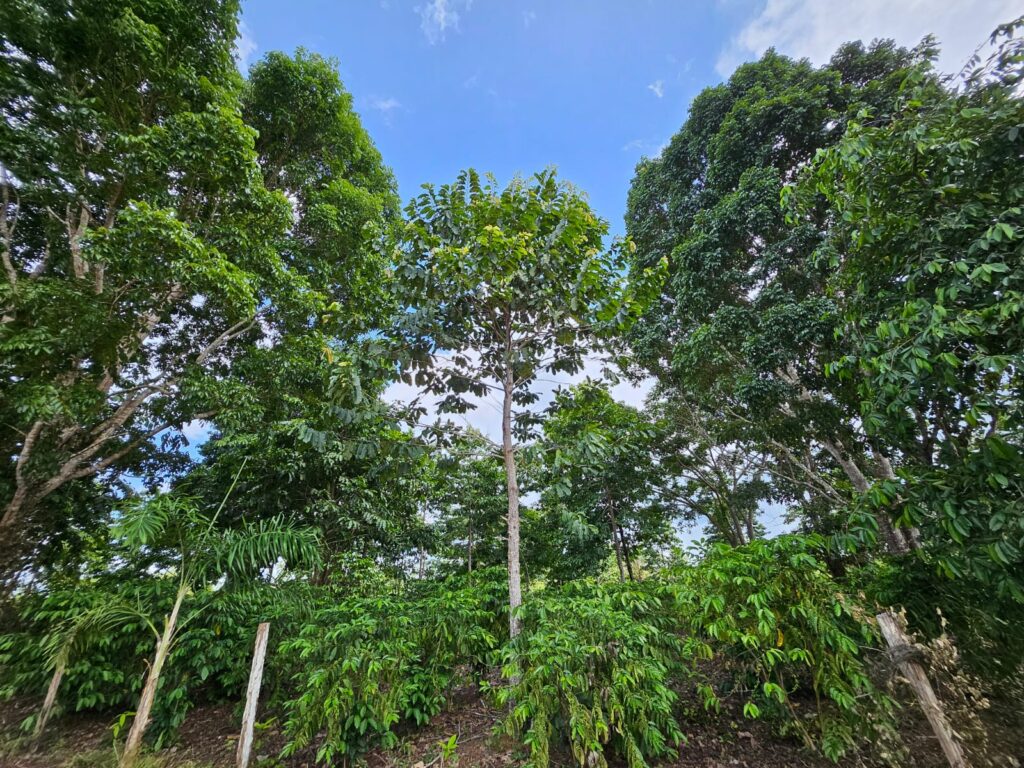
Over time, Indigenous communities integrated these improved varieties into diversified agroforestry systems, cultivating coffee under forest canopies and intercropping with native species.
“This is the reframing of a crop historically introduced through colonial dynamics into an economic instrument aligned with Indigenous values,” says Alves. “It is now a medium for territorial integrity and cultural continuity rather than a marker of dispossession.”
Specialty Reframed
Since the early 2000s, when Embrapa consolidated its canephora breeding program in Rondônia, researchers have worked closely with farmers through regular field visits, co-designing production cycles and investing in infrastructure such as elevated drying patios. Alves notes that systematic cupping has allowed producers to measure, price, and negotiate their coffee differently—transforming quality from an external assessment into a locally understood metric.
Alves is also a co-author of the 2025 Canephora Flavor Wheel, an open-source scientific initiative that formalized sensory descriptors specific to the coffee species, and which reinforced its legitimacy within specialty frameworks.
This work to codify and legitimize robusta has also coincided with a broader market shift. Roasters such as Nick Mabey of Assembly Coffee in London and Mikołaj Pociecha of Cherry Chunk Coffee Roasters in Amsterdam—both of whom actively source and roast canephora—are openly questioning specialty coffee’s bias towards arabica.
“Decades of marketing effectively demonized canephora,” says Mabey, who has worked with the species for nearly a decade.
For Pociecha, Amazonian canephora illustrates resilience, processing flexibility, and shelf stability as structural strengths. “We should stop talking only about altitude and start talking about latitude and biodiversity,” he says. “Producers of Robusta Amazônica are fluent in both traditional and experimental processing. I’ve tasted these coffees rested for up to four years; the bitterness decreases while complexity remains.”
Initiatives such as Projeto Tribos and the Florada Premiada competition—a national quality award program highlighting 100% Robusta Amazônico lots—have created formal pathways into specialty markets for Indigenous producers. Winning coffees, often scoring between 80 and 90+ points, are purchased at premium prices, with profits returning directly to the communities.
Coffee, Economy, and Social Justice
Colonial accounts and later development policies often portrayed Indigenous land use as economically unproductive—a framing that helped justify territorial occupation in the Amazon. The rise of Amazonian canephora challenges that legacy by demonstrating that forest-based land stewardship can be both economically viable and technically sophisticated.
In international sustainability debates—particularly those surrounding deforestation-linked supply chains—Amazonian coffee is frequently grouped within broader concerns about agricultural expansion. For Alves, this framing obscures the region’s social history and the crop’s role in regenerating degraded land.
“What takes 50 years to regenerate naturally can happen in 10 with coffee,” he argues, noting that planting robusta within diversified agroforestry systems in degraded pastures can improve soil structure and biomass accumulation, all while sustaining local livelihoods. “Failing to distinguish between pasture-driven deforestation and coffee-based intensification fuels persistent misconceptions. More coffee farmed in sustainable systems means healthier forests and better quality of life—not more deforestation.”
This regenerative dynamic is visible in agroforestry cooperatives such as RECA (Intercropped and High-Density Economic Reforestation), where smallholders cultivate coffee alongside Brazil nuts, cupuaçu, cacao, and peach palm. These systems do not replace the forest; they integrate production within it. “You can’t standardize nature,” Alves says. “You have to learn to value diversity.”
Data released in 2025 by Embrapa reinforces this environmental dimension. A study conducted in the Matas de Rondônia region found that robusta-based agroforestry systems sequester approximately 2.3 times more carbon than is emitted throughout their production cycle, resulting in a net positive balance of roughly four tons of carbon per hectare per year—particularly when replacing degraded pasture.
For Alves, the success of Amazonian coffee represents a form of social repair. “In the Amazon, the periphery won,” he says, referencing the Indigenous peoples, formerly enslaved populations, and poor migrants who built this culture. “Coffee is a tool of resistance.”