Like other plants, coffee is susceptible to attacks from pests and diseases. As an agricultural product and the source of millions of people’s livelihoods, such attacks can have devastating repercussions.
Waves of coffee leaf rust have decimated coffee-growing regions for more than a hundred years, from Sri Lanka in the 1870s to Central American countries in the 2010s. The coffee berry borer, meanwhile, has spread to nearly every coffee-producing country and causes more than $500 million in damages every year. Myriad other pests like mealybugs and beetles, as well as less common diseases like brown blight and root rot, also impact coffee farms around the world.
One hugely destructive coffee disease that has received relatively little attention, despite its devastating impact, is coffee wilt disease. Since it was first observed in Central Africa in 1927, coffee wilt disease (CWD) spread in two major waves to many coffee-producing countries across the continent. It had an especially devastating impact on robusta coffee farms in the Democratic Republic of Congo and Uganda, all but wiping out coffee production in the DRC by the late 1990s. It has also emerged in Ethiopia, albeit on a smaller scale.
The threat has appeared to fade in recent years. However, CWD’s history of devastation, and its ability to lurk unnoticed before springing back up to wipe out coffee farms, make it worth paying attention to. With luck, understanding its past may help the industry prevent its spread in the future.
The Forgotten Threat
Coffee wilt disease remains an overlooked and understudied risk to coffee, says Dr. Lily Peck, an evolutionary biologist in the Department of Ecology and Evolutionary Biology at the University of California, Los Angeles. “It’s arguably one of the biggest diseases to affect coffee production in Sub-Saharan Africa,” she says.
The disease was first detected in 1927 in what is today the Central African Republic. As Julie Flood, senior plant pathologist at the U.K.-based nonprofit CABI, wrote in a 2021 overview of the disease, CWD was first observed on liberica, which at the time was the dominant coffee species in Africa. Over the next 20 years, researchers found the disease on both robusta and arabica plants, as CWD evolved host-specific strains for each coffee species. It spread quickly to robusta plantations in Côte d’Ivoire, the DRC, and Guinea throughout the 1940s and ’50s.
As Flood wrote, this first wave of CWD destroyed more than 50% of coffee production in both Côte d’Ivoire and the DRC, while its spread to Guinea caused production to decline nearly 50% by 1958.

Unlike coffee leaf rust, which is dispersed by airborne spores and can thus travel long distances without human interaction, CWD is caused by a soilborne fungal pathogen. As such, it cannot spread so widely. Instead, the disease spreads locally by farming practices such as weeding and pruning using machetes, which damage plants and provide an entry point for the pathogen. Moving infected plants or wood debris between farms or across borders spreads the disease over longer distances.
Once a plant is infected, there is no remedy for CWD. Contaminated plants must be dug up and burned. A campaign of widespread uprooting as well as the development of new, more resistant varieties temporarily eradicated the disease in the 1960s, marking the end of the first wave. However, as Peck described in a 2023 review article in the journal Plant Pathology, “the disease has always persisted, the pathogen hidden from view, ready to exploit weaknesses and break out again.”
After its temporary decline, CWD came roaring back at the end of the 1970s. This second wave primarily impacted the DRC, which gained independence from Belgium in 1960 as Zaire, and had since been embroiled in political conflict and economic turmoil. “The most important lesson from CWD is that the risk of disease re-emergence is greatly exacerbated when production systems collapse and trade is disrupted by conflict,” Peck writes.
Although its production had more than doubled between 1960 and 1985, the DRC’s coffee exports collapsed over the next two decades as CWD spread and fighting disrupted both trade routes and farming communities. Coffee production in 2010 was less than a tenth of what it had been in 1990.
Peck theorizes that CWD’s spread to Uganda came because farmers in the DRC, looking for new markets as their own country struggled, transported plant material across the border in the early 1990s. “From 1996 onwards, CWD caused the collapse of Ugandan coffee production; nearly half of Uganda’s robusta crop was destroyed, with losses of over $100 million; around half of Uganda’s smallholder farms were badly affected,” Peck writes.
Uganda’s 1995 export levels were only reattained in 2020, after many years of rebuilding work from scientists, farmers, and government agencies. Farmers planted new, disease-tolerant varieties, or in some cases simply replaced their coffee crops with cacao or bananas.
From Misery to a Miracle
While CWD has largely been forgotten by the wider industry, memories are still fresh in the communities it impacted. Kambale Kisumba Kamungele, executive director of the DRC branch of the nonprofit Café Africa, grew up on a coffee farm and saw firsthand the devastation that CWD can inflict.
“Coffee wilt disease was first detected on our family farm in 1988, in the outskirts of Beni, North Kivu,” Kamungele says. “The impact was gradual but devastating—productivity declined year after year until all the coffee trees were eventually decimated.”
The disease affected the whole community, many of whom were connected to the coffee industry in some way. “We could see how misery reached and struck all the layers of the local societies, because from the farmers all the way to the drivers to the processors and the exporters, everybody was hit. And there was no government initiative to go and intervene in the situation, because the country was collapsing.”
The lack of government funding for things like training and education programs exacerbated the crisis, as did the breakdown of the International Coffee Agreement in 1989 and the subsequent plunge in coffee prices. Ongoing conflict hindered recovery efforts, but in the mid-1990s a company called Esco Kivu, a subsidiary of the trading company Schluter-Congo, began introducing cocoa to farmers in the eastern DRC as an alternative to coffee. Although it had been a major crop during colonial rule, cocoa production plateaued after independence. The devastation of CWD caused many farmers to switch crops, to the point that today the DRC is a significant cocoa exporter.
At the same time, Kamungele says, “Local communities put themselves together along the value chains. It was rather a miracle, what happened.” Local agronomists bred and distributed the seedlings to farmers, who planted them and organized themselves into cooperatives. After three years the plants started to produce. “Progressively, the robusta production was restored. Of course, the production has not reached the levels that we had after independence or the level that we had in the ’70s, early ’80s, but there is a visible restoration and improvement of the quality of life of farmers.”
The Past Shapes the Future
CWD garners less international attention than other coffee diseases, possibly because there haven’t been many recent outbreaks. “If you have five diseases that are currently a massive problem, your bandwidth for thinking about a disease that used to be a problem and could be a problem again in the future is much diminished,” Peck says.
The other issue is that, because it mainly impacts smallholder African farmers, “there’s definitely less interest in finding some sort of treatment or way to manage it, because most of the farmers wouldn’t be able to afford that treatment.”
Today, Peck writes in her paper, CWD appears to be under control in the robusta-growing regions of eastern and Central Africa. Reports of small outbreaks in Ethiopia and the Côte d’Ivoire leave no room for complacency. Although it is harder to spread than coffee leaf rust, she writes, CWD could be devastating if it reached robusta-rich countries like Brazil or Vietnam.
Efforts are ongoing to continue to regenerate coffee farms in the DRC. As part of his work with Café Africa, Kamungele is trying to replicate the regeneration success of eastern DRC in other areas of the country. There are coffee estates in the west and northwest that were also wiped out and abandoned in the wake of conflict, low prices, and the spread of CWD.
Café Africa has worked to introduce new plant material from the national agriculture research body, train farmers, and organize them into cooperatives. “Now a new harvest has started, and you begin to see the transformation of the lives of people in the big forest where they had no coffee,” Kamungele says. “[I am taking] my experience from the East, and I’m using it in the western part of the DRC. I’m seeing the difference. I’m witnessing the positive impact.”
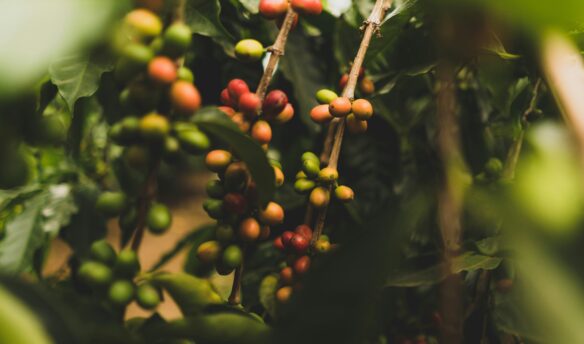
Photo by Chalo Garcia on Unsplash