✉️ This story was featured in this week’s Coffee News Club
👋 Get the Coffee News Club newsletter in your inbox weekly—sign up.
Coffee is a genetically complex plant, and some species are especially fragile in the face of climate change. Of the two most common coffee species, arabica is notoriously vulnerable to rising heat and drought, while robusta, often considered hardier than arabica, may be less resilient than first thought.
Researchers have explored alternative species like stenophylla and liberica, as well as new arabica varieties and hybrids, which are more robust in the face of temperature extremes. And now a new hybrid has joined the chat.
Researchers at Kew Royal Botanic Gardens in the United Kingdom, led by Dr. Aaron Davis, have identified a new family of hybrids of the liberica and excelsa coffee species. The researchers hope that their discovery will offer farmers another climate-resilient coffee alternative to arabica.
Liberica and excelsa are coffee species that often hybridize when grown on the same farm. (It was once thought that excelsa was a variant of liberica, but last year Davis and his team showed that excelsa is a separate species.) Researchers identified the new hybrid by examining 113 different samples collected from three continents and published their findings in Scientific Reports. While farmers have long cultivated liberica and excelsa, as well as informal hybrids of the two, the study aimed to “verify and quantify” the hybridization for the first time.
The samples exhibited different traits depending on their origin, but all showed “overlapping values for key agronomic traits, including seed size and parchment thickness,” the authors wrote. Liberica cherries are larger and have a thicker skin than arabica. The plants are relatively low-yielding but more disease-resistant than arabica, and they grow better at lower elevations and in hotter weather.
Excelsa is higher-yielding but less resistant to disease, and it performs better at higher elevations. The new hybrid, which researchers proposed calling Coffea × libex, seems to have the best of both species.

The South India Coffee Company contributed to the study with samples and field expertise. In a press release, the company detailed some of the benefits of libex: its higher yield compared to liberica, its resistance to coffee leaf rust, and its climate resilience.
Another important element is taste. Liberica’s flavor profile can be “unfamiliar and challenging” to some coffee drinkers, SICC wrote. Others have described it as vegetal or savory. By comparison, the study authors describe libex as more balanced and accessible, although they note that a more rigorous sensory evaluation is needed.
Read more on the new libex coffee hybrid from Sprudge here.
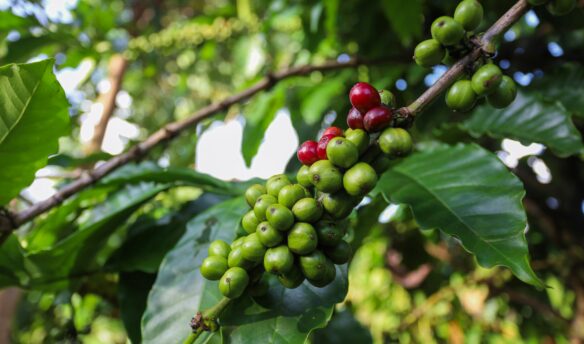
Photo by PROJETO CAFÉ GATO-MOURISCO on Unsplash