✉️ This story was featured in this week’s Coffee News Club
👋 Get the Coffee News Club newsletter in your inbox weekly—sign up.
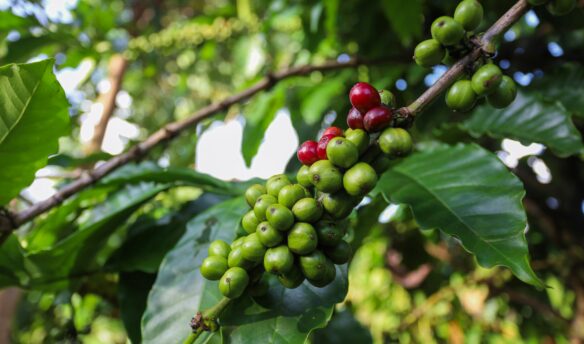
The coffee berry borer (CBB) is one of the most destructive pests in the coffee industry. Borers cause hundreds of millions of dollars worth of damage to farms around the world each year.
Researchers have been working on ways to counteract CBB damage, from conventional approaches such as spraying pesticides to more sustainable options, including harvesting coffee cherries more frequently to disrupt the CBB’s lifecycle and even introducing tiny parasitic wasps to consume the troublesome insects.
One of the reasons the beetles are so hard to fight is their microscopic size—the critters are so small that they are very hard to spot. To help, a team of scientists from Edith Cowan University in Australia developed a software system that uses drones and advanced image processing to detect CBB infections. The system is designed for drones to focus on detecting evidence of the presence of borers rather than identifying the insect itself.
“Coffee berry borers are very difficult to identify. They’re tiny little insects that are very difficult to see with the naked eye,” study co-author Dr. David Cook said in a press release. “However, instead of looking for the coffee berry borer itself, we looked for what it did.”
To explain how the software works, Cook used the analogy of drilling into a piece of wood, which leaves sawdust around the hole. “In the same way, when a borer bores into a coffee berry, they leave an enormous amount of debris, called frass and this is much easier to identify.”
If not detected and dealt with, CBB infestations can rapidly spread and decimate farms. With this new software, farmers can fly drones above their trees and quickly identify affected areas, allowing them to remove infestations and save their harvests.

Study co-author Dr. Leisa Armstrong explained the economic benefits of the technology. “Coffee is a high value crop. If you can eradicate the infection and save a crop rather than losing a percentage of the harvest, then it’s a financial improvement,” she said.
Read more about the drone pest detector from Global Coffee Report here.