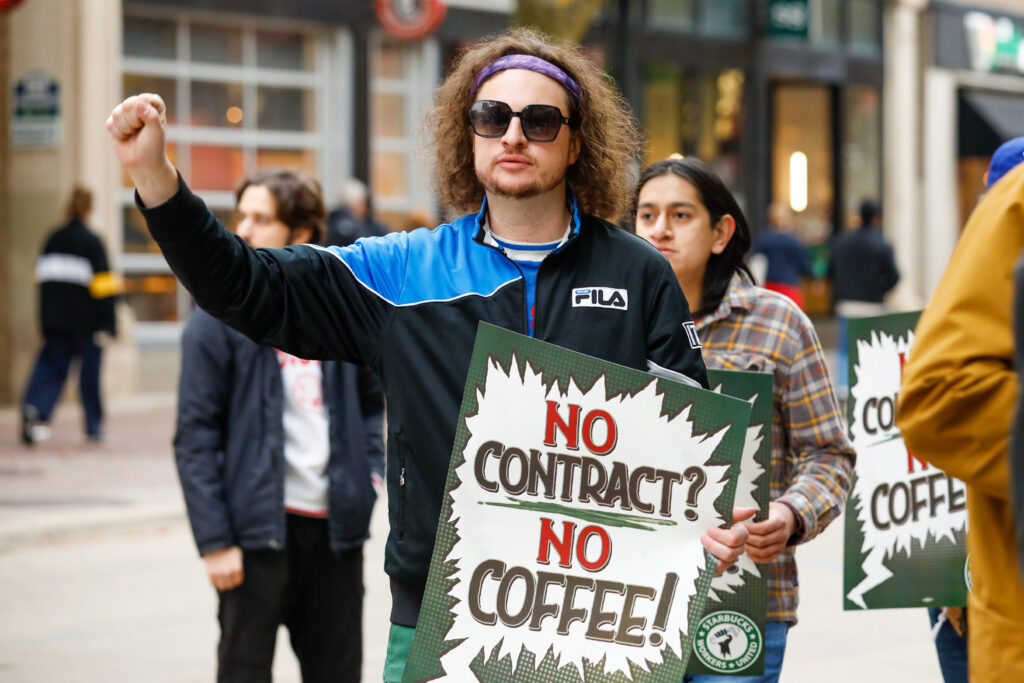
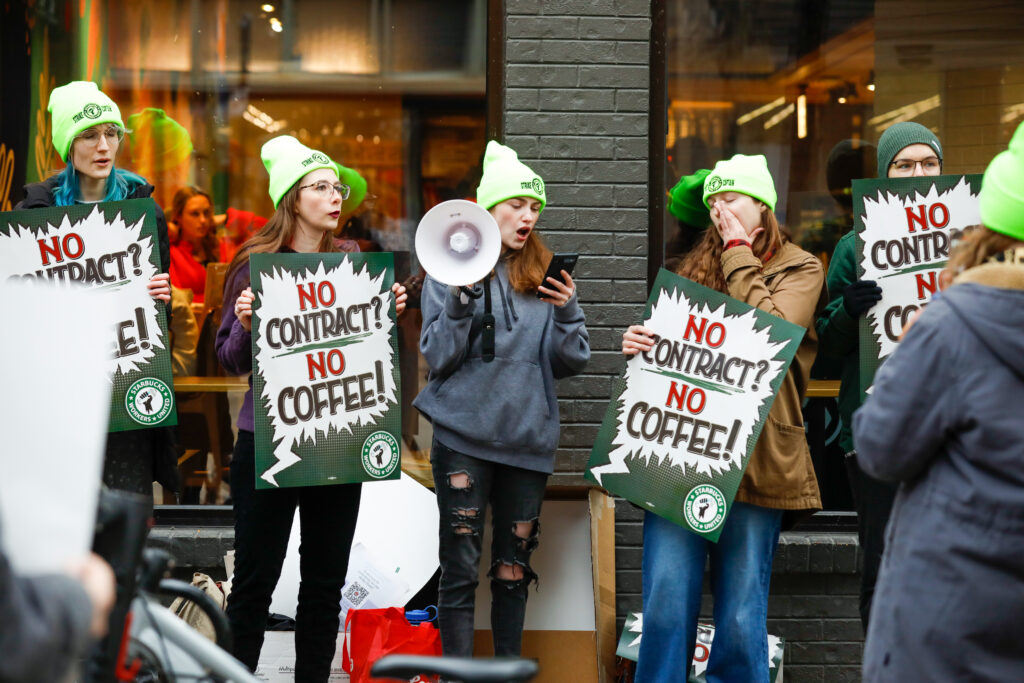
On Nov. 1, about two dozen people marched in front of a Starbucks location on State Street in Madison, Wis. They chanted union calls while holding signs that read “NO CONTRACT! NO COFFEE!”
This was just one in a series of practice pickets held at 70 Starbucks stores across 60 cities. Fresh Cup was on the scene in Madison to talk to baristas and supporters. The practice pickets took place ahead of the holiday season, traditionally one of the corporation’s busiest times.
Members of the Starbucks Workers United union started voting on Oct. 24 on whether to move forward with a strike and authorized strike action on Nov. 5. The union said they would begin walking out on Nov. 13—Red Cup Day, a major event for the chain, which typically features giveaways and limited-edition holiday drinks—if the company does not agree to a collective bargaining contract by then.

It’s been almost four years since the first Starbucks in Buffalo, New York, unionized, in December 2021. Since then, at least 650 other Starbucks locations across the nation have unionized, but the labor union has yet to agree to a first contract with the chain.
With these latest demonstrations, the union hopes to put additional pressure on the company to come to the bargaining table.
“We are here to show Starbucks that we are wanting to come to the table, that we are organized, that we have the backing of other unions, that we have the backing of … a good number of the stores in our district, and that we want to come to the table, and that we have the power to negotiate for a better contract for our workers,” said Emily Swanson, an organizer who has worked for Starbucks for four years.
The union claims that negotiations broke down in “December 2024 when Starbucks backtracked on our path forward, and we waged the largest strike in the coffee giant’s history,” according to the Starbucks Workers United website.
Starbucks has blamed the union for the breakdown in negotiations. “Workers United, which represents only 4% of our partners, chose to walk away from the bargaining table. We’ve asked them to return—many times. If they’re ready to come back, we’re ready to talk,” the company wrote in a statement on its website.
“Workers United only represents around 4% of our partners but chose to walk away from the bargaining table. If they’re ready to come back, we’re ready to talk. Any agreement needs to reflect the reality that Starbucks already offers the best job in retail, including more than $30 an hour on average in pay and benefits for hourly partners,” Starbucks spokesperson Jaci Anderson said in an email to Fresh Cup.
This isn’t the first time Starbucks employees have taken strike action. Last year, workers went on strike around Christmas: The union reported that more than 300 stores were shut down, while Starbucks disputed this figure, estimating that 170 stores were closed. Workers also went on strike in May 2025 due to new dress code rules, which the union said should have been litigated at the bargaining table.
One of the biggest focal points for unionized workers is pay discrepancy.
In July, a report from the American Federation of Labor and Congress of Industrial Organizations (AFL-CIO) chronicled the stark wage gap between workers and CEOs.Starbucks had one of the largest worker-to-CEO pay gaps, with workers earning 6,666 times less than CEO Brian Niccol. The AFL-CIO’s report said the average CEO-to-worker pay ratio was 285:1.
Workers also noted that Niccol was given a compensation package worth around $96 million for his first four months as CEO, a position he took on in September 2024.
“It would take one day of Starbucks profits to bring to the table the contract that we are looking to negotiate,” said Swanson.

In 2024, Starbucks reported $36.176 billion in annual revenue, which averages to about $99 million in revenue per day.
Starbucks said that the argument about daily sales covering the requests from the union is an incomplete understanding of the issue.
“We’re investing over $500 million to put more partners in stores during busy times. The facts show people like working at Starbucks. Partner engagement is up, turnover is nearly half the industry average, and we get more than 1 million job applications a year,” Anderson wrote.
In Madison, workers from other unions joined the practice picket. “Unions set a standard for workers across the board. When they win their contract, it puts us in a better position to win our contract, as workers supporting workers,” said Aaron Liu, who works for Madison’s Hilton Monona Terrace hotel. Workers at the hotel won their union vote in August.
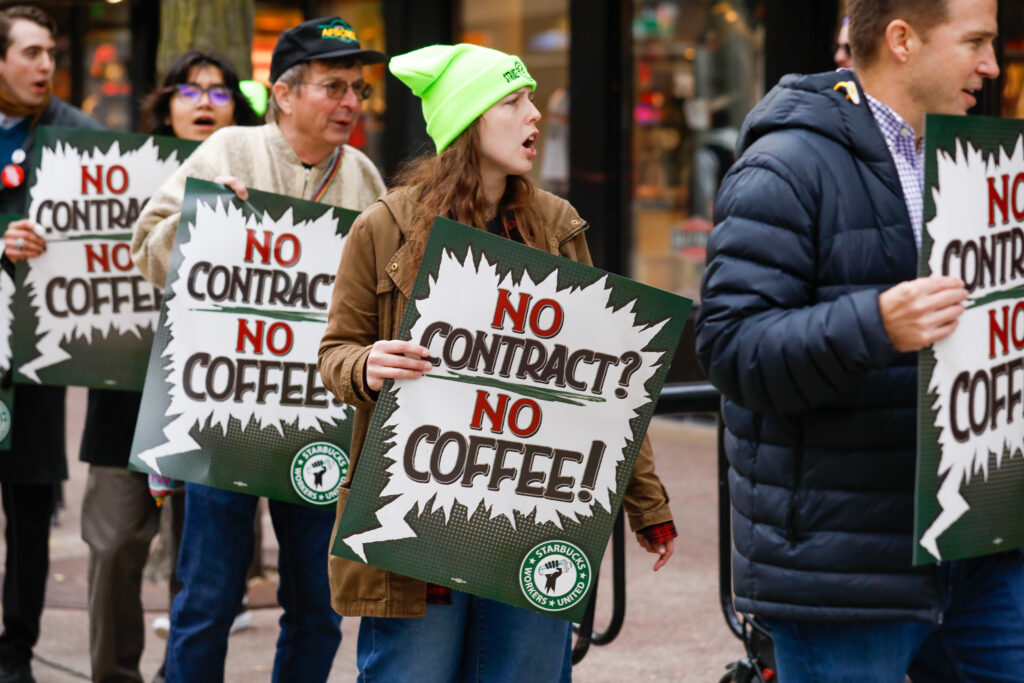
“The bosses are all—they’re all coordinating. They’re all on the same side. We should all be on the same side, too,” Liu added.
Workers encouraged supporters to frequent unionized stores and attend rallies. Liu also had some advice for those who are considering unionizing their own workplaces.
“There are two big things [to know]: one, that you can do it too, and two, that you can win,” Liu said. “We’re all just regular people out here trying our best to improve our lives, improve our neighbors’ lives, and when we stick together, we can win.”