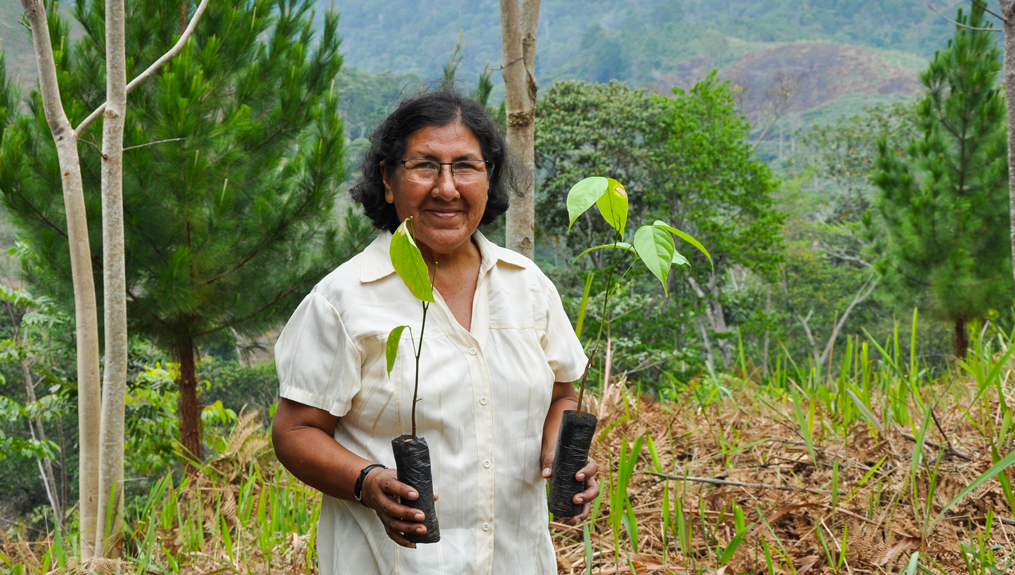
Esperanza Dionisio, President of Cooperativa Agraria Cafetalera Pangoa and founder of the Pangoa Women’s Committee poses with two coffee seedlings. Courtesy of Grow Ahead (September 2019).
[C]anadian roaster company Bean North Coffee Roasting Co. Ltd. recently announced its partnership with green coffee importers Coop Coffee in an effort to support a women-run reforestation project in the Peruvian Amazon.
The project was launched by Grow Ahead, a crowdfunding platform that supports small-scale farmers and climate resiliency projects around the world. Grow Ahead is raising funds, which will be matched by one of Coop Coffee’s producer partners, Cooperativa Agraria Cafetalera Pangoa (CAC Pangoa), to promote organic and fair trade coffee production in the region, provide economic opportunities for the women in the community, and protect the land from the effects of climate change. The campaign aims to raise $25,000 to support the project goals, which include: working with Pangoa’s women farmers to reforest 90 plots of land, totaling 45 hectares; planting a total of 22,500 trees; and expanding dynamic agroforestry in the Peruvian Amazon to sequester carbon into the soil through the local ecosystem.
“Since starting to reforest, we have seen massive improvements,” says Esperanza Dionisio, president of CAC Pangoa and founder of the Pangoa Women’s Committee. “The soil has more water and planting trees creates microclimates that are better for production, since it balances the excess heat. And as a result, our farmers don’t have to deal with as many ups and downs as the climate changes.”
Among its own efforts, Bean North Coffee Roasting Co. Ltd. is launching a new coffee blend called “Hot Coffee for a Cool Planet” and donating $1 from each purchase of the blend to the campaign covering the cost of one tree being planted per bag.
“As a proud owner-member of Coop Coffees, we believe that the farmers who grow our coffee deserve a high quality of life and a healthy environment to live and work in,” says Michael King, manager and co-owner of Bean North. “To that end, we have focused on building long-term working relationships with producer groups and paying a fair price. This improves standards of living for producers and results in higher quality coffee for the end consumer.”
Adds Julia Gentner, program manager of Grow Ahead, this project exemplifies “how to responsibly collaborate on sustainable, diversified economic opportunities in Amazonian communities.”

“At a time when awareness of the need to protect the Amazon is of critical importance,” she says, “we encourage our global network to act together with the people of Pangoa as they empower themselves with the tools necessary to strengthen resilience on their lands.”