Editor’s note: Following the Nepal flash flood disaster on August 26, relief efforts are underway to support affected communities. If you wish to contribute to the ongoing efforts, consider donating to the Government of Nepal Prime Minister’s Disaster Relief Fund.
Seemingly every corner of Nepal’s capital city, Kathmandu—as well as its surrounding valley, which comprises the districts of Bhaktapur and Lalitpur—has a tea shop, a coffee shop, or a cafe. Today, the region counts more than 700 cafes, which serve freshly ground beans to tourists, locals, and digital nomads. Here, this all-day cafe model is clearly sustainable.
However, beyond the Kathmandu Valley, coffee shops and businesses must choose a different business strategy to survive. In Eastern Nepal, developing cities don’t receive nearly as many tourists as the capital, and have no comparative work-from-cafe culture.
To pivot, and stay sustainable, many coffee businesses are instead choosing to operate as hybrid businesses—and are providing a wide range of offerings, all under one roof.
Coffee, Books, and Poetry
Dexit Dhakal opened The Brewed Book Cafe in 2023, in Birtamod—one of Eastern Nepal’s fastest-growing municipalities, located some 270 miles from Kathmandu. He thought of it as a modern alternative to his father’s old wholesale bookshop. Originally, he planned to have a cafe with an adjoining stationery and book shop. In reality, the two soon became fully integrated.

He was inspired to address what he saw as a gap in the market: There were few places where people could hang out and gather creatively, or “a place that offered peace, time to think and relax,” he says. Outside the Kathmandu Valley, many smaller cities still lack non-academic bookstores, and people have limited access to books. “There was no one in the book space and there was no reading culture. I wanted to promote books and their sale. So let me bring it.”
With that in mind, Dhakal created a space where residents could “interact with and explore books close-up; perhaps locals will be attracted to books.” Today, people drop in to browse the collection of fiction, non-fiction, business, and self-help books, as well as Nepali literature.

In the evenings, The Brewed Book Cafe transforms into a community center. It hosts poetry nights, movie discussions, art workshops, and coffee conversations with inspirational local figures. The poetry nights regularly draw several dozen customers and offer an open stage. “Those who want to recite [poems] and watch the show can join for free,” says Dhakal.
These events draw footfall that adds to the business’s day-to-day sales, while its cafe component has been core to its success: After three years of operations, Dhakal says that 20% of the business’s revenue comes from the sale of books and stationery, while the remaining 80% comes from beverages and food sold at the cafe.
Farm-to-Community
In Biratnagar—the capital of Eastern Nepal’s Koshi Province—Yunesh Raj Shrestha and Deena Pradhan founded Baari in 2020. The husband-and-wife duo wanted to create a place where they could host coffee tastings and a barista training center, all while sourcing and roasting beans directly from farmers across Nepal.
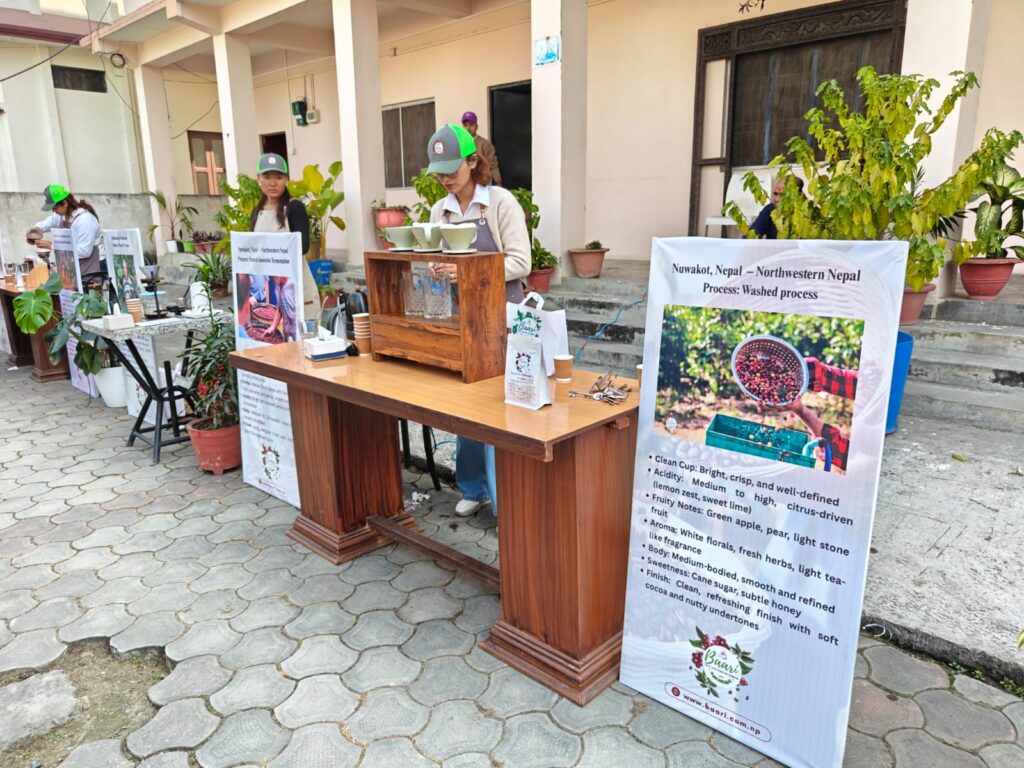
“As Baari grew, we realized that every origin requires a different roasting approach,” Pradhan explains. “By roasting our own beans, it helps us control quality and consistency, work more closely with farmers, experiment with new flavor profiles, and highlight the unique characteristics of each coffee instead of using a one-size-fits-all profile.”
Shrestha comes from a hospitality background. In 2000, his father had opened Biratnagar’s first cafe, Valentine’s Bakery Cafe. “We introduced the espresso machine coffee, Lavazza, in 2014,” he says. “This is how we started coffee culture in Biratnagar.”
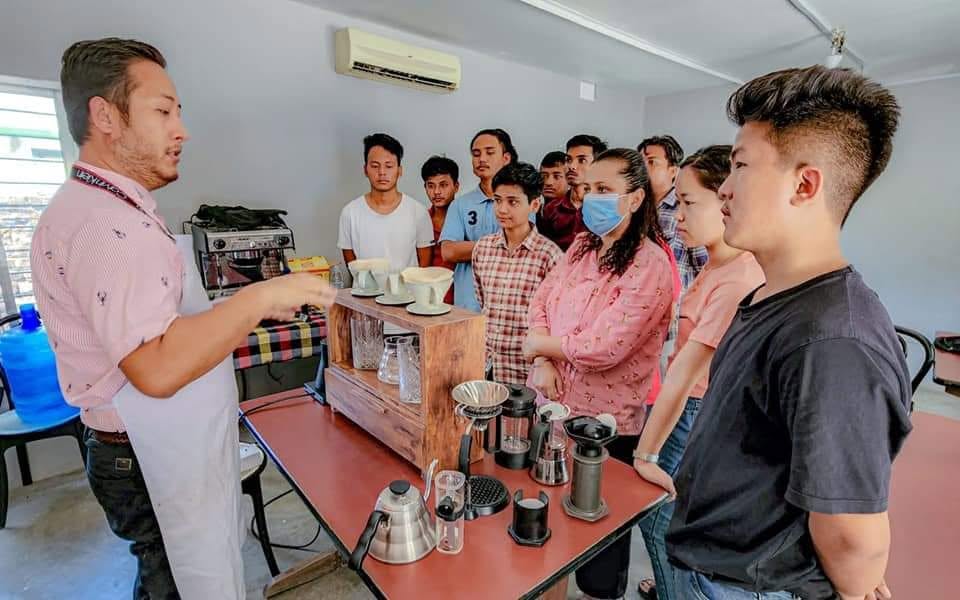
His family soon noticed the need for skilled workers. After becoming an affiliate of Nepal’s Council for Technical Education and Vocational Training, the business began offering short-term barista training. The program, launched in 2014, was initially held at Valentine’s Cafe, and has trained more than 6,000 aspiring baristas since. “Many of whom are now running their own restaurants, working in cafes, hotels, and hospitality businesses in Nepal and abroad,” Pradhan says.
Since Baari Roastery opened in 2020, the training has moved to its premises and expanded. The program now goes beyond barista essentials, and covers bean-to-cup fundamentals, flavor profiling, roasting techniques, and cupping sessions. Today, it makes up 37% of Baari’s total revenue. (Pradhan estimates that proceeds from Baari’s roasted beans, green beans, and ground beans, meanwhile, make up approximately half of the business’s total revenue.)
Beyond coffee and training, Baari also invests in community, hosting coffee tastings and pop-up markets for local creators. The founders discontinued their cafe operations a few months ago to focus on building Baari Coffee Club: a dedicated coffee studio for education and community engagement.
The idea, says Pradhan, is “to bring together coffee enthusiasts, home brewers, professionals, entrepreneurs, and anyone curious about specialty coffee under one roof; a space for both social interaction and professional learning rather than simply a place to eat and drink.”
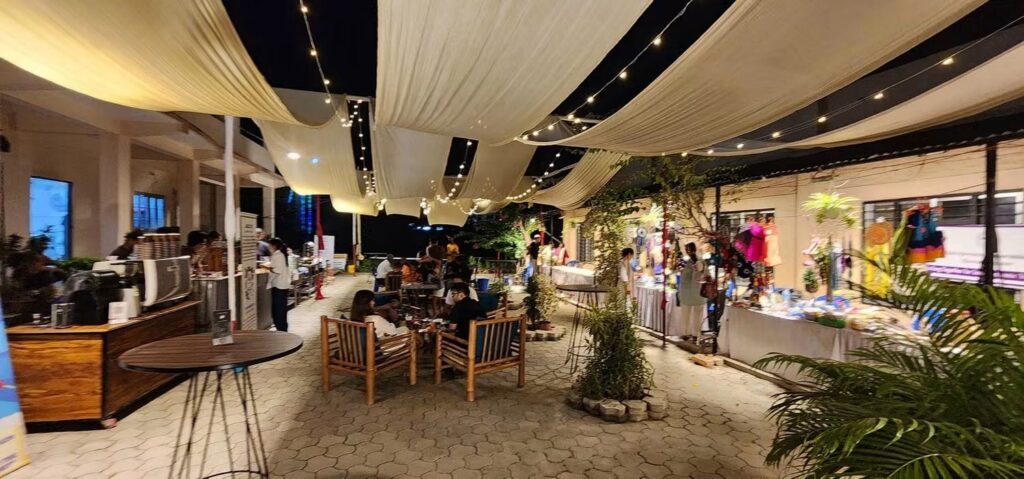
During coffee tastings, the two highlight the regions in Nepal where their beans are sourced, also explaining the processing methods used for each coffee. Barista trainees from their program additionally get hands-on experience by serving coffee to attendees.
Building on these interactive gatherings, Baari also hosts The Weekend Bazaar, a weekly Saturday market, to “celebrate local entrepreneurship, support small businesses, and strengthen the growing coffee culture in Eastern Nepal,” says Pradhan. It started with a simple idea: “to create a platform where local entrepreneurs, artisans, and home-based businesses in Biratnagar could showcase their products while bringing people together over great coffee.”
Coffee Beyond Kathmandu
This reinvention hints at a broader trend for Nepali coffee businesses outside of Kathmandu. Instead of catering to larger crowds of tourists and remote workers, businesses are operating as multi-purpose hubs that address a wide range of local community needs.
Some, like Baari, have integrated vocational training and coffee tastings with weekly markets. Others, such as The Brewed Book Cafe, combine coffee service with literature and poetry nights.
Clearly, there’s no one-size-fits-all solution for these distinctive businesses. What does unite them, however, is the way in which these versatile models help owners build sustainable practices—all while cultivating lasting community culture.