Coffee cultivation in Zambia was just an experiment when it first began, back in the early-to-mid 1900s. Initial attempts failed. It wasn’t until 1967—when the Ngoli Coffee Scheme in Kasama, northern Zambia, was established as a smallholder settlement—that the first plants were successfully grown. Two years later, coffee plants occupied just 46 acres across the entire country.
Progress was slower than planned. By 1974, the Ngoli Coffee Scheme had expanded, and was producing several tons of green coffee annually. Building on its example, the government extended coffee production to Kateshi Estate, also in northern Zambia, in the late 1970s with the support of the World Bank and other partners. It cleared 4,200 acres of land, constructed irrigation furrows from a nearby river, and cultivated 35 acres with plants from the original nursery.
These early schemes laid the foundation for Zambia’s commercial coffee industry. In the process, they also linked estate production with smallholder participation, and diversified the economy beyond copper mining. In the 1970s, Zambia was producing about 70 metric tons of coffee annually. By 2025, according to FAOSTAT (the Food and Agriculture Organization Statistical Database of the United Nations), output had grown to nearly 8,800 metric tons of green coffee per year.
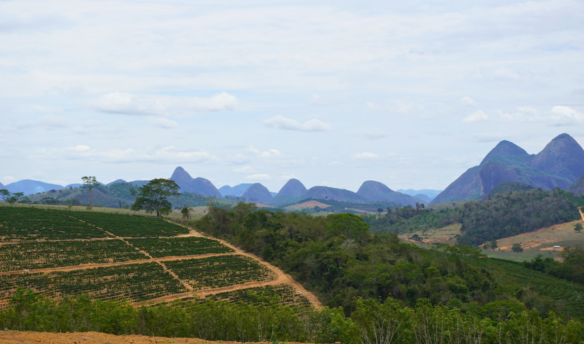
Today, coffee is cultivated in regions such as Kasama, Serenje, and the Muchinga escarpment in northern Zambia, all known for their high-altitude conditions that favor arabica. Zambia began exporting coffee in 1985, and has since established a reputation internationally.
Despite this relatively short history, coffee has become an increasingly important part of Zambia’s domestic beverage culture. While tea remains dominant in most Zambian households, coffee is steadily gaining recognition among locals and visitors alike. In the process, it’s revealed just how much, and how quickly, the country’s relationship to coffee has evolved.
Coffee at Home: Supermarkets, Roasters, and Cafes
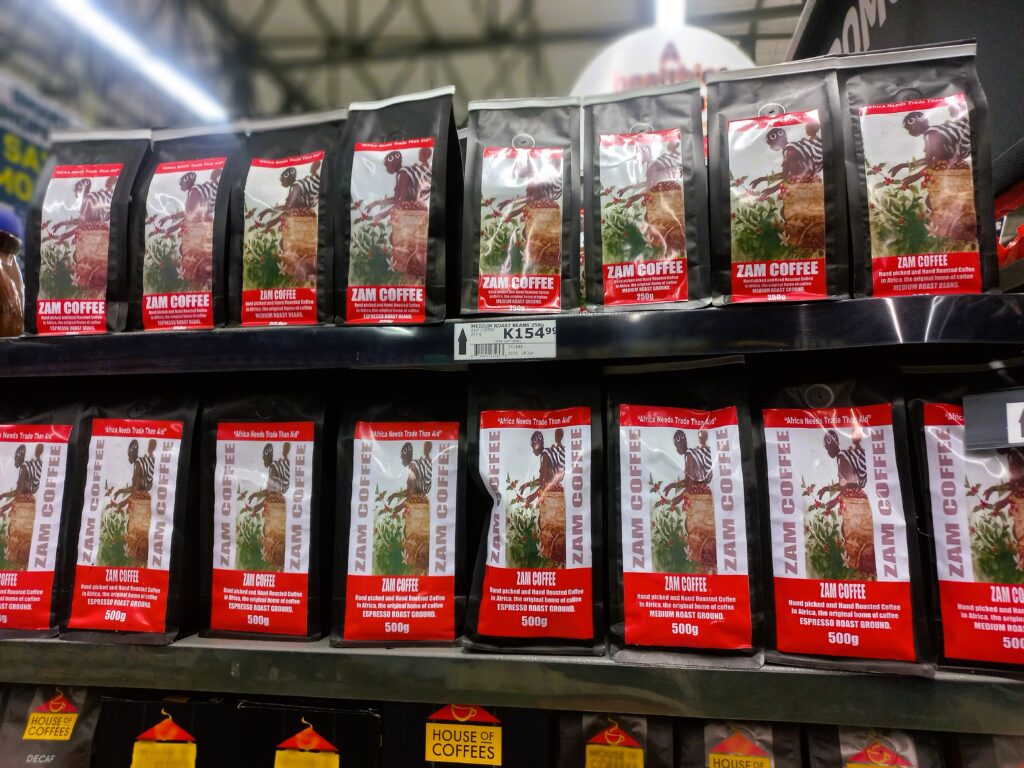
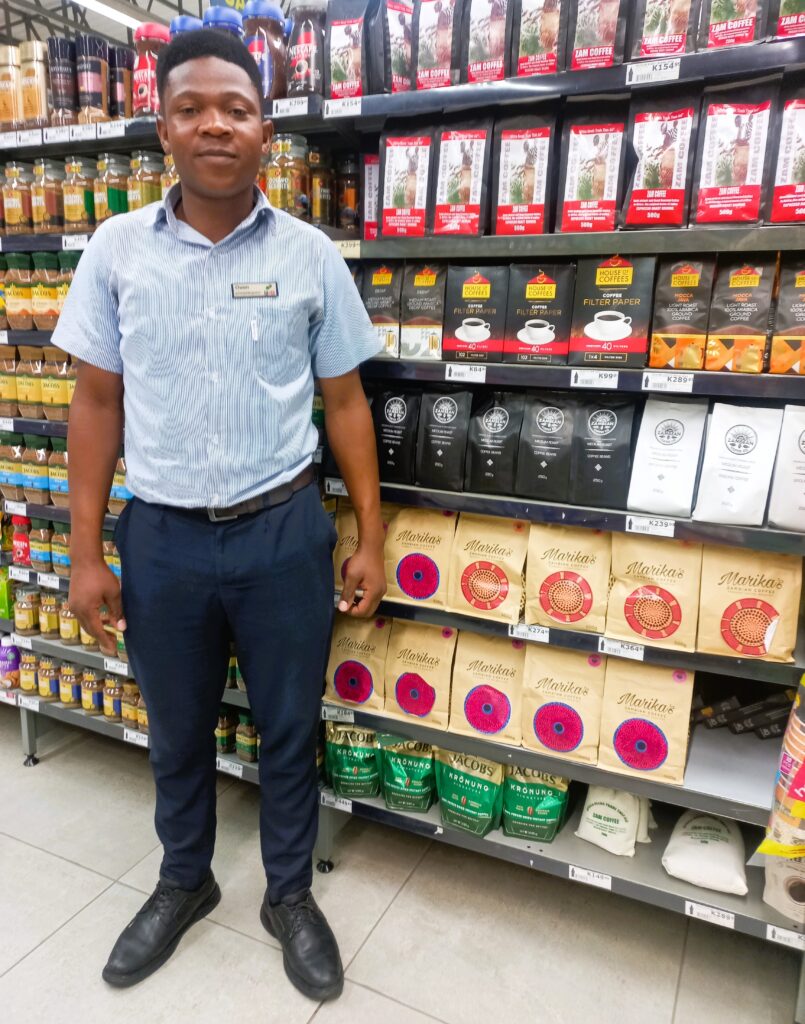
In Zambia, coffee is either sold as whole beans or ground. This is the case at Pick n Pay Supermarket—a South African grocery chain—at Garden City Mall in Lusaka, just a quick trip from the capital’s Kenneth Kaunda International Airport.
Zambian coffee brands are the first ones visitors encounter in the store’s beverage aisle. Among them is Marika’s Coffee, which was established in 2007 by Teija Bosse. Her ambition was “to roast the best Zambian coffee available for the local market, and package it smartly in high-quality packaging to guarantee freshness for longer,” as she told Nkwazi Magazine.
“My coffee journey started at Munali Coffee, where I worked in quality control and learned to taste, roast, and eventually did my Q exams in 2010,” Bosse tells me. “I was inspired to produce the best possible coffee locally with our Zambian beans, which led me to start Marika’s Coffee in 2007 and later Peaberry Coffee Roasters in 2015.”
Marika’s has since developed into a well-known brand, and is now exported to Europe. In addition, the company also runs in-store cafes at select Pick n Pay locations in Lusaka and Copperbelt Province.
“We always believe in buying high‑quality beans and roasting them to bring out the best possible cup,” Bosse explains. “Having judged the World Barista Championships since 2009, and now serving as a Q instructor, I know what quality is about, and that’s what we bring out at Peaberry.”
Bosse’s role additionally extends beyond roasting.
“We continue training baristas and coffee tasters, improving quality, and strengthening the coffee culture in Zambia,” she says. “I also run Q courses internationally and stay involved with the global coffee industry, bringing more knowledge back home. Quality is not just about the cup; it is about building a culture that values excellence.”
A Pick n Pay cashier, Owen Phiri, says that Zambian coffee is steadily becoming more popular at the store. “I can’t say that it’s a top-seller at the moment, but it is getting there,” he says. “What I have noticed is that some of the buyers of Zambian coffee are usually visitors from other countries. It’s a good sign when we get people from outside Zambia interested in locally grown products.”
He adds that the country’s coffee culture is also supported by local cafés, such as Brew Me Café, located in the same mall. Brew Me is a hotspot for remote workers, tourists, and students. It also sells its own branded coffee, placed prominently on the counter next to the register, where customers can easily spot it.
Shaping Zambia’s Coffee Future
Kai Lublinkhof, whose family farm outside Mazabuka in southern Zambia cultivates arabica across 74 acres, describes Zambia’s coffee industry as “quality over quantity.”
“The arabica coffee grown here is good-quality, but on a much smaller scale than other African coffee-producing nations,” he says. While top producers like Ethiopia and Uganda each harvest hundreds of thousands of metric tons annually, Zambia’s output is so limited that it does not appear among Africa’s top 10 producers—countries such as Togo, ranked 10th, still yield around 18,000 metric tons a year.
Lublinkhof explains that the farm is part of a larger community, which is also known for sugar and crop rotation. “The climate and soils on the farm are suitable for arabica, which allows us to harvest very good-quality coffee,” he adds.
The main buyers for his green coffee beans are Peaberry Coffee Roasters and Peaberry cafes.
“These buyers account for 80% of the crop. The remaining coffee is exported to the Netherlands or to traders in South Africa,” he says. “We do very little marketing—the company website is our only advertisement; all other sales come from people passing by the farm and word of mouth.”
Reflecting on the broader industry, Lublinkhof emphasizes the potential. “There is a chance to increase production, particularly in northern Zambia,” he says. He points to the Zambia Coffee Growers Association (ZCGA) as a crucial player in that effort.
“The ZCGA is a well-represented group that plays a major role for local coffee farmers. They handle many of the complications that come with exporting coffee to other markets,” he adds. “The ZCGA is also helpful to new coffee farmers with advice on farming setup, coffee milling, and strict quality inspections on the final product.”
Inside the Zambia Coffee Growers Association
According to Nyembezi Mwale of the Zambia Coffee Growers Association, the association—headquartered in Lusaka and established in 1989—has spent more than three decades coordinating and promoting Zambia’s coffee industry.
“Our mandate is to support a vibrant, sustainable, and internationally competitive coffee sector by bringing together producers, exporters, government, and development partners around a shared vision for growth,” Mwale says.
The organization is the sole authorized exporter of Zambian coffee, meaning it coordinates exports; maintains industry records; and ensures integrity, quality, and traceability for international buyers.

“Our work includes registering coffee growers, maintaining production and export data, facilitating export processes, supporting market access, and advocating for policies that strengthen the sector,” she says. “We also collaborate with government agencies, research institutions, and development partners to support farmer capacity, improve quality standards, and promote sustainable coffee production.”
Mwale notes that ZCGA’s membership includes everyone from commercial estates and emerging medium‑scale farmers to smallholder producers, roasters, exporters, and other industry partners. “Historically, estates have driven much of Zambia’s production, but today we are witnessing growing interest among smallholder farmers, creating exciting opportunities for more inclusive and geographically diverse production,” she says.
Looking ahead, Mwale stresses ZCGA’s long‑term vision for the coffee industry in Zambia.
“Our aspiration is not simply to grow and export more coffee, but to build an industry that is resilient, inclusive, and internationally respected,” she says. “One that creates lasting value for producers, attracts investment, and proudly showcases Zambia on the global coffee stage.”
Cover photo by Clint McKoy on Unsplash