Lawmakers continue to push for coffee to be exempt from tariffs. Plus, cafes around the country step up as the U.S. government halts SNAP benefits, and customers still do not want to hang out at Starbucks.
‘Bipartisan Senators Introduce The No Coffee Tax Act’ – via Sprudge
In September, Representatives Ro Khanna (D-California) and Don Bacon (R-Nebraska) introduced legislation in the U.S. House of Representatives that would exempt coffee from President Trump’s tariffs. Now, members of the Senate are following suit with a bipartisan bill of their own.
Last week, Senators Catherine Cortez Masto (D-Nevada) and Rand Paul (R-Kentucky) introduced the “No Coffee Tax Act.” The aim, the bill states, is to “prohibit the imposition of additional tariffs on coffee imported from countries to which the United States has extended normal trade relations.”
“This coffee tax doesn’t help American business in any serious way, but it does raise costs at the grocery store for hardworking families across the United States,” Cortez Masto said in a statement. “It’s past time to end Trump’s coffee tax.”
Trump himself addressed the issue of coffee tariffs during a trip to Malaysia last week. “We want to get coffee down a little bit,” he told reporters aboard Air Force One. Trump met with Brazil’s President Luiz Inacio Lula da Silva at the ASEAN trade summit in Malaysia, and Lula described the conversation as “positive.” Imports from Brazil, including coffee, are currently subject to a 50% tariff.
During the ASEAN summit, the U.S. and Vietnam also announced a framework for a trade agreement that would make certain, as-yet-unnamed products tariff-free. At the moment, goods from Vietnam face a 20% import tax.
As Nick Brown reports for Daily Coffee News, coffee is expected to be among the items exempt from tariffs from Vietnam. “There’s a handful of things like coffee, et cetera, the type of stuff we don’t make in the United States — like, climatologically, we can’t. So it makes sense if people are going to do a deal with us, we’ll give them a good deal there,” U.S. Trade Representative Jamieson Greer said.

Last week, back in the U.S., Sen. Paul also co-sponsored a resolution alongside Sen. Tim Kaine (D-Virginia) to end the national emergency Trump declared to impose 50% tariffs on Brazil. The vote passed 52-48, with five Republicans voting with Democrats. However, as Ashley Murray reported for Florida Phoenix, “the resolution is not likely to see a vote in the Republican-controlled U.S. House, meaning it is not likely to become law.”
Read the full story on the coffee tariff legislation limbo here.
‘Portland Coffee Shop Has Now Raised Over $200,000 To Feed People Losing SNAP Benefits’ – via The Oregonian
On Oct. 1, the U.S. federal government shut down after lawmakers failed to pass a funding bill. Since then, millions of federal workers have gone unpaid as politicians on both sides of the aisle blame each other for the lack of a resolution. Polls show that nearly half of Americans blame Trump and the GOP for the government shutdown.
Because of the shutdown, the U.S. Department of Agriculture has claimed that it cannot afford to continue funding the Supplemental Nutrition Assistance Program (SNAP), a federal program that assists low-income families in purchasing groceries. The program is set to run out of money on Nov. 1, despite USDA having a $6 billion contingency fund.
But coffee shops across the country have stepped up, spurred by a viral story out of Portland, Ore. As Lizzy Acker reports for The Oregonian, Heretic Coffee announced on Oct. 26 that it would offer free breakfasts to SNAP recipients beginning in November. “No proof needed. No questions asked,” the shop wrote on Instagram.
People quickly started donating to the cause, and as of Friday, Heretic says it has raised over $310,000. “I legitimately thought we would get a couple hundred dollars,” Heretic owner Josh White told The Oregonian. Heretic has teamed up with Portland-based nonprofit Equitable Giving Circle to help redistribute funds beyond what Heretic needs.
SNAP, formerly known as food stamps, helps nearly 42 million Americans afford groceries. Attorneys General from 25 states have sued the Trump administration over the funding freeze.
It’s not just Heretic. Fresh Cup’s Haley Greene has been tracking other coffee companies raising money and offering assistance, from Utah to Oklahoma. Daily Coffee News did the same, but, as Nick Brown notes, while these efforts are inspiring, they “remain short-term responses to the ongoing food-security crisis in the U.S., where approximately one in seven households are food-insecure.”
Read more on how the coffee industry is stepping up here.
‘Starbucks Customers Are Exiting Fast, Not Lingering Over Coffee’ – via Bloomberg
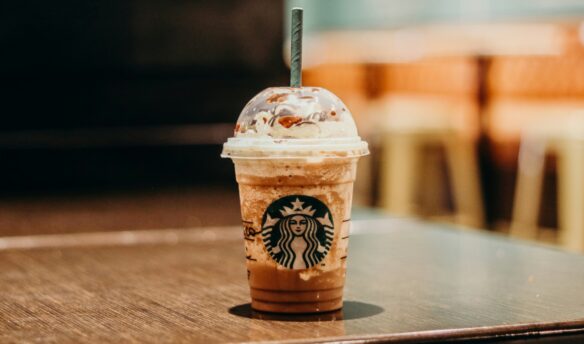
We’ve talked a lot about Starbucks CEO Brian Niccol’s turnaround plan, known as “Back to Starbucks,” mostly because, well, so far, it hasn’t exactly gone to plan. The goal is to make the coffee giant’s locations more appealing places to spend time, and this has included adding more comfortable furniture, reducing discounts, and simplifying the menu.
The goal is to revive the chain’s fortunes after several quarters of sluggish sales. Starbucks’ latest quarterly report, released last week, showed an uptick in global same-store sales—stores that have been open at least a year—although U.S. sales remained flat.
However, customers have yet to be convinced to spend time at Starbucks, Redd Brown reports for Bloomberg. Data from Placer.ai showed that more than 40% of visits in 2023 lasted longer than 10 minutes; today, that figure has fallen to about 33%.
“They’ve trained their customer(s) to use this brand as a convenience channel, not as a place where you sit down and linger,” Jon Tower, an analyst with the bank Citi, told Brown.
Starbucks has been refurbishing its stores and says customers are staying longer at newly updated locations. “Early results from uplifted coffeehouses in New York City and Southern California are already showing promise,” a company spokesperson said. “Customers are staying longer, visiting more often, and sharing positive feedback.”
Read more about how people still don’t want to hang out at Starbucks via Bloomberg or via CNBC TV18 here.
More News
‘Coffee Prices at U.S. Grocery Stores Continue to Rise’ – via Daily Coffee News
‘Portrait Coffee & Outkast Team Up To Celebrate 25 Years Of Stankonia’ – via Sprudge
‘Uganda September Coffee Exports Surge 59% on Bumper Crop’ – via Reuters
‘Coffee Delivery Is Now a $1 Billion Business for Starbucks’ – via CNBC
‘Mokhtar Alkhanshali & David Eggers Are Opening An Art Cafe Together In San Francisco’ – via Sprudge
Is Coffee Good For You?
This week, we have two studies that examined a similar topic—beverage temperature—and came to very different conclusions.
Researchers from universities in California and North Carolina examined the association between food and beverage temperature and certain health outcomes among more than 400 Asian and white adults in the U.S.
In the study, published in the British Journal of Nutrition, the researchers found that drinking more cold beverages in the summer was associated with increased anxiety and more sleep disturbance among Asian adults. Conversely, white adults who drank more hot beverages in winter saw lower levels of depression and improved sleep quality.
“Something as simple as the temperature of what we eat and drink can have real impacts on health,” said lead author Tianying Wu in a press release. “Because cold and hot consumption is such a routine part of daily life in the U.S., at home and in restaurants, the findings have broad relevance to everyday health choices.”
The second study, conducted by researchers from the National Cancer Institute, examined the relationship between hot beverages and throat cancer, specifically esophageal squamous cell carcinoma (ESCC). The study, published in the British Journal of Cancer, found that daily consumption of hot coffee and tea was a risk factor for developing ESCC.
Researchers followed more than 450,000 participants in the U.K. Biobank biomedical database for more than a decade. They found that those who reported drinking 4-6 “very hot” beverages each day—that is, hotter than 65°C/149°F—were more likely to develop ESCC than those who preferred warm drinks. Very hot drinkers were in the minority, as two-thirds of those surveyed drank their coffee or tea at merely “hot” temperatures (closer to 60°C/140 °F).
Drinking hot beverages was also associated with ESCC, with risk increasing with the number of daily drinks. “Tea and coffee have each been associated inversely with overall mortality and incidence of a number of common diseases,” the authors write. “However, individuals who like their beverages very hot might benefit from reducing the temperature of their beverages, at least with regards to their risk of ESCC.”
Beyond the Headlines
‘Looking Back at 25 Years of the World Barista Championship’ by Michael Butterworth
‘‘You Love It or You Hate It’: Pumpkin Spice Lattes Divide Europe’ by Jeanna Smialek