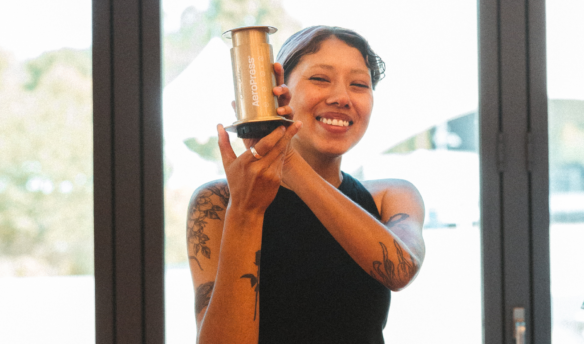
“We all have tools to make amazing coffee, but the most important is our voice. Whether it’s on stage or in the cafe, it’s our responsibility to represent everyone and to share the value of coffee,” Jack Simpson of Axil Coffee Roasters said during his winning routine at the World Barista Championship (WBC), held in Milan last week.
With his relaxed demeanor and friendly, Australian twang, Simpson seemed surprisingly at ease on stage, given the pressure of the competition. The WBC is one of the most visible events in coffee, which is why messages like Simpson’s especially resonate: With the whole industry watching, what would you say about the state of coffee right now?
The World Barista Championship invites national winners from around the world—this year, 51 countries were represented—to compete for the top title. During the event, each competitor must prepare three courses of espresso-based beverages, all while giving a presentation about their coffee. The WBC is widely considered the most prestigious of the seven competitions sponsored by World Coffee Championships (WCC), an organization owned and operated by the Specialty Coffee Association (SCA).
Simpson won the 25th edition of the WBC. This year’s event was held in Milan from October 17 through the 21 at HostMilano, a biennial trade show during which major coffee industry manufacturers launch new products and machinery. He was joined on the podium by Simon SunLei of China, who placed second, and Ben Put of Canada, who took third place.
While hundreds of people gathered to watch Simpson and other competitors vie for the title of World’s Best Barista, the stage was very different 25 years ago. The first WBC was held in Monte Carlo, Monaco in 2000, and featured just a handful of competitors. What started as a humble sideshow at trade shows has, over the ensuing quarter century, developed into a driving force within the global coffee industry.
In that time, the WBC has built a formidable legacy. Over the past 25 years, it has popularized new coffee processing methods, standardized new features on coffee equipment, and launched the careers of many competitors. These achievements haven’t come without scrutiny, however. Following the crowning of a new champion, it’s a good time to look back on the history of the competition—and reflect on how the WBC can, and should, evolve for the future.
The WBC Effect
Like many contenders, Klaus Thomsen started competing as a way to push himself. “For me, it was very much about challenging myself, but also about meeting like-minded people in the industry, sharing ideas, and having a great time together,” he says. Thomsen was named the 2006 World Barista Champion, and later cofounded Coffee Collective, a roastery with eight cafe locations across Denmark.
Thomsen attributes much of his success to winning the WBC.
“It tremendously impacted my whole trajectory and led to me co-founding the Coffee Collective,” he says. “I got to travel to so many countries, visiting a ton of coffee producers, as well as roasters and coffee shops all over the world. It also gave me a lot of connections to people across the globe and a network I still enjoy today.”
This life-changing potential inspires many baristas to compete year after year. In Simpson’s case, he is the three-time Australian champion; he placed third and second at the WBC in 2023 and 2024, respectively. At the WBC 2024 in Busan, South Korea, Simpson missed first place by a single point. Like Simpson, Thomsen also competed multiple times at the WBC before finally winning.

For his 2025 routine, Simpson shared entries from his journal over the previous year, including his reflections on the result in Busan.
“I’m instantly sad and disappointed and confused. Were all of those hours training worth it?” he wrote.
Simpson credited coffee producer Jonathan Gasca Serna of Colombia for changing his perspective. In 2024 and 2025, Simpson used coffee from Serna’s Zarza Coffee in Huila, Colombia and from Jamison Savage of Finca Deborah in Volcan, Panama.
“He was overjoyed, not because his coffee almost won the WBC, but because his coffee deserved to be there,” Simpson said of Serna during his finals performance. “Jonathan reminded me that coffee is about people and human connections, not just results.”
Changing the Game
Over the WBC’s 25-year history, the rules and scoring have changed, but the basic format has remained the same. Competitors make a round of espressos, milk beverages, and then signature drinks for a panel of four judges, all within 15 minutes. Judges evaluate the competitor in categories such as taste experience, accuracy of flavor notes, and attention to detail.
Small tweaks have been made to these categories over time. In 2016, for instance, the WCC changed the rules for the milk course: Instead of a fixed drink with a specific coffee-to-milk ratio, competitors could make drinks with different volumes of milk. In 2023, competitors were allowed to use plant-based milk instead of dairy milk for the first time.
In Milan this year, Ben Put of Canada took advantage of that rule change by including a frozen disk of coconut milk at the bottom of his milk beverage. After the judges took a single sip, Put used electric mixers to incorporate the coconut milk.
Beyond the drinks themselves, the competition has changed in other critical ways, including how competitors talk about the coffees they serve. “Although the basics are very much the same, it has evolved quite a bit,” says Thomsen. “Flavor descriptors have to be very precise now. The amount of information passed on during the presentations feels like tenfold what it used to be.”
Today, competitors like Simpson speak for almost the entire 15 minutes, structuring information about their coffee and recipes around a theme. The top competitors often collaborate directly with coffee producers to find a competitive edge.
Throughout his routine, Simpson shared detailed processing information and gleanings acquired during visits to both partner coffee farms. By comparison, at the 2007 World Barista Championship in Tokyo, winner James Hoffmann introduced his espresso course as “a single-estate Costa Rican coffee,” with no further farm or processing information.
Since then, sharing highly specific information has become the default, including details about novel coffee processing methods.
At the 2015 WBC in Seattle, winner Saša Šestić of Australia helped popularize carbonic maceration, a processing technique inspired by a winemaking method. Ten years later, anaerobic fermentation and other alternative processing methods have become the norm, not just in barista competitions but on the menus of coffee shops globally.

Simpson used two such alternative processing methods at this year’s event. But he also warned in his routine that pursuing such trends presents a risk for coffee farmers.
“New varietals and crazy processing methods are always interesting to try, but are we going to buy these coffees year after year? We can change what we buy with the seasons, but for the producer it’s a risk,” says Simpson. “We need to make sure we’re sending a clear and responsible message back to the producer. Today I’m sending a message back to Jonathan that his coffee is amazing, not because of his new bioreactors, but because of his dedication.”
A Broken System?
Simpson’s presentation points to the double-edged sword of barista competitions. Although some experimental competition coffees can lead to fame and fortune for coffee farmers, such processing methods are risky—and most of the risk is placed on farmers.
“The WBC is a breeding ground for innovation, allowing baristas to experiment and push the boundaries of our craft,” says Thomsen. “I hope it will keep developing and dare to change the format a bit, so we’ll see even more diversity of the competitors in the finals.”
It’s not just the coffees used on stage that give critics pause. In the competition’s 25-year history, only two women have won: Agnieszka Rojewska of Poland in 2018 and Jooyeon Jeon of South Korea in 2019. In 2016, Lem Butler of the United States became the first Black competitior to win the US Barista Championship and reached the final six of the WBC. Baristas from producing countries are also underrepresented on the world stage: In 2011, Alejandro Mendez of El Salvador became the first winner from a coffee-producing country.
The lack of diversity among champions is just one of the concerns among critics of the competition.
“Barista competitions are an elitist endeavor that are hiding behind the idea of building community,” says Lee Safar, a coffee consultant and host of the Map it Forward podcast.
“Our industry is judging each other—we literally get trained to judge each other—which leads to the opposite of community,” she says. “People who don’t win leave resentful and feeling defeated, that’s the opposite of community.”
Safar is concerned that the competition offers an illusion of upward mobility for baristas and farmers, while failing to address what she dubs “the coffee crisis.”
“My biggest problem is this: The people who really win are the sponsors and the SCA. [The competitions are] a circus for the real problems that are being experienced at origin,” says Safar. “These competitions are not solving any actual problems on a greater scale. They’re providing an opportunity that feeds the fame economy.”
Instead of competitions, Safar wishes greater attention were given to solving systemic economic, business, trade, and technological challenges for small and medium businesses in the coffee ecosystem.

Adding to that, competitions are expensive. Between high-end coffees, luxurious glasswares, and specialized equipment, baristas can spend thousands of dollars preparing for a single competition. Although established competitors often find sponsorship, most will spend hundreds of hours training. Many competitors hire former champions or judges as coaches.
“Imagine if we took all of the money that’s been invested in these competitions, and the energy and time that’s been spent, and invested it in solving actual problems across the supply chain,” Safar says. “Imagine what we could achieve. That would be actual community.”
A Platform to Dream
Still, the event maintains a hold on coffee professionals around the globe. For 2024 World Barista Champion Mikael Jasin of Indonesia, the WBC inspired him to pursue a career in coffee. He had recently started working as a barista in Melbourne when the city hosted the 2013 World Barista Championship.
“That’s what WBC is: a platform to dream,” he said before handing off the trophy to the 2025 champion. “What we do in competition, we do in real life.”
Due to the timing of HostMilano this year, Jasin was the reigning WBC champion for 18 months. During that time, he traveled to 22 countries to appear at various industry events. Jasin started a coffee company, So So Good Coffee Company, in partnership with his former employers at Common Grounds Coffee Roaster and ST. ALi, in 2020, the same year he won the Indonesian Barista Championship.
“As an Indonesian working in coffee, I’ve always felt a responsibility—and a desire—to share our coffees and our coffee culture. Especially with the platform lent to me by this title,” Jasin wrote on his personal Instagram.
Simpson echoed the sentiment in his presentation, showing that the WBC stage has—and can continue to be—a force for positive change in the industry.
“We as baristas not only have the ability to affect positive change, but the responsibility,” he said.
All photos by Michael Butterworth