✉️ This story was featured in this week’s Coffee News Club
👋 Get the Coffee News Club newsletter in your inbox weekly—sign up.
The European Union’s Deforestation Regulation (EUDR), now delayed by a year, was designed to keep items linked to deforestation out of the bloc. To make sure that the coffee they buy isn’t connected to deforestation, importers rely on software that accurately maps a farm’s location and tracks changes in land use.
However, the Alliance of Bioversity International and CIAT says that current databases used by map-making organizations have been misclassifying many coffee-growing regions as being “high risk” for deforestation. This leaves farmers vulnerable to being passed over by potential clients seeking coffee compliant with the new law.
To counter this, the Alliance has launched a new mapping database, Sample Earth, that aims to provide mapmakers with better data to build “accurate, inclusive maps.”
To create reference maps, data scientists train artificial intelligence systems using vast databases of satellite imagery and other land-use data. However, according to the Alliance, the databases often ignore rural regions, making the maps less accurate.
“Most maps are not accurate at local scales because the data is biased toward regions with a lot of training data,” Thibaud Vantalon from the Alliance’s Digital Inclusion research area said in a press release. “Remote regions are very poorly mapped,” Vantalon said.
The European Commission defines deforestation as “the conversion of forest to agricultural use.” According to the EC, assessing whether a commodity contributed to deforestation means “looking backwards in time to see if the crop land was a ‘Forest’ at any time since” December 2020.

If a coffee-growing region is misclassified as “forest,” it would be considered deforested under the EUDR. Buyers using the reference map could then ignore whole areas rather than chance buying coffee from misclassified farms.
So far, the open-access dataset includes about 100,000 geolocation points in Ghana and Vietnam, two of the world’s largest producers of coffee and cocoa. The creators aim to add additional countries in the future.
Inaccurate data can have a big impact. According to research by the Alliance, a map published last year by the European Union classifies more than half the coffee-producing areas in Colombia, China, Guatemala, and Mexico as forest.
Critics of the EUDR have said the legislation potentially excludes smallholder farmers for whom the costs of compliance are too high. Faulty data adds to this exclusion: “Maps are needed for due diligence, and buyers will likely steer clear of areas misclassified as ‘high risk’ for deforestation,” said Louis Reymondin, a data scientist at the Alliance.
Read the full story on the coffee mapping confusion from Daily Coffee News here.
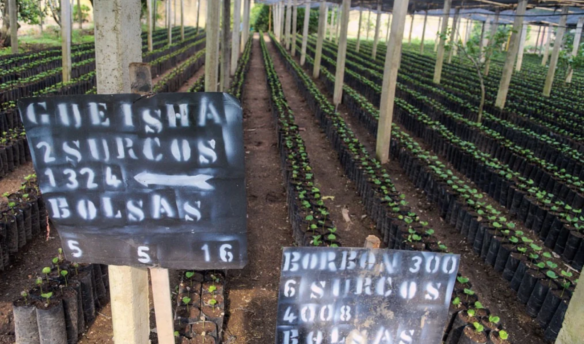
Photo by PROJETO CAFÉ GATO-MOURISCO on Unsplash