✉️ This story was featured in this week’s Coffee News Club
👋 Get the Coffee News Club newsletter in your inbox weekly—sign up.
Deforestation still plagues the coffee industry, despite growing interest in sustainability and agroforestry. A new report from the nonprofit Coffee Watch, published last week, mapped two decades’ worth of forest loss in one of Brazil’s key coffee-growing regions.
From 2001 to 2023, more than 11 million hectares of forest were cleared in the Cerrado and Atlantic Forest, the report found. More than 700,000 hectares of deforested land were on coffee farms, and 300,000 hectares were explicitly cleared for coffee cultivation. “While not all nearby forest loss is directly caused by coffee, the spatial pattern is clear: where coffee spreads, forests retreat,” the report’s authors write.
Coffee Watch linked deforestation to worsening climate impacts in Brazil, including reduced rainfall and crop failures. Since 2014, the authors wrote, “8 of the last 10 years have seen rainfall deficits in major coffee zones — a sharp shift from prior decades.” Soil moisture was also depleted across the areas measured, causing plants to struggle and produce less. Over the last decade, “Brazil’s major coffee-producing regions have faced a rising frequency of severe droughts,” the report states.
“The ecologically destructive way we grow coffee is going to result in us not having coffee,” Coffee Watch’s director Etelle Higonnet told Ephrat Livni of the New York Times.
Livni points out that a recent Brazilian study reached a similar conclusion, connecting deforestation in the Amazon rainforest to reduced rainfall in the region.
Coffee Watch advocates for actors in Brazil to adopt large-scale agroforestry practices. While less than 1% of Brazil’s central coffee-growing regions currently use agroforestry practices, which integrate trees into farms to provide shade and enhance benefits such as regulating temperatures and fostering biodiversity. The report found that doing so provides “a natural shield against nearly every climate and ecological stressor” mentioned in it.

Investing in agroforestry, the report concluded, “isn’t just an ecological opportunity — it’s now a business imperative. Coffee can no longer afford to chase short-term yields at long-term cost. Forests and trees must be reintegrated into the production model — not as a niche add-on, but as a core operating principle.”
Read more on how coffee cultivation is driving deforestation from the New York Times here.
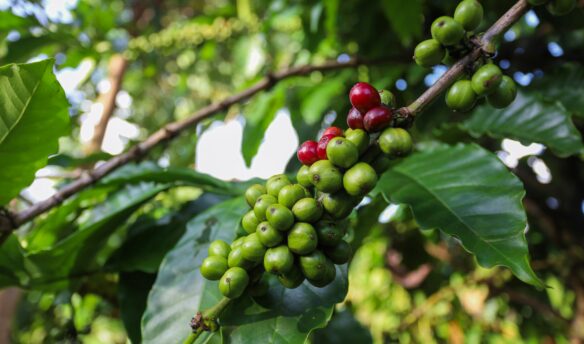
Photo by Shelby Murphy Figueroa on Unsplash